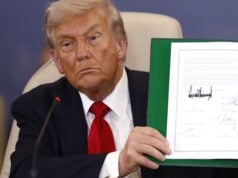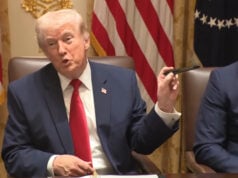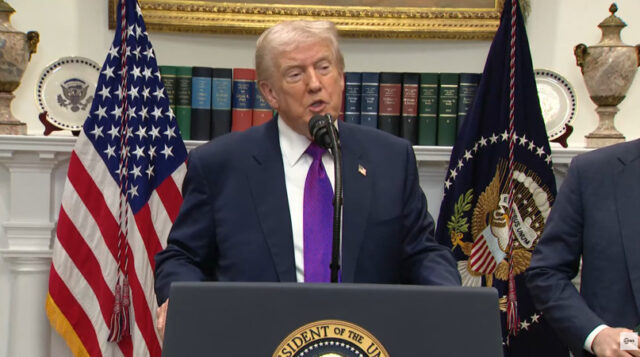
WASHINGTON — In what he characterized as the “single largest deregulatory action in American history,” President Donald Trump, alongside Environmental Protection Agency (EPA) Administrator Lee Zeldin, announced on February 12, 2026, the formal revocation of the 2009 Endangerment Finding. This landmark scientific and legal determination had for 16 years served as the bedrock of federal authority to regulate greenhouse gas emissions under the Clean Air Act.
Video courtesy of DWS
By rescinding the finding—which concluded that carbon dioxide and five other heat-trapping gases endanger public health and welfare—the administration has effectively dismantled the primary legal mechanism used by previous governments to set emissions standards for vehicles, power plants, and industrial facilities.
A Seismic Shift in Climate Policy
The announcement, delivered from the Roosevelt Room of the White House, marks the culmination of a year-long effort by the Trump administration to “unleash American energy dominance.” Since taking office in January 2025, the President has prioritized the removal of what he describes as “ideologically motivated” regulations that he claims have stifled the fossil fuel industry and inflated costs for American families.
“The Endangerment Finding was the source of trillions of dollars in hidden costs,” Administrator Zeldin stated during the briefing. “By eliminating it, we are returning common sense to policy, restoring consumer choice, and ensuring that the EPA stays within the strict letter of the law as written by Congress.”

The EPA estimates that this repeal, combined with the subsequent elimination of federal greenhouse gas (GHG) emission standards for vehicles through model year 2027 and beyond, will save American taxpayers over $1.3 trillion. The administration further claims the move will reduce the average price of a new vehicle by approximately $2,400 by removing costly mandates for electric vehicle (EV) integration and fuel-efficiency technologies.
The Legal and Scientific Fallout
The 2009 Endangerment Finding was originally issued in response to the 2007 Supreme Court case Massachusetts v. EPA, which ruled that greenhouse gases fit the definition of “air pollutants” under the Clean Air Act. The finding compelled the EPA to regulate these emissions if they were found to threaten public health.
By revoking this determination, the Trump administration is not just rolling back specific rules; it is attempting to pre-emptively block future administrations from regulating carbon emissions without new, explicit authority from Congress. This follows the legal trend set by the 2022 Supreme Court decision in West Virginia v. EPA, which utilized the “major questions doctrine” to limit agency overreach in the absence of clear legislative mandates.
However, the scientific community has reacted with alarm. In September 2025, a panel from the National Academies of Sciences, Engineering, and Medicine released a report reaffirming that the evidence for human-caused climate change is “beyond scientific dispute.” Critics argue that the administration is “ignoring the thermometer” to favor the coal and oil industries.
Economic and Environmental Impact
The repeal has immediate practical implications:
- Automotive Industry: All federal GHG emission standards for cars and light trucks are effectively erased. This eliminates incentives for “start-stop” technology and off-cycle credits that pushed manufacturers toward electrification.
- Power Sector: While the current repeal specifically targets mobile sources (vehicles), Zeldin confirmed the agency is moving toward a similar “finding of no significant contribution” for power plants, which would insulate coal and gas-fired plants from federal carbon limits.
- Global Standing: This move coincides with the United States’ second formal withdrawal from the Paris Climate Agreement, signaling a complete retreat from international climate leadership.
Supporters, including many Republican lawmakers and energy advocacy groups, praised the decision. They argue that the “war on carbon” was a backdoor attempt to restructure the American economy. “This is a victory for the rule of law,” said one industry representative. “Agencies should not have the power to transform entire sectors of the economy based on a single administrative finding.”
Conversely, environmental groups and several state governors have already vowed to fight the repeal in court. California Governor Gavin Newsom called the action “illegal” and a “gift to billionaire polluters,” warning it would lead to more frequent and severe wildfires, droughts, and heatwaves.
The Road Ahead
Legal experts anticipate a flurry of litigation. Organizations like the Natural Resources Defense Council (NRDC) and Earthjustice are expected to argue that the EPA cannot simply ignore the vast body of scientific evidence supporting the original 2009 finding.
“The EPA has a legal obligation to protect us,” said Meredith Hankins, a legal director at the NRDC. “They are cynically pretending climate change isn’t a risk. We will see them in court, and we are going to win.”
As the battle moves from the White House to the courthouse, the American energy landscape remains in a state of flux. While the administration promises lower utility bills and cheaper gas-powered cars, the long-term costs of climate-related disasters and the potential loss of competitive edge in the global green-tech market remain significant points of contention.
Sources and Links
- U.S. Environmental Protection Agency (EPA): President Trump and Administrator Zeldin Deliver Single Largest Deregulatory Action in U.S. History
- Associated Press: Trump’s EPA revokes finding on greenhouse gas threat
- The Guardian: Trump’s EPA repeals landmark climate finding in gift to ‘billionaire polluters’
- TIME Magazine: The History of the Endangerment Finding and Its Repeal
- Office of the Governor of California: Statement on Trump’s Repeal of EPA Authority
- Harvard Environmental & Energy Law Program: Analysis of EPA Proposal to Eliminate Power Sector Regulations
- Council on Foreign Relations: Trump to Revoke Legal Basis for Key Climate Regulations
Disclaimer
Artificial Intelligence Disclosure & Legal Disclaimer
AI Content Policy.
To provide our readers with timely and comprehensive coverage, South Florida Reporter uses artificial intelligence (AI) to assist in producing certain articles and visual content.
Articles: AI may be used to assist in research, structural drafting, or data analysis. All AI-assisted text is reviewed and edited by our team to ensure accuracy and adherence to our editorial standards.
Images: Any imagery generated or significantly altered by AI is clearly marked with a disclaimer or watermark to distinguish it from traditional photography or editorial illustrations.
General Disclaimer
The information contained in South Florida Reporter is for general information purposes only.
South Florida Reporter assumes no responsibility for errors or omissions in the contents of the Service. In no event shall South Florida Reporter be liable for any special, direct, indirect, consequential, or incidental damages or any damages whatsoever, whether in an action of contract, negligence or other tort, arising out of or in connection with the use of the Service or the contents of the Service.
The Company reserves the right to make additions, deletions, or modifications to the contents of the Service at any time without prior notice. The Company does not warrant that the Service is free of viruses or other harmful components.