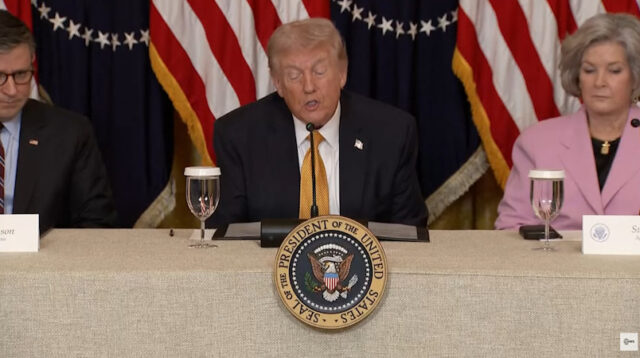
WASHINGTON — In a series of high-stakes remarks delivered Monday morning, President Donald J. Trump intensified his administration’s stance on the escalating war with Iran, issuing a blunt demand to international allies to provide naval support for the reopening of the Strait of Hormuz. Speaking to reporters before a meeting with the Kennedy Center board of trustees, and following comments made while traveling on Air Force One, the President signaled that the United States is no longer willing to bear the sole burden of policing the world’s most critical maritime energy artery.
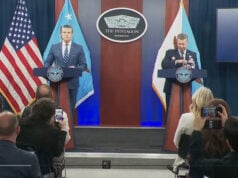
Update from CENTCOM Commander on Operation Epic Fury: pic.twitter.com/oGJ3QJBz5o
— U.S. Central Command (@CENTCOM) March 16, 2026
The President’s latest rhetoric comes as Operation Epic Fury enters its third week, with global energy markets reacting to the continued blockade of the waterway. Brent crude oil was trading near $105 per barrel on Monday, reflecting deep anxieties over a supply disruption that has trapped more than 600 ships in the Red Sea and paralyzed roughly one-fifth of the world’s traded oil.

The Demands for a Global Coalition
President Trump revealed that he has formally “demanded” that approximately seven countries, which he described as heavily reliant on Middle East crude, send warships to secure the strait. While he declined to name all of the nations involved in current negotiations, he specifically noted that countries like China, France, Japan, South Korea, and Britain have previously been appealed to for assistance.
“I’m demanding that these countries come in and protect their own territory, because it is their own territory,” Trump stated, arguing that the United States is energy independent and less reliant on the strait than its global partners. “You could make the case that maybe we shouldn’t even be there at all, because we don’t need it. We have a lot of oil. We’re the number one producer anywhere in the world times two.”
The President’s comments on Air Force One suggested a potential shift in U.S. strategy, hinting that if allies do not contribute to the security of the region, the U.S. might reconsider its commitment to maintaining the flow of commerce through the waterway. He specifically named British Prime Minister Keir Starmer, alleging that the UK leader had initially been hesitant to put British aircraft carriers “into harm’s way.”
Military Progress and the “Obliteration” of Targets
The President provided a characteristically bold assessment of the military campaign’s progress. He claimed that the U.S. has “decimated” Iran’s military capabilities, asserting that the Iranian air force and navy have been effectively “obliterated.”
Specifically, Trump touted the success of strikes on Kharg Island, Iran’s primary oil export hub. While the administration previously indicated that oil infrastructure was preserved to prevent a total global economic collapse, the President suggested on Monday that military facilities on the island are “dead.”
“We’ve totally decimated it,” Trump told reporters, adding that he “left 100 yards” around the energy pipes to avoid years of reconstruction, but warned that he could strike them “just for fun” or if Tehran continues to interfere with shipping.
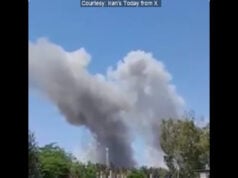
U.S. Central Command (CENTCOM) echoed some of these claims, reporting that large-scale precision strikes on Kharg Island on Friday destroyed more than 90 military targets, including storage bunkers for naval mines and missiles. Adm. Brad Cooper, lead of CENTCOM, stated that the U.S. has successfully destroyed over 100 Iranian naval vessels since the conflict began. Trump further claimed that more than 30 mine-laying ships have been neutralized, though he admitted the U.S. is still uncertain if any mines were actually deployed into the water before those ships were sunk.
Stalled Negotiations and Domestic Backlash
Despite the military pressure, President Trump made it clear he is in no rush to sign a ceasefire or a new nuclear agreement. “Iran wants to make a deal, and I don’t want to make it because the terms aren’t good enough yet,” he said. This contradicts claims from Iranian Foreign Minister Abbas Araghchi, who told CBS on Sunday that Tehran has not requested negotiations and is prepared for a long-term defense.
Domestically, the President’s remarks have sparked a fresh wave of criticism. Opponents and some families of the 13 U.S. service members killed in the conflict so far have expressed outrage at the suggestion that the U.S. “shouldn’t even be there.” Critics argue that the administration launched a war of choice and is now attempting to outsource the risk to other nations after failing to secure a quick victory.
White House Press Secretary Karoline Leavitt defended the President’s stance, stating that ensuring the success of Operation Epic Fury is the Commander-in-Chief’s “number one priority.” She also noted that a planned trip to China might be postponed as the President focuses on the coalition-building efforts.
As the conflict continues, the International Energy Agency (IEA) has begun the release of nearly 412 million barrels of emergency oil stocks—the largest collective action in history—in an attempt to stabilize prices. However, Energy Secretary Chris Wright cautioned that there are “no guarantees” that fuel prices will fall as long as the Strait of Hormuz remains contested.
Sources Used and Links
- Associated Press (AP): Trump says he’s demanded countries help ‘protect their own territory,’ police Iran’s Strait of Hormuz
- The Guardian: Middle East crisis live: European countries resist Trump’s demand for help to clear the strait of Hormuz
- CBS News: Watch Live: Trump speaking ahead of Kennedy Center board meeting
- PBS News: Trump threatens to ‘knock the hell out of’ Iran’s Kharg Island in impromptu phone call
- The White House: Fact Sheet: President Donald J. Trump Addresses Threats to the United States by the Government of Iran
- Newsday: The Latest: Trump calls for help to reopen the Strait of Hormuz
Disclaimer
Artificial Intelligence Disclosure & Legal Disclaimer
AI Content Policy.
To provide our readers with timely and comprehensive coverage, South Florida Reporter uses artificial intelligence (AI) to assist in producing certain articles and visual content.
Articles: AI may be used to assist in research, structural drafting, or data analysis. All AI-assisted text is reviewed and edited by our team to ensure accuracy and adherence to our editorial standards.
Images: Any imagery generated or significantly altered by AI is clearly marked with a disclaimer or watermark to distinguish it from traditional photography or editorial illustrations.
General Disclaimer
The information contained in South Florida Reporter is for general information purposes only.
South Florida Reporter assumes no responsibility for errors or omissions in the contents of the Service. In no event shall South Florida Reporter be liable for any special, direct, indirect, consequential, or incidental damages or any damages whatsoever, whether in an action of contract, negligence or other tort, arising out of or in connection with the use of the Service or the contents of the Service.
The Company reserves the right to make additions, deletions, or modifications to the contents of the Service at any time without prior notice. The Company does not warrant that the Service is free of viruses or other harmful components.