The Desperate Search in the Zagros Heights
TEL AVIV — On the evening of April 4, 2026, the geopolitical landscape of the Middle East hangs by a fraying thread as the United States military accelerates its search-and-rescue efforts in the rugged Kohgiluyeh and Boyer-Ahmad province of southwestern Iran. The focus of the mission is a lone American pilot, missing since their F-15E Strike Eagle was brought down during a combat sortie over the Islamic Republic on Friday.
While the Weapons Systems Officer (WSO) from the same aircraft was successfully recovered in a high-risk extraction under heavy fire, the pilot’s status remains “Unknown.” Pentagon officials, speaking on the condition of anonymity, described the search area as “nightmarish,” defined by deep limestone gorges, dense oak forests, and a pervasive presence of Iranian Revolutionary Guard Corps (IRGC) patrols.
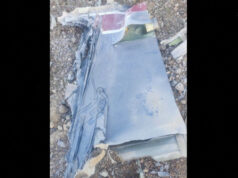
Iranian state media has exploited the situation, broadcasting grainy footage of what they claim is the aircraft’s wreckage. In a move that has drawn sharp condemnation from Washington, Tehran has officially offered a bounty to local villagers for any information leading to the “enemy pilot’s” capture. This psychological warfare has added a layer of extreme urgency to the Pentagon’s efforts, as the window for a successful evasion-and-recovery mission begins to close.

“All Hell Will Rain Down”: The 48-Hour Clock Begins
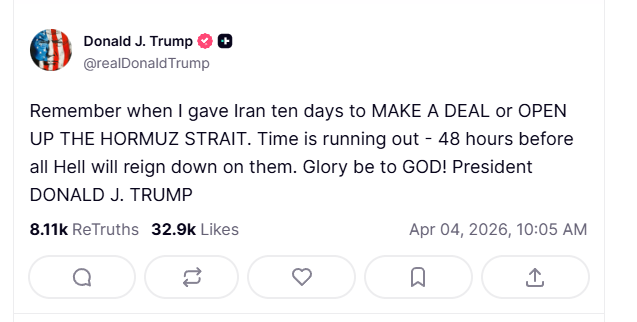 As search teams navigate the treacherous Iranian terrain, President Donald Trump has escalated the diplomatic stakes to their highest point since the start of Operation Epic Fury. Posting on Truth Social on Saturday afternoon, the President issued a blistering ultimatum that leaves little room for ambiguity.
“Remember when I gave Iran ten days to MAKE A DEAL or OPEN UP THE HORMUZ STRAIT. Time is running out—48 hours before all Hell will rain down on them. Glory be to GOD! President DONALD J. TRUMP”
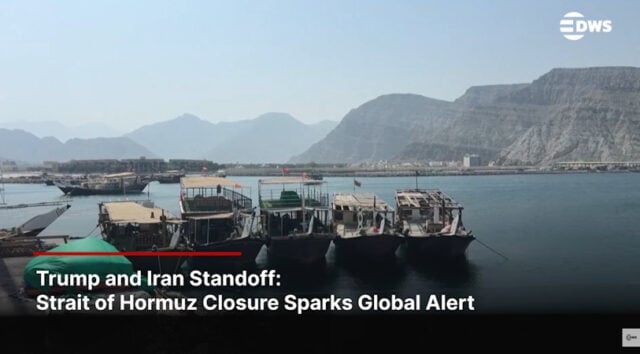
The deadline is set for Monday, April 6, 2026, at 8:00 P.M. Eastern Time. The primary demand remains the immediate and unconditional reopening of the Strait of Hormuz, which Iran has effectively blockaded for weeks, choking off global energy supplies and sending oil prices into a tailspin.
Administration officials have clarified that “all hell” refers to a massive, coordinated kinetic strike against Iran’s domestic infrastructure. Unlike previous surgical strikes on missile sites and nuclear facilities, this new phase of the war would target the very systems that sustain the Iranian state: power grids, oil refineries, and water desalination plants. The threat is a “total economic and industrial decapitation” intended to force the regime to the negotiating table—or collapse it entirely.
A History of Shifting Deadlines
The current 48-hour ultimatum is not the first time President Trump has set a clock on the Iranian regime during this conflict. Since the initiation of hostilities in late February, the administration has utilized a strategy of “fluid deadlines,” a tactic that supporters call “strategic unpredictability” and critics describe as “diplomatic whiplash.”
The First Ultimatum: March 21
On March 21, the President issued his first 48-hour warning. He demanded that Iran “obliterate” the naval blockade in the Persian Gulf or face immediate strikes on its power plants. As the world braced for impact, the deadline passed on March 23 without a strike.
The Five-Day Extension: March 23
On the morning of March 23, Trump announced a five-day pause. He claimed that “very good and productive conversations” were happening behind the scenes, facilitated by regional partners. He stated the strikes would be withheld “subject to the success of ongoing meetings,” offering a brief reprieve to global markets.
The Ten-Day “Request”: March 26
The pause was further extended on March 26, when Trump claimed the Iranian government had requested a ten-day window to negotiate a comprehensive deal. Despite denials from Tehran’s Foreign Ministry, the U.S. observed this ten-day “quiet period,” which is now coming to an end. Today’s 48-hour warning serves as the final countdown for that ten-day extension.
The Strategic Toll of Operation Epic Fury
The conflict, now entering its second month, began with the objective of dismantling Iran’s nuclear and missile infrastructure. According to the Council on Foreign Relations, U.S. and Israeli forces have successfully targeted several key facilities, including the underground enrichment centers at Fordow and Natanz.
However, the cost of the campaign is mounting. The loss of the F-15E on Friday was followed by reports of an A-10 Warthog crashing in the Persian Gulf. While the A-10 pilot was recovered, the loss of two high-value air assets in 24 hours has raised questions about the resilience of Iran’s mobile air defenses.
The “Department of War”—the new moniker for the Pentagon under the Trump administration—has remained defiant. Secretary Pete Hegseth has characterized the mission as a “crusade for stability,” noting that the U.S. presence in the region has reached 50,000 personnel. The mission has shifted from containment to what the administration calls a “maximum pressure kinetic campaign.”
The Human and Economic Cost
The potential for “all hell” to rain down has sent shockwaves through the global community. Humanitarian organizations warn that strikes on desalination plants could lead to a catastrophic water crisis for millions of Iranian civilians. Meanwhile, the IRGC has vowed to retaliate by targeting similar infrastructure in neighboring Gulf states, threatening the stability of the entire region.
Economically, the stakes are equally high. The Strait of Hormuz is the world’s most important oil transit point. A prolonged conflict, or the total destruction of Iranian oil infrastructure, could push global energy prices to levels not seen in decades, triggering a worldwide recession.
Conclusion: The Final Hours
The fate of the missing American pilot and the future of the Middle East now hinge on the next 48 hours. If the pilot is captured, they become a high-value pawn in a deadly game of chess. If the Monday deadline passes without a diplomatic breakthrough, the “rain of hell” promised by the President could transform a regional skirmish into a generational war.
For now, the world watches the clock and the mountains, waiting for a sign of the missing aviator or a signal that the fire and fury can be averted.
Sources and Links
- PBS News (April 4, 2026): Iran calls on public to find ‘enemy pilot’ as US continues frantic search. https://www.pbs.org/newshour/world/iran-calls-on-public-to-find-enemy-pilot-as-us-continues-frantic-search
- The Guardian (April 4, 2026): Search for missing US crew member of downed fighter jet enters second day. https://www.theguardian.com/world/2026/apr/04/iran-search-missing-us-crew-member-downed-fighter-jet-second-day
- ANI News (April 4, 2026): “48 hours before all hell will rain”: Trump’s ultimatum to Iran to make deal, open Hormuz. https://www.aninews.in/news/world/us/48-hours-before-all-hell-will-rain-trumps-ultimatum-to-iran-to-make-deal-open-hormuz20260404202855
- India Today (April 4, 2026): 48 hours before all hell will rain down: Trump warns Iran on Hormuz blockade. https://www.indiatoday.in/world/story/48-hours-before-all-hell-will-rain-down-donald-trump-to-iran-on-hormuz-blockade-2891655-2026-04-04
- Council on Foreign Relations (April 3, 2026): A Guide to Trump’s Second-Term Military Strikes and Actions. https://www.cfr.org/articles/guide-trumps-second-term-military-strikes-and-actions
- PBS News (March 23, 2026): U.S. won’t strike Iran’s power plants for 5 days, Trump says in turnaround on Strait of Hormuz deadline. https://www.pbs.org/newshour/world/u-s-wont-strike-irans-power-plants-for-5-days-trump-says-in-turnaround-on-strait-of-hormuz-deadline
Disclaimer
Artificial Intelligence Disclosure & Legal Disclaimer
AI Content Policy.
To provide our readers with timely and comprehensive coverage, South Florida Reporter uses artificial intelligence (AI) to assist in producing certain articles and visual content.
Articles: AI may be used to assist in research, structural drafting, or data analysis. All AI-assisted text is reviewed and edited by our team to ensure accuracy and adherence to our editorial standards.
Images: Any imagery generated or significantly altered by AI is clearly marked with a disclaimer or watermark to distinguish it from traditional photography or editorial illustrations.
General Disclaimer
The information contained in South Florida Reporter is for general information purposes only.
South Florida Reporter assumes no responsibility for errors or omissions in the contents of the Service. In no event shall South Florida Reporter be liable for any special, direct, indirect, consequential, or incidental damages or any damages whatsoever, whether in an action of contract, negligence or other tort, arising out of or in connection with the use of the Service or the contents of the Service.
The Company reserves the right to make additions, deletions, or modifications to the contents of the Service at any time without prior notice. The Company does not warrant that the Service is free of viruses or other harmful components.