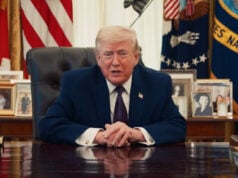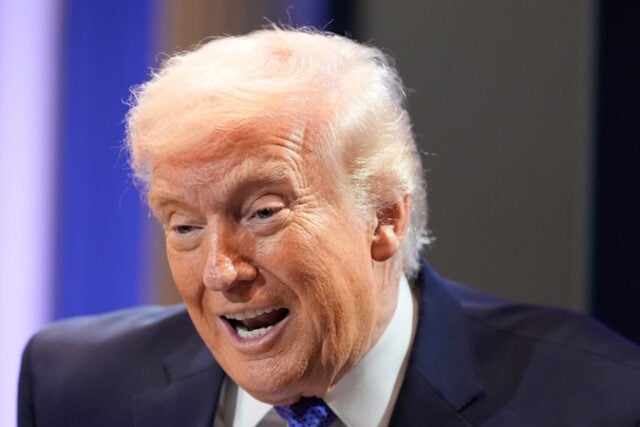
WASHINGTON — In a weekend of rapid-fire legal and economic maneuvering, President Donald Trump announced a new 15% global tariff on Saturday, February 21, 2026. The move serves as a direct and defiant response to a major U.S. Supreme Court ruling just 24 hours earlier that had declared his previous tariff regime illegal.
The President’s latest action shifts the legal foundation of his trade policy from the International Emergency Economic Powers Act (IEEPA) to Section 122 of the Trade Act of 1974. By doing so, Trump is attempting to preserve his “America First” agenda while navigating a rare judicial check on his executive authority.
The Judicial Blow: SCOTUS Strikes Down IEEPA Tariffs
On Friday, February 20, the Supreme Court issued a landmark 6-3 decision in Learning Resources, Inc. v. Trump. The Court ruled that the executive branch exceeded its authority by using IEEPA—a 1977 law intended for national emergencies—to impose sweeping, permanent tariffs.
Chief Justice John Roberts, writing for the majority, argued that the power to tax and set duties is reserved for Congress under Article I of the Constitution. The ruling effectively invalidated hundreds of billions of dollars in “Reciprocal Tariffs” collected throughout 2025. Justice Roberts noted that the term “regulate importation” within IEEPA does not grant the President “unbounded” power to levy taxes. Notably, two of Trump’s own appointees, Justices Neil Gorsuch and Amy Coney Barrett, joined the majority, prompting the President to issue a series of scathing social media posts, labeling the decision “anti-American.”

Undeterred, the administration quickly pivoted to Section 122 of the Trade Act of 1974. This specific provision allows a president to impose temporary import surcharges of up to 15% for 150 days to deal with “serious balance-of-payments” problems.
The White House justified the 15% hike by citing a $1.2 trillion trade deficit, arguing that the outflow of U.S. currency constitutes an economic emergency that must be corrected. Unlike the previous IEEPA tariffs, which the administration had hoped would be permanent, the Section 122 duties are legally capped at 150 days unless Congress votes to extend them.
Economic Impact and Market Uncertainty
The sudden shift from a 10% global rate (initially proposed Friday evening) to 15% on Saturday has sent shockwaves through global markets. While certain goods—such as critical minerals, pharmaceuticals, and USMCA-compliant products from Canada and Mexico—remain exempt, the broad nature of the tax is expected to increase costs for U.S. consumers.
Economists from the Yale Budget Lab and Tax Foundation estimate that while the Supreme Court ruling may trigger nearly $160 billion in refunds for past-paid tariffs, the new 15% surcharge will likely offset those gains, potentially adding $800 in annual costs for the average American household.
Global Reactions
International leaders have reacted with a mix of frustration and renewed resolve. German Chancellor Friedrich Merz warned that the “constant uncertainty” is “poison” for the global economy, while French President Emmanuel Macron suggested that Europe would consider its own “reciprocal” measures.
As the administration prepares for the tariffs to take effect at 12:01 a.m. on February 24—coinciding with the State of the Union address—the legal battle is far from over. Trade experts expect new lawsuits to challenge whether the current trade deficit truly meets the “balance-of-payments” criteria required by the 1974 Act.
Sources and Links
- The Guardian: Trump raises tariffs to 15% on imports from all countries
- Associated Press (AP): Trump says he’ll raise tariffs to 15 percent after Supreme Court ruling
- SCOTUSblog: Supreme Court strikes down tariffs
- The White House (Archived): Fact Sheet: President Donald J. Trump Imposes a Temporary Import Duty
- Tax Foundation: Supreme Court Strikes Down President Trump’s Tariffs
- Yale Budget Lab: State of U.S. Tariffs: SCOTUS Ruling Update
Disclaimer
Artificial Intelligence Disclosure & Legal Disclaimer
AI Content Policy.
To provide our readers with timely and comprehensive coverage, South Florida Reporter uses artificial intelligence (AI) to assist in producing certain articles and visual content.
Articles: AI may be used to assist in research, structural drafting, or data analysis. All AI-assisted text is reviewed and edited by our team to ensure accuracy and adherence to our editorial standards.
Images: Any imagery generated or significantly altered by AI is clearly marked with a disclaimer or watermark to distinguish it from traditional photography or editorial illustrations.
General Disclaimer
The information contained in South Florida Reporter is for general information purposes only.
South Florida Reporter assumes no responsibility for errors or omissions in the contents of the Service. In no event shall South Florida Reporter be liable for any special, direct, indirect, consequential, or incidental damages or any damages whatsoever, whether in an action of contract, negligence or other tort, arising out of or in connection with the use of the Service or the contents of the Service.
The Company reserves the right to make additions, deletions, or modifications to the contents of the Service at any time without prior notice. The Company does not warrant that the Service is free of viruses or other harmful components.