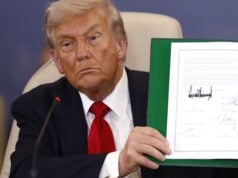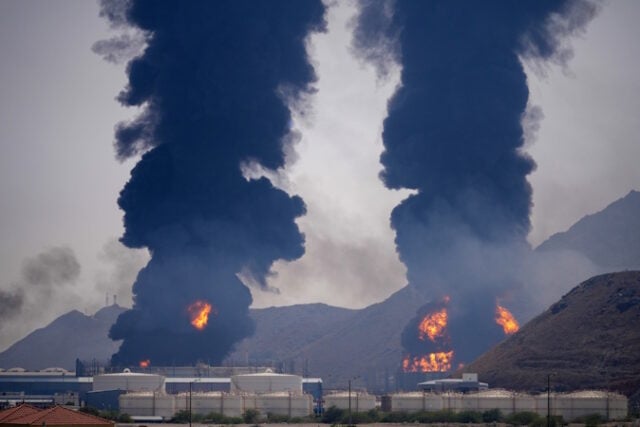
WASHINGTON — In a move that sent shockwaves through global capitals and financial hubs, President Donald J. Trump announced on Thursday a ten-day extension to his deadline for launching a devastating “Energy Plant destruction” campaign against Iran. The decision, which pushes the threshold for military escalation to Monday, April 6, 2026, at 8:00 P.M. ET, marks a high-stakes pivot toward diplomacy as the “Strait of Hormuz War” enters its second month.
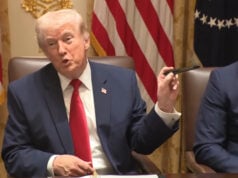
Speaking from the Cabinet Room alongside Secretary of State Marco Rubio and Defense Secretary Pete Hegseth, the President characterized the extension as a gesture of goodwill in response to a request from the Iranian government. “Talks are ongoing and, despite erroneous statements to the contrary by the Fake News Media, and others, they are going very well,” Trump posted on Truth Social earlier in the day. He later told reporters that while he remains “the opposite of desperate” for a deal, he is willing to allow “the greatest negotiators in the world” to find an off-ramp.
The 15-Point Ultimatum
The diplomatic reprieve hinges on a secretive 15-point “action list” presented to Tehran via Pakistani intermediaries. While the White House has withheld the full text, Special Envoy to the Middle East Steve Witkoff confirmed that the framework demands the “permanent abandonment” of Iran’s nuclear ambitions and the immediate, unconditional reopening of the Strait of Hormuz to international shipping.
“We have strong signs that an agreement is a possibility,” Witkoff stated during the televised cabinet meeting. “We will see if we can convince Iran that this is the inflection point where there are no good alternatives for them other than more death and destruction.”

Tehran’s response remains characteristically opaque. Iranian Foreign Minister Abbas Araghchi acknowledged the exchange of messages but denied that it constitutes formal “negotiations,” dismissing the U.S. proposal as “one-sided and unfair.” Nevertheless, the announcement of a pause in the planned destruction of Iran’s power grid suggests that behind-the-scenes channels are active, even as military strikes on other tactical targets continue daily.
Market Turbulence: A Tale of Two Realities
The financial world reacted to the news with a mixture of relief and profound anxiety. Earlier in the week, an initial five-day pause triggered a massive relief rally, with the Dow Jones Industrial Average surging over 1,000 points. However, the optimism was short-lived. By the close of trading on Thursday, March 26, the markets turned sharply bearish.
- Wall Street Slump: The Dow closed down 450 points, while the Nasdaq Composite plummeted 2.3%, officially sliding into correction territory—a 10% drop from its recent peak. Analysts attribute this volatility to a “fog of war” induced by the President’s mixed messaging, alternating between claims of “total victory” and warnings that Iran had better “get serious before it’s too late.”
- The Energy Squeeze: Global energy prices remain at punishing levels. Brent crude is hovering near $107 per barrel, while U.S. West Texas Intermediate (WTI) is trading around $93. While Trump claimed oil prices “have not gone up as much as I thought,” the reality at the pump is stark: the U.S. national average for gasoline has hit $3.98 per gallon, according to AAA, with some regions seeing much higher spikes.
- Logistics and Shipping: The Strait of Hormuz, through which 20% of the world’s oil and liquefied natural gas (LNG) flows, remains “effectively closed.” Over 150 tankers are currently anchored outside the Gulf, unwilling to risk astronomical insurance rates that have climbed four to six times their pre-war levels.
In a curious twist, President Trump cited a “present” from Iran—the allowed passage of 10 Pakistani-flagged tankers through the Strait—as evidence that the “tenor and tone” of conversations had improved.
The Cost of Conflict
The humanitarian and economic toll of the four-week war is mounting. The International Energy Agency (IEA) has warned of a “major, major threat” to the global economy if the blockade persists. Qatar has already declared force majeure on gas contracts following drone attacks on its production facilities, and heavyweights like Saudi Arabia and Kuwait have been forced to cut production as storage space runs out for oil that cannot be shipped.
Inside Iran, the situation is increasingly desperate. U.S. and Israeli strikes have already eliminated key military leadership, including IRGC Navy Commander Alireza Tangsiri, whom Israel holds responsible for “throttling” the Strait. Trump’s threat to target power plants and desalination facilities—the literal lifeblood of the region—remains the ultimate leverage.
“They want to make a deal,” Trump asserted. “The reason they want to make a deal is they have been just beat to shit.”
The Road to April 6
As the clock resets, the international community watches with bated breath. G7 leaders, including those from the UK, France, and Japan, have issued a joint statement condemning the closure of the Strait and calling for an immediate moratorium on attacks against civilian infrastructure. For now, the “Energy Plant destruction” campaign is on ice, but the President’s rhetoric suggests the ice is thin.
If no breakthrough is reached by the new April 6 deadline, the White House has signaled it is prepared to move from containment to “obliteration,” potentially targeting Iran’s remaining economic pillars. For the American consumer, the stakes are measured in cents at the pump and points in their 401(k)s. For the world, the next ten days represent the final, narrow window to prevent a total regional conflagration.
Sources and Links
- The Guardian: Trump extends deadline for Iran to open strait of Hormuz by 10 days
- Washington Post: Trump says U.S. to hold off for 10 days on hitting Iran energy sites
- Al Arabiya: Trump delays strikes on Iran energy assets, says talks ‘going well’
- CBS News: Trump says he’s granting Iran’s request to extend pause on energy site strikes
- The Hindu: Iran-Israel war highlights: Trump delays Strait of Hormuz deadline
- Iran International: Trump says US in ‘substantial’ talks with Iran as strikes continue
- The Guardian (Economy): ‘The stakes are enormous’: how a prolonged Iran war could shock the global economy
- Al Jazeera: Oil prices rise higher as Iran denies US talks
- OPB/NPR: Trump delays striking Iran’s power plants for 5 days during ‘productive conversations’
- Chatham House: US energy prices were set to rise long before the Iran war
- GOV.UK: Joint statement from leaders on the Strait of Hormuz: 19 March 2026
- Wikipedia: 2026 Strait of Hormuz crisis
Disclaimer
Artificial Intelligence Disclosure & Legal Disclaimer
AI Content Policy.
To provide our readers with timely and comprehensive coverage, South Florida Reporter uses artificial intelligence (AI) to assist in producing certain articles and visual content.
Articles: AI may be used to assist in research, structural drafting, or data analysis. All AI-assisted text is reviewed and edited by our team to ensure accuracy and adherence to our editorial standards.
Images: Any imagery generated or significantly altered by AI is clearly marked with a disclaimer or watermark to distinguish it from traditional photography or editorial illustrations.
General Disclaimer
The information contained in South Florida Reporter is for general information purposes only.
South Florida Reporter assumes no responsibility for errors or omissions in the contents of the Service. In no event shall South Florida Reporter be liable for any special, direct, indirect, consequential, or incidental damages or any damages whatsoever, whether in an action of contract, negligence or other tort, arising out of or in connection with the use of the Service or the contents of the Service.
The Company reserves the right to make additions, deletions, or modifications to the contents of the Service at any time without prior notice. The Company does not warrant that the Service is free of viruses or other harmful components.