WASHINGTON D.C. — Entering its second week, the military conflict between the United States and Iran has reached a critical diplomatic impasse. On Friday, March 6, 2026, President Donald Trump clarified the administration’s endgame in no uncertain terms: there will be no negotiated settlement, only the total unconditional surrender of the Iranian leadership.
The declaration comes as domestic pressure mounts. While the White House describes the operation as a necessary response to regional provocations, American households are already feeling the “war tax” at the gas pump. With the 2026 midterm elections on the horizon, the intersection of foreign policy and high fuel costs has become the central flashpoint in American politics.
“No Deal”: Trump’s Hardline Ultimatum
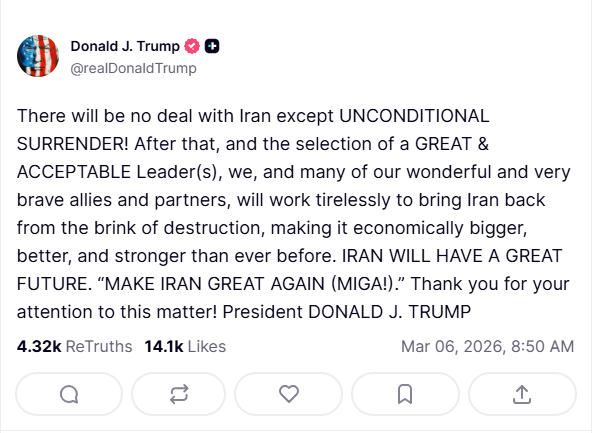 In a series of statements from the White House and on social media, President Trump dismissed the possibility of a diplomatic “off-ramp” that would leave the current Iranian government in power.
“There will be no deal with Iran except UNCONDITIONAL SURRENDER!” Trump posted. “They’ve had their chances. We are going to finish it once and for all. After they surrender, we will Make Iran Great Again!”
Critics and some military analysts warn that demanding unconditional surrender—a term rarely used in modern warfare—could lead to a protracted, bloody conflict with no clear exit strategy. However, the administration maintains that the “maximum pressure” campaign has successfully decapitated much of Iran’s naval capability, with Trump asserting that the Iranian navy is currently “at the bottom of the sea.”

🎥 WATCH: ~50 Israeli Air Force fighter jets dismantled Ali Khamenei’s underground military bunker beneath the Iranian regime’s leadership compound in Tehran. pic.twitter.com/Nw0tvvQMRX
— Israel Defense Forces (@IDF) March 6, 2026
Economic Fallout: The $3.25 National Average
The immediate casualty of the conflict has been the global energy market. Despite the United States’ status as a major oil producer, the disruption of the Strait of Hormuz—through which 20% of the world’s oil passes—has triggered a sharp spike in crude prices.
Key economic indicators show:
- Gas Prices: The national average for a gallon of gas jumped 11 cents overnight and has risen 27 cents in the past week, reaching $3.25.
- Oil Prices: Crude oil prices have surged 16% since the onset of hostilities.
- Domestic Impact: Analysts at AAA and Again Capital warn that if the war continues for another month, gas prices could easily top $4.00, acting as an “immediate, unwanted tax hike” on American families.
When asked about the rising costs, President Trump told reporters, “If they rise, they rise. This is far more important than having gasoline prices go up a little bit.”
2026 Midterms: Public Opinion and Voter Anxiety
The timing of the war is precarious for the GOP. Internal White House memos reportedly describe the failure to contain price rises as “catastrophic” for the upcoming midterm elections. Current polling reflects a deeply divided and anxious electorate:
- Low Support for Strikes: A recent Reuters/Ipsos poll found that only 27% of Americans approve of the current U.S. military strikes.
- Inflation Fears: According to a Fox News poll, voters rank inflation (84%) and the future of the U.S. (85%) as significantly higher concerns than Iran’s nuclear capabilities.
- Approval Gap: While 82% of Republicans view Iran as a major threat, only 32% of Democrats and 32% of Independents approve of the current military actions.
- Strategic Outlook: The “Short War” Gamble
The Trump administration is banking on a short, decisive campaign. White House energy advisers believe the initial “sticker shock” at the pump will fade if the conflict concludes within four to five weeks. However, economists from firms like Morgan Stanley suggest that a “protracted oil-supply disruption” could box in the Federal Reserve, forcing a choice between fighting war-driven inflation or preventing a recession.
Sources and References
- Morgan Stanley: Iran Conflict: Seven Takeaways for Investors
- Reuters: Trump on rising gas prices during Iran operation: ‘If they rise, they rise’
- PBS NewsHour: U.S. economy already unsteady; Iran war adds uncertainty
- NPR/WEKU: U.S. gasoline prices set to jump with Iran war
- The Japan Times: White House officials warn of ‘catastrophic’ election impact from gas prices
- Economic Times: Fox News Poll: 73% of voters view Iran as national security threat
Disclaimer
Artificial Intelligence Disclosure & Legal Disclaimer
AI Content Policy.
To provide our readers with timely and comprehensive coverage, South Florida Reporter uses artificial intelligence (AI) to assist in producing certain articles and visual content.
Articles: AI may be used to assist in research, structural drafting, or data analysis. All AI-assisted text is reviewed and edited by our team to ensure accuracy and adherence to our editorial standards.
Images: Any imagery generated or significantly altered by AI is clearly marked with a disclaimer or watermark to distinguish it from traditional photography or editorial illustrations.
General Disclaimer
The information contained in South Florida Reporter is for general information purposes only.
South Florida Reporter assumes no responsibility for errors or omissions in the contents of the Service. In no event shall South Florida Reporter be liable for any special, direct, indirect, consequential, or incidental damages or any damages whatsoever, whether in an action of contract, negligence or other tort, arising out of or in connection with the use of the Service or the contents of the Service.
The Company reserves the right to make additions, deletions, or modifications to the contents of the Service at any time without prior notice. The Company does not warrant that the Service is free of viruses or other harmful components.