WASHINGTON — In a series of escalating declarations from the Oval Office, President Donald Trump has intensified his demands for a global naval coalition to intervene in the Persian Gulf, insisting that the international community must take over the burden of securing the Strait of Hormuz. As the conflict with Iran enters a volatile third week, the President announced on Monday that he is indefinitely postponing his highly anticipated diplomatic trip to Beijing, stating that his presence is required at home to manage what he termed a “short-term glitch” in global energy markets.
The postponement of the China summit, originally scheduled for late March, marks a significant shift in the administration’s foreign policy priorities. While the White House had spent months preparing for a “grand reset” with President Xi Jinping, the rapidly deteriorating situation in the Middle East has forced a pivot. Trump told reporters during an event on Monday that while he “loves” the idea of meeting with Xi, the necessity of overseeing “Operation Epic Fury” and managing the domestic fallout of soaring fuel costs takes precedence.
“Because of the war, I want to be here. I have to be here,” Trump said. “We are doing a great job, a job that nobody else could do, but I need the countries of the world to step up. They’re getting the oil; we don’t even need the oil as much as they do. China needs it, Japan needs it, Europe needs it. They should be there protecting their own ships.”
“Not Our Fight”: Global Resistance Mounts
Despite the President’s insistence, a growing chorus of international leaders and domestic critics is pushing back, arguing that the United States initiated the current hostilities and should not expect others to provide the military muscle to resolve them.

In London, Prime Minister Keir Starmer has notably distanced the United Kingdom from the offensive operations. While the U.K. has allowed the U.S. to use certain bases for “defensive actions,” Starmer has rebuffed calls to join a formal naval blockade or escort mission. The sentiment has trickled down to the British political fringes as well. Rupert Lowe, an independent MP, captured the mood of an isolationist flank by stating plainly that the conflict is “not our fight.”
Similar echoes are heard within Trump’s own political base. Representative Marjorie Taylor Greene, usually a staunch ally of the President, expressed hesitation on social media, warning against the “endless war” cycle. “Every time America is on the verge of greatness, we get involved in another foreign war,” Greene wrote. “This is not our fight. Peace is the answer.”
In Beijing, the response has been even more refrigerated. Chinese Foreign Ministry spokesman Lin Jian confirmed that while communication regarding the postponed presidential visit remains open, China has no immediate plans to send warships to join a U.S.-led coalition. Officials in Beijing have characterized the crisis as a consequence of American “unilateralism” and have called for an immediate cessation of hostilities rather than military escalation.
Pain at the Pump: “A Small Price to Pay”
As the diplomatic tug-of-war continues, American consumers are facing the most immediate consequences of the conflict: a dramatic spike in energy costs. The national average for a gallon of regular gasoline has surged to $3.58, a jump of more than 60 cents in just a single month. In states like California, prices have already eclipsed the $5.30 mark, with some rural counties reporting figures as high as $6.00.
The sudden rise is a stark contrast to the sub-$2.00 prices Trump touted during his 2024 campaign and the early months of his second term. However, the President has dismissed the economic anxiety, characterizing the surge as a necessary sacrifice for national security.
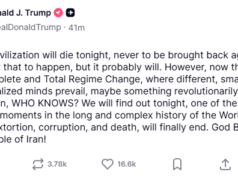
“Short-term oil prices, which will drop rapidly when the destruction of the Iran nuclear threat is over, is a very small price to pay for U.S.A., and World, Safety and Peace,” Trump posted on Truth Social. He later added in a press briefing that the spike is a “little glitch” and that “only fools would think differently.”
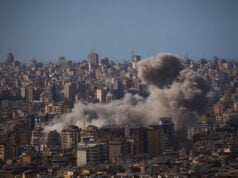
Energy analysts, however, are less optimistic. With the Strait of Hormuz—through which 20% of the world’s oil flows—effectively paralyzed by Iranian mines and threats of retaliation, crude oil has surged past the $100-per-barrel threshold. Experts warn that if the “excursion” lasts more than a few weeks, the U.S. economy could face a “heart attack” as transport and manufacturing costs ripple through the supply chain.
Domestic Fallout and Strategic Delays
The decision to delay the China trip has also raised eyebrows on Capitol Hill. Treasury Secretary Scott Bessent attempted to frame the delay as a “logistical” necessity, but many see it as an admission that the administration’s focus is becoming increasingly consumed by the Middle East. Trump had hoped to secure a major trade deal in Beijing to bolster his standing ahead of the 2026 midterm elections. Now, that victory is on hold.
Democrats have seized on the volatility, accusing the President of “failing at the business of war” and alienating allies at the exact moment they are needed most. “He prematurely declared victory, claimed Iran was ‘100% destroyed,’ and is now begging the world to save a shipping lane he said was already safe,” one senior Democratic staffer noted.
The Pentagon, meanwhile, continues to prepare for “convoy operations,” though the lack of international participation remains a glaring hole in the strategy. While Trump claims “numerous countries are on the way,” few have publicly committed the hardware necessary to reopen the Strait. For now, the United States stands largely alone in its military posture, with the President gambling that the “small price” of $4.00 gas won’t eventually cost him his political capital.
Sources Used and Links
- NPR / OPB: “Trump threatens NATO allies over Strait of Hormuz help” (March 16, 2026) – Link
- MS NOW / MaddowBlog: “After alienating allies and declaring victory, Trump ‘demands’ foreign help in war” (March 16, 2026) – Link
- The Guardian: “‘Could be the making of him’: Starmer’s allies praise stance on Trump and Iran” (March 14, 2026) – Link
- The Guardian: “Trump’s military attack on Iran reveals split among Maga diehards” (June 2025/Updated March 2026 Context) – Link
- Kyodo News: “Trump says his China trip needs to be delayed by 1 month due to Iran war” (March 16, 2026) – Link
- The Sunday Guardian: “Trump China Visit: President Requests Delay of China Trip Due to Iran War” (March 16, 2026) – Link
- Washington Examiner: “Gas prices: 64 cents higher than a month ago, and no state averages under $3 per gallon” (March 11, 2026) – Link
- TIME: “Oil Prices Top $100 A Barrel, Trump Says It’s a Short-Term Blip” (March 13, 2026) – Link
- WPHM: “Trump dismisses soaring gas prices as ‘a little glitch’ of Iran war” (March 9, 2026) – Link
- AAA Fuel Prices: “Jump at the Pump as National Average Goes Up Nearly 27 Cents” (March 5, 2026) – Link
Disclaimer
Artificial Intelligence Disclosure & Legal Disclaimer
AI Content Policy.
To provide our readers with timely and comprehensive coverage, South Florida Reporter uses artificial intelligence (AI) to assist in producing certain articles and visual content.
Articles: AI may be used to assist in research, structural drafting, or data analysis. All AI-assisted text is reviewed and edited by our team to ensure accuracy and adherence to our editorial standards.
Images: Any imagery generated or significantly altered by AI is clearly marked with a disclaimer or watermark to distinguish it from traditional photography or editorial illustrations.
General Disclaimer
The information contained in South Florida Reporter is for general information purposes only.
South Florida Reporter assumes no responsibility for errors or omissions in the contents of the Service. In no event shall South Florida Reporter be liable for any special, direct, indirect, consequential, or incidental damages or any damages whatsoever, whether in an action of contract, negligence or other tort, arising out of or in connection with the use of the Service or the contents of the Service.
The Company reserves the right to make additions, deletions, or modifications to the contents of the Service at any time without prior notice. The Company does not warrant that the Service is free of viruses or other harmful components.