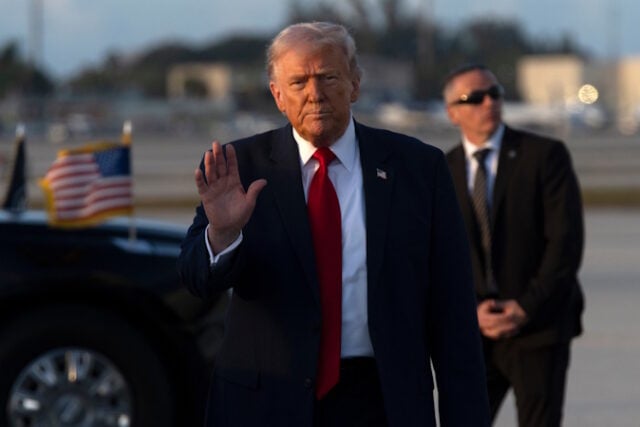
MIAMI, Florida — On the tenth day of a conflict that has fundamentally reordered the Middle East, President Donald Trump is set to take the podium at 5:30 p.m. EDT for a highly anticipated news conference. Speaking from his Miami-area golf club before returning to Washington, the President is expected to provide a “definitive update” on a military campaign that he has already characterized as a decisive victory, despite growing global economic instability and the rise of a new, hard-line leadership in Tehran.
The announcement of the press conference comes hours after Trump, in a series of remarks to reporters and via social media, asserted that the war with Iran is “very complete, pretty much.” The President’s confidence stands in stark contrast to the volatility on Wall Street and the naming of Mojtaba Khamenei as Iran’s new Supreme Leader, a move that signals Iran’s intent to dig in for a protracted struggle rather than succumb to the “unconditional surrender” the White House has demanded.
Click to watch the news conference. You can go to the White House YouTube Channel or your favorite news outlet
The “Very Complete” Declaration
Speaking to reporters while traveling aboard Air Force One and later at his Florida estate, President Trump painted a picture of a shattered Iranian military. “I think the war is very complete, pretty much,” Trump told CBS News correspondent Weijia Jiang. “They have no navy, no communications, they’ve got no air force. Their missiles are down to a scatter. Their drones are being blown up all over the place, including their manufacturing of drones. If you look, they have nothing left. There’s nothing left in a military sense.”
Trump’s assessment follows ten days of blistering joint U.S. and Israeli airstrikes, dubbed Operation Epic Fury. According to military analysts and White House briefings, the campaign has targeted nearly 2,000 sites, including ballistic missile silos, drone production facilities, and the command-and-control infrastructure of the Islamic Revolutionary Guard Corps (IRGC).

The President insisted that the U.S. is “very far ahead of schedule” regarding his initial four-to-five-week estimate for the conflict. However, while the President celebrates the “decimation” of Iran’s conventional military assets, the humanitarian and economic toll continues to mount. Reports of civilian casualties, including a strike on a girls’ school in Iran during the first days of the war, have drawn international condemnation, though the President has attributed such incidents to “inaccurate Iranian munitions.”
Iran’s New Leadership: A Defiant Succession
The geopolitical landscape shifted dramatically early Monday morning when Iranian state television announced that Ayatollah Mojtaba Khamenei, the son of the late Supreme Leader Ali Khamenei, has been officially named as the country’s new head of state. The appointment comes after the elder Khamenei was killed in the opening wave of U.S.-Israeli strikes on February 28.
Mojtaba Khamenei, long seen as a shadowy and hard-line figure within the regime, is believed to have the unwavering support of the IRGC. His ascension is a direct rebuff to President Trump’s recent calls for the Iranian people to “take back” their government.
“I have no message for him,” Trump said when asked about the new Supreme Leader. The President added that he has “someone in mind” to eventually lead Iran, suggesting that the U.S. is not merely seeking a cessation of hostilities but a total regime overhaul.
Iranian officials, meanwhile, have signaled that the war is far from over. A top official told CNN that Tehran is prepared for a “long conflict,” ruling out any immediate return to the negotiating table. Majid Mousavi, commander of the IRGC Aerospace Force, warned that the “force and frequency” of missile launches will increase, claiming that future strikes will utilize warheads weighing no less than one ton.
Economic Ripples and Market Anxiety
The primary driver for the 5:30 p.m. news conference appears to be the economy. The President specifically scheduled the address for “after the markets close,” a move intended to provide a cooling-off period following a day of significant losses.
Benchmark oil prices briefly surged past $114 a barrel on Monday, the highest level since 2022. The conflict has severely disrupted shipping in the Persian Gulf and sparked fears that the Strait of Hormuz could be permanently closed by Iranian mines or remaining coastal batteries.
Despite the surge in gasoline prices, Trump remains dismissive of long-term economic damage. “Gas prices will drop quickly once this is over,” he predicted. He also noted plans to eventually refill the Strategic Petroleum Reserve, which has been drawn upon to stabilize the current spike.
Global markets, however, are less certain. Inflationary fears have gripped the Eurozone and Asian markets, with many nations bracing for a prolonged energy crisis if the “very complete” war transitions into a grinding insurgency or a maritime blockade.
The Military Reality: A Second Week of Conflict
The war entered its second week with U.S. and Israeli forces maintaining total air dominance over Iranian airspace. Admiral Brad Cooper, commander of U.S. Central Command (CENTCOM), stated that joint forces are now operating with “impunity,” striking targets deep within Iranian territory.
The U.S. military confirmed a seventh American fatality on Monday. While the U.S. death toll remains relatively low, the regional impact is widening. Thousands of Iranians have fled the country, and the death toll in Lebanon has neared 500 as Israel expands its strikes against Hezbollah positions linked to the Iranian command structure.
There are also growing concerns regarding Iran’s nuclear stockpile. While Trump has stated he is “nowhere near” a decision on deploying ground troops, he has not ruled them out for the specific purpose of securing enriched uranium. Operation “Midnight Hammer”—the strike on known nuclear facilities—has left the status of Iran’s nuclear material in question, with some intelligence reports suggesting it remains hidden in reinforced underground bunkers.
The Diplomatic Vacuum
Diplomacy appears to have reached a total standstill. The White House recently revealed that Iran had rejected a “good faith” offer for a joint civilian nuclear program with American investment just weeks before the strikes began.
International reactions remain fractured. While the Arab League has called Iran’s strategy “reckless,” several Gulf nations, including Saudi Arabia and the UAE, are walking a tightrope. They have reported intercepting Iranian missiles and drones but are wary of being drawn into a direct war that could destroy their own infrastructure.
Russia, meanwhile, is reportedly sharing intelligence with Tehran to assist in targeting U.S. assets, a move that the Institute for the Study of War (ISW) suggests highlights a deepening “adversarial cooperation.”
Previewing the 5:30 PM News Conference
When President Trump takes the stage this afternoon, he is expected to address three key pillars:
- Military Progress: Expanding on the “very complete” nature of the war and detailing the destruction of the IRGC’s command structure.
- The Succession in Tehran: Formally addressing the appointment of Mojtaba Khamenei and reinforcing the U.S. stance on regime change.
- Energy and the Economy: Attempting to reassure the American public and global markets that the current oil shock is “short-term” and that the path to energy stability lies in a post-revolutionary Iran.
Sources close to the administration suggest the President may also issue a “final warning” to any regional actors, including Iraqi militias and Hezbollah, who continue to target U.S. facilities.
As the nation waits for the President’s remarks, the central question remains: If the military conflict is indeed “complete,” what does the peace look like? With a new Supreme Leader in power and oil prices at record highs, the “short excursion” Trump described is quickly becoming a era-defining test of his “Maximum Pressure” doctrine.
Sources and Links
- CBS News: Live Updates: As U.S.-Israeli war with Iran intensifies, Trump says it is “very far ahead of schedule”
- Reuters: Trump to hold a press conference after markets close on Monday
- The Hindu: Israel-Iran war LIVE: Mojtaba Khamenei chosen as next supreme leader
- PBS NewsHour: The war in Iran has entered a second week. Here’s where things stand
- Institute for the Study of War (ISW): Iran Update Evening Special Report, March 6, 2026
- Al Jazeera: What is the US endgame in Iran, as the war escalates?
- Encyclopaedia Britannica: 2026 Iran conflict – Overview and Timeline
- The Guardian: Trump news at a glance: US leader says Iran being ‘decimated’
Disclaimer
Artificial Intelligence Disclosure & Legal Disclaimer
AI Content Policy.
To provide our readers with timely and comprehensive coverage, South Florida Reporter uses artificial intelligence (AI) to assist in producing certain articles and visual content.
Articles: AI may be used to assist in research, structural drafting, or data analysis. All AI-assisted text is reviewed and edited by our team to ensure accuracy and adherence to our editorial standards.
Images: Any imagery generated or significantly altered by AI is clearly marked with a disclaimer or watermark to distinguish it from traditional photography or editorial illustrations.
General Disclaimer
The information contained in South Florida Reporter is for general information purposes only.
South Florida Reporter assumes no responsibility for errors or omissions in the contents of the Service. In no event shall South Florida Reporter be liable for any special, direct, indirect, consequential, or incidental damages or any damages whatsoever, whether in an action of contract, negligence or other tort, arising out of or in connection with the use of the Service or the contents of the Service.
The Company reserves the right to make additions, deletions, or modifications to the contents of the Service at any time without prior notice. The Company does not warrant that the Service is free of viruses or other harmful components.