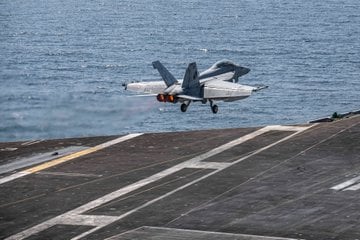
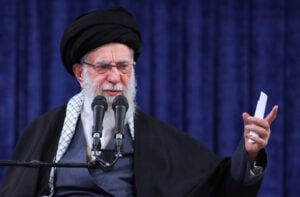
In a Truth Social Post, President Donald Trump has officially confirmed the death of Ayatollah Ali Khamenei, the Supreme Leader of the Islamic Republic of Iran. The announcement follows a day of unprecedented military violence that saw joint U.S. and Israeli forces launch “Operation Epic Fury,” a massive aerial and missile campaign that has effectively decapitated the Iranian leadership and leveled critical strategic infrastructure across the country.
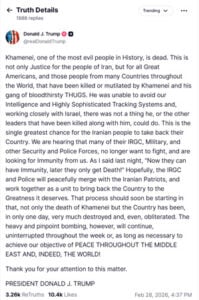 “Today, the world is a safer place,” President Trump declared in a televised statement on Saturday afternoon. “The reports are correct. Ali Khamenei is dead. His reign of terror, which spanned nearly four decades, has come to a violent and final end. We have struck the heart of the regime, and we have done so with a precision and power the world has never seen.”
The President’s confirmation follows hours of intense speculation after a targeted strike leveled the Supreme Leader’s heavily fortified compound in central Tehran. While Iranian state media initially attempted to claim Khamenei was safe, the lack of any proof of life and the collapse of government communication channels led to the eventual admission of a “catastrophic loss” by mid-level officials in the Iranian Foreign Ministry.

As the President stated, our objective is to defend the American people by eliminating imminent threats from the Iranian regime.
The President ordered bold action. CENTCOM forces are delivering an overwhelming and unrelenting blow. pic.twitter.com/B0k5gV4YnU
— U.S. Central Command (@CENTCOM) February 28, 2026
CENTCOM’s Task Force Scorpion Strike – for the first time in history – is using one-way attack drones in combat during Operation Epic Fury. These low-cost drones, modeled after Iran’s Shahed drones, are now delivering American-made retribution. 🇺🇸 pic.twitter.com/VYdjiECKDT
— U.S. Central Command (@CENTCOM) February 28, 2026
🛩️THE LARGEST MILITARY FLYOVER IN IDF HISTORY:
~200 IAF jets completed a broad strike against the missile array and the aerial defense systems of the IRGC in western and central Iran.
500+ targets hit, including aerial defense systems & missile launchers in several locations… pic.twitter.com/PVOuzlOekj
— Israel Defense Forces (@IDF) February 28, 2026
The Decapitation Strike: “Operation Epic Fury”
The operation began in the pre-dawn hours of Saturday, February 28, 2026. According to Pentagon briefings, the primary objective was the “neutralization of existential threats,” including Iran’s nuclear enrichment facilities, ballistic missile production centers, and the senior leadership of the Islamic Revolutionary Guard Corps (IRGC).
At approximately 1:15 a.m. EST, a coordinated wave of F-35 Lightning II stealth fighters and B-21 Raider bombers—supported by a massive barrage of Tomahawk cruise missiles from the U.S. Navy’s 5th Fleet—penetrated Iran’s sophisticated S-400 air defense networks. The strike on Khamenei’s compound was described by military analysts as a “bunker-busting” operation, utilizing specialized munitions designed to penetrate deep underground fortifications.
Initial assessments from the Israel Defense Forces (IDF) indicate that the strike also killed several other top-tier leaders, including:
- Ali Shamkhani: Long-time security advisor and architect of Iran’s regional proxy network.
- Mohammad Pakpour: Commander of the IRGC Ground Forces.
- Aziz Nasirzadeh: Minister of Defense.
“The people who make all the decisions, most of them are gone,” Trump told reporters shortly after his address. “It was a very powerful, very successful strike.”
A Nation in Chaos: Protests and Celebrations
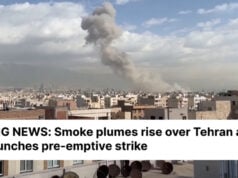
As news of Khamenei’s death filtered through the streets of Tehran and other major cities, the atmosphere was one of profound shock followed by erupting pockets of celebration. Despite the smoke still rising from the ruins of government buildings, videos surfaced on social media showing Iranians in the Ekbatan and Pardis neighborhoods dancing and distributing sweets—an act of defiance that would have been met with execution just 24 hours prior.
However, the human cost of the operation has been significant. The Iranian Red Crescent Society reported that the death toll has reached at least 201 people, with over 700 injured. One of the most devastating reports involved a strike near a girls’ primary school in the southern city of Minab, where state media claims dozens of students were killed. While the U.S. military maintained it targeted only “high-value military assets,” the humanitarian fallout has drawn sharp criticism from international bodies.
In Washington, the reaction was equally polarized. Thousands of demonstrators descended upon Lafayette Square outside the White House. The crowd was split between members of the Iranian diaspora waving pre-revolutionary flags and chanting “Zan, Zendegi, Azadi” (Woman, Life, Freedom), and anti-war activists holding signs that read “No More Blood for Oil” and “Unauthorized War.”
The protests briefly turned tense as pro-regime change demonstrators clashed with those calling for an immediate ceasefire, requiring a heavy presence from the U.S. Secret Service and D.C. Metropolitan Police to maintain a perimeter around the executive mansion.
Retaliation and the Closing of the Strait
The remnants of the Iranian military and the IRGC attempted a frantic retaliation throughout Saturday morning. Over 100 ballistic missiles and “suicide” drones were launched toward U.S. installations and allied nations.
- Bahrain & UAE: Shrapnel from intercepted missiles caused at least one fatality in Abu Dhabi and several injuries at the U.S. Naval base in Bahrain.
- Israel: The IDF confirmed several interceptions over Tel Aviv and Haifa, though seven civilians were reportedly injured by falling debris.
- Jordan & Kuwait: Both nations reported successfully shooting down projectiles that violated their airspace.
The most immediate threat to the global economy appeared as the IRGC Navy reportedly moved to block the Strait of Hormuz. This narrow waterway handles roughly 30% of the world’s seaborne oil trade. Global oil prices spiked by 12% within hours of the announcement, as major airlines canceled all flights to the Middle East and insurance premiums for shipping reached record highs.
The Power Vacuum: Who Leads the New Iran?
With Khamenei dead and the Assembly of Experts in disarray, the question of succession has become an existential crisis for the Islamic Republic. Under the Iranian constitution, a “Provisional Leadership Council” should take over, but the current military reality has rendered the constitution nearly moot.
The leading candidates for leadership—or what remains of it—include:
| Potential Candidate | Profile | Status/Likelihood |
| Mojtaba Khamenei | The Supreme Leader’s son. | Widely unpopular; seen as a continuation of the old guard. His current whereabouts are unknown. |
| Ali Larijani | Secretary of the SNSC. | A pragmatic veteran; he had been reportedly designated by Khamenei as a crisis manager. |
| Alireza Arafi | Clerical hardliner. | A deputy in the Assembly of Experts; represents the religious fundamentalist faction. |
| Military Junta | IRGC Commanders. | There is a high probability that the remaining IRGC leadership will abandon the clerical system in favor of a direct military dictatorship to maintain order. |
“We have a very good idea of who might be next,” President Trump noted, hinting at backchannel communications with potential “moderate” elements within the Iranian state. “The Iranian people have their only chance in generations to take back their country. When we are finished, it will be yours to take.”
International Reaction: A World on Edge
The global community is reeling from the sudden escalation. UN Secretary-General António Guterres called for an emergency session of the Security Council, stating the UN was “not in a position” to confirm the death but urging “maximum restraint to avoid a total regional conflagration.”
French President Emmanuel Macron and German Chancellor Olaf Scholz both issued statements condemning the lack of diplomatic consultation, with Macron emphasizing that France “was not involved” in the strikes. Conversely, British Prime Minister Keir Starmer stated that British assets were in the sky to protect “allies and interests,” effectively backing the U.S.-Israeli position.
The 47th President of the United States remains undeterred by the international outcry. “I was elected to end the threat of a nuclear Iran, and that is exactly what we are doing,” Trump said. “The era of the Ayatollah is over. A new day for the world has begun.”
Sources and Links
- The Guardian: US-Israel war on Iran: Trump appears to support reports supreme leader Khamenei is dead
- Times of Israel: Israeli official says Khamenei killed; Trump: Regime really didn’t want a deal
- PBS News: U.S. and Israel launch a major attack on Iran as Trump urges Iranians to ‘take over your government’
- The Hindu: Iran-Israel conflict LIVE: Netanyahu says ‘many signs’ Supreme Leader Khamenei is dead
- Council on Foreign Relations: Gauging the Impact of Massive U.S.-Israeli Strikes on Iran
- Council on Foreign Relations: Leadership Transition in Iran
- Wikipedia: 2026 Iran–United States crisis
- The Aviationist: [Updated] Israel and U.S. Launch Attack on Iran
Disclaimer
Artificial Intelligence Disclosure & Legal Disclaimer
AI Content Policy.
To provide our readers with timely and comprehensive coverage, South Florida Reporter uses artificial intelligence (AI) to assist in producing certain articles and visual content.
Articles: AI may be used to assist in research, structural drafting, or data analysis. All AI-assisted text is reviewed and edited by our team to ensure accuracy and adherence to our editorial standards.
Images: Any imagery generated or significantly altered by AI is clearly marked with a disclaimer or watermark to distinguish it from traditional photography or editorial illustrations.
General Disclaimer
The information contained in South Florida Reporter is for general information purposes only.
South Florida Reporter assumes no responsibility for errors or omissions in the contents of the Service. In no event shall South Florida Reporter be liable for any special, direct, indirect, consequential, or incidental damages or any damages whatsoever, whether in an action of contract, negligence or other tort, arising out of or in connection with the use of the Service or the contents of the Service.
The Company reserves the right to make additions, deletions, or modifications to the contents of the Service at any time without prior notice. The Company does not warrant that the Service is free of viruses or other harmful components.