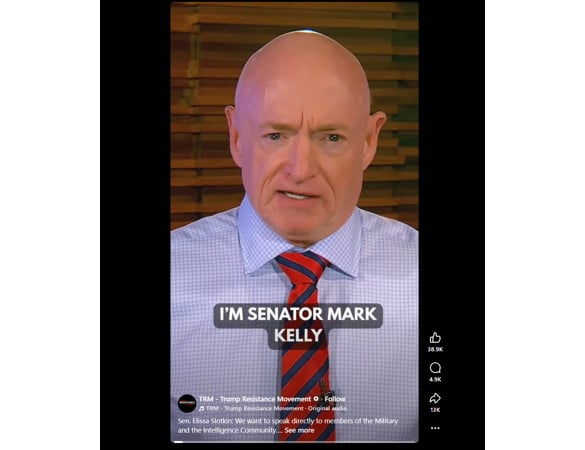
In a dramatic escalation of political rhetoric, President Donald Trump on Thursday condemned six Democratic lawmakers—including veterans of the military and intelligence community—as “traitors” for urging U.S. service members to refuse illegal orders.
The dispute centers on a short video released earlier this week by the lawmakers—Elissa Slotkin (D‑Mich.), Mark Kelly (D‑Ariz.), Jason Crow (D‑Colo.), Chrissy Houlahan (D‑Pa.), Chris Deluzio (D‑Pa.) and Maggie Goodlander (D‑N.H.). They addressed military and intelligence personnel, asserting that they have the duty to refuse orders that violate the law or the Constitution.
President Trump responded on his social‑media platform, writing: “SEDITIOUS BEHAVIOR FROM TRAITORS!!! LOCK THEM UP???” and later adding: “SEDITIOUS BEHAVIOR, punishable by DEATH!” He also reposted content by others calling for the lawmakers’ execution, including a message saying: “HANG THEM GEORGE WASHINGTON WOULD !!”

Democratic leaders swiftly condemned Trump’s remarks as dangerous and an incitement to violence—emphasizing that political disagreements should not be met with threats of execution. Meanwhile, the White House press secretary stated the administration does not believe the president was endorsing literal execution of lawmakers, instead framing the comments as rhetorical condemnation of what was depicted as reckless conduct.
Legal and military experts have weighed in, noting that while service members do have a duty to refuse unlawful commands, the video’s broad language raises concerns about undermining military discipline and civilian‑military relations. As the salience of this controversy grows, the event adds to a mounting debate about the boundaries of political discourse, the role of the military in domestic politics, and the legal limits of presidential rhetoric in charged partisan environments.
Sources:
Disclaimer
Artificial Intelligence Disclosure & Legal Disclaimer
AI Content Policy.
To provide our readers with timely and comprehensive coverage, South Florida Reporter uses artificial intelligence (AI) to assist in producing certain articles and visual content.
Articles: AI may be used to assist in research, structural drafting, or data analysis. All AI-assisted text is reviewed and edited by our team to ensure accuracy and adherence to our editorial standards.
Images: Any imagery generated or significantly altered by AI is clearly marked with a disclaimer or watermark to distinguish it from traditional photography or editorial illustrations.
General Disclaimer
The information contained in South Florida Reporter is for general information purposes only.
South Florida Reporter assumes no responsibility for errors or omissions in the contents of the Service. In no event shall South Florida Reporter be liable for any special, direct, indirect, consequential, or incidental damages or any damages whatsoever, whether in an action of contract, negligence or other tort, arising out of or in connection with the use of the Service or the contents of the Service.
The Company reserves the right to make additions, deletions, or modifications to the contents of the Service at any time without prior notice. The Company does not warrant that the Service is free of viruses or other harmful components.