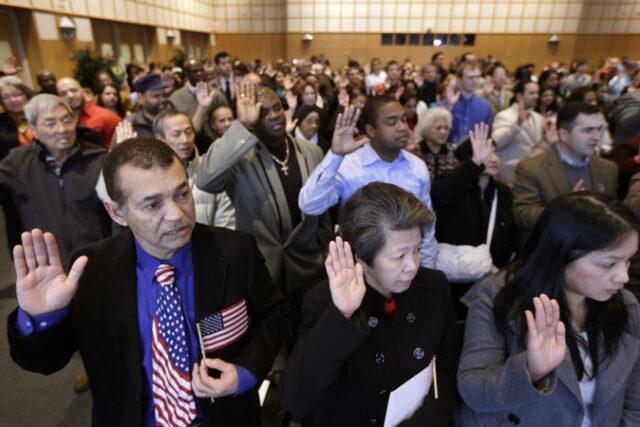
WASHINGTON — In an unprecedented move that marks a sharp departure from decades of U.S. refugee policy, the Trump administration has set the refugee admissions ceiling for fiscal year 2026 at just 7,500—the lowest in U.S. history—and signalled that the majority of those slots will be allocated to white South African Afrikaners.
According to a Federal Register notice, the small number of refugee admissions will be “justified by humanitarian concerns or is otherwise in the national interest.” Notably, the notice identifies “Afrikaners from South Africa” as a priority group.
The administration’s decision comes amid broader efforts to dramatically reduce U.S. refugee admissions from around the world—even as millions remain displaced. Under the previous Joe Biden administration, the ceiling stood at 125,000 for the previous year.
The policy represents a reversal of the longstanding humanitarian principle of “need-based” resettlement. Humanitarian and refugee-advocacy organisations have attacked the move as a politicisation of the refugee system, arguing that it privileges a wealthy white minority from South Africa over far larger populations in conflict-zones who have been vetted and approved for years.

The rationale provided by the White House emphasises alleged racial persecution of Afrikaners by South Africa’s Black-led government—an allegation that Pretoria rejects. South Africa’s foreign ministry states that no data supports the notion that white South Africans are being targeted for race-based persecution.
Earlier this year, the Trump administration fast-tracked the arrival of groups of white South Africans—59 Afrikaners arrived on a charter flight under the programme—and simultaneously suspended refugee streams from other countries.
Critics note the ethical and practical implications: diverting scarce refugee-slots to a demographic that is already economically advantaged in its home country, while thousands of still-vetted refugees from crisis-zones remain stuck in limbo. +1
As the policy takes effect, resettlement agencies face difficult choices. Some have refused to participate, claiming the programme undermines racial justice and the principle of impartial humanitarian protection.
With the ceiling set and the preferential category defined, the U.S. refugee system appears to be entering a new era—one that proponents say focuses on national interest and perceived ethnic discrimination, but which opponents warn may erode America’s longstanding role as a refuge for the most persecuted.
Sources:
Disclaimer
Artificial Intelligence Disclosure & Legal Disclaimer
AI Content Policy.
To provide our readers with timely and comprehensive coverage, South Florida Reporter uses artificial intelligence (AI) to assist in producing certain articles and visual content.
Articles: AI may be used to assist in research, structural drafting, or data analysis. All AI-assisted text is reviewed and edited by our team to ensure accuracy and adherence to our editorial standards.
Images: Any imagery generated or significantly altered by AI is clearly marked with a disclaimer or watermark to distinguish it from traditional photography or editorial illustrations.
General Disclaimer
The information contained in South Florida Reporter is for general information purposes only.
South Florida Reporter assumes no responsibility for errors or omissions in the contents of the Service. In no event shall South Florida Reporter be liable for any special, direct, indirect, consequential, or incidental damages or any damages whatsoever, whether in an action of contract, negligence or other tort, arising out of or in connection with the use of the Service or the contents of the Service.
The Company reserves the right to make additions, deletions, or modifications to the contents of the Service at any time without prior notice. The Company does not warrant that the Service is free of viruses or other harmful components.