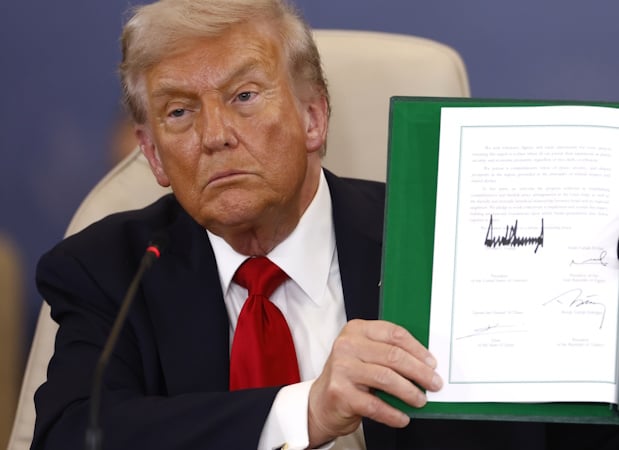
WASHINGTON — In a move that breaks with over 160 years of American fiscal tradition, the U.S. Department of the Treasury announced on Thursday that President Donald J. Trump’s signature will soon be featured on all new U.S. paper currency. The decision, which marks the first time a sitting president’s signature will appear on legal tender, is being framed by the administration as a tribute to the nation’s upcoming 250th anniversary.
The announcement was first reported by Vanity Fair and later confirmed by Treasury officials. According to the plan, the president’s signature will replace that of the Treasurer of the United States on all denominations of paper bills, starting with the $100 note scheduled for printing this June. Treasury Secretary Scott Bessent’s signature will remain on the currency, appearing alongside the president’s.
A Historic Departure from Tradition
Since the mid-19th century, U.S. paper currency has traditionally carried the signatures of two specific officials: the Secretary of the Treasury and the Treasurer of the United States. This practice became standardized in 1861 during the Lincoln administration. By removing the Treasurer’s signature to make room for the President’s, the Treasury is discarding a century and a half of bureaucratic precedent.
U.S. Treasurer Brandon Beach, whose signature would normally occupy the space now reserved for the president, expressed full support for the change. “As the 250th anniversary of our great nation approaches, American currency will continue to stand as a symbol of prosperity, strength, and the unshakable spirit of the American people under President Trump’s leadership,” Beach said in a statement. “Printing his signature on the American currency is not only appropriate, but also well deserved.”

Treasury Secretary Scott Bessent echoed these sentiments, describing the move as a way to recognize “historic achievements” during what the administration calls America’s “Golden Age” economic revival. “There is no more powerful way to recognize the historic achievements of our great country and President Donald J. Trump than U.S. dollar bills bearing his name,” Bessent stated.
Legal and Symbolic Implications
The decision has immediately sparked a debate among legal scholars and historians. Under 31 U.S.C. § 5114, federal law mandates that “only the portrait of a deceased individual may appear on United States currency.” This law was designed to prevent the appearance of a monarchy and to ensure that the nation’s currency remains a symbol of the Republic rather than any single living leader.
However, administration officials argue that the law applies specifically to portraits and does not explicitly forbid the signature of a sitting president. Critics, however, contend that the spirit of the law—intended to prevent the “cult of personality” often associated with autocracies—is being violated.
“The tradition of excluding the president’s name or likeness from currency while they are in office is one of the subtle but important ways we distinguish our democracy from a kingdom,” said one historian. “When you reach into your wallet, you are holding the credit of the United States, not the personal brand of the executive.”
The “Semiquincentennial” Rebranding
The Treasury maintains that the “Trumpified” currency is part of a broader effort to celebrate the Semiquincentennial—the 250th anniversary of American independence on July 4, 2026. This initiative includes a series of commemorative items, such as a 24-karat gold coin bearing Trump’s likeness, which was approved by a federal arts commission earlier this month.
The signature change is not intended to be a temporary commemorative measure. According to reports, Trump’s signature will remain on the printing plates indefinitely, or until a future administration decides to revert to the traditional design.
This move follows several other instances in Trump’s second term where federal institutions have been rebranded. These include the renaming of the Kennedy Center for the Performing Arts to the “Trump-Kennedy Center” and the renaming of the U.S. Institute of Peace. Large banners featuring the president’s face have also been installed on various federal buildings in Washington D.C.
Political Backlash
Reaction on Capitol Hill was swift and divided along partisan lines. Democratic lawmakers criticized the timing and the nature of the announcement, pointing to economic pressures facing many Americans.
Rep. Shontel Brown (D-OH) took to social media to call the plan “gross and un-American,” adding that the new bills would “remind us who to thank when we pay more for gas, goods, and groceries.” The criticism comes as the U.S. economy grapples with the fallout of the war in Iran, which began on February 28, 2026, leading to a sharp rise in energy and food costs.
Republicans, conversely, hailed the move as a bold assertion of American leadership and economic sovereignty. Supporters argue that the president’s signature on the dollar serves as a “seal of confidence” for international markets, reinforcing the “dollar dominance” that Secretary Bessent frequently cites in his policy speeches.
Technical Rollout
The U.S. Bureau of Engraving and Printing (BEP) is already in the process of developing new printing plates to accommodate the president’s signature. The first batch of currency featuring the new design is expected to be the $100 bill, which will enter circulation in early summer 2026. Other denominations, including the $1, $5, $10, $20, and $50 bills, will follow as existing stocks are depleted and new runs are ordered.
For many Americans, the change will be the most visible alteration to their daily financial lives in decades. While the portraits of Washington, Lincoln, and Hamilton will remain on the face of the bills, the presence of a sitting president’s name on every transaction is an undeniable shift in the aesthetic of American money.
As the nation prepares for its 250th birthday, the “Trump signature” bills are set to become either a prized memento of a transformative era or a focal point for continued national debate over the boundaries of executive branding.
Sources Used and Links
- U.S. Department of the Treasury Official Press Release: Treasury Announces President Donald J. Trump’s Signature to Appear on Future U.S. Paper Currency
- The Associated Press: US Treasury plans to put Trump’s signature on new paper currency in first for sitting president
- The Guardian: Trump signature to appear on US bills in first for sitting president
- Mediaite: Trump’s Treasury Dept. Is Adding His Signature to All U.S. Currency — First Time Using a Sitting President’s Name
- CBS News: Trump’s signature will be featured on U.S. paper currency, a presidential first, Treasury says
- Federal Reserve Bank of Atlanta: The Presidents in Your Wallet
- U.S. Mint: History of Presidents on Our Coins
Disclaimer
Artificial Intelligence Disclosure & Legal Disclaimer
AI Content Policy.
To provide our readers with timely and comprehensive coverage, South Florida Reporter uses artificial intelligence (AI) to assist in producing certain articles and visual content.
Articles: AI may be used to assist in research, structural drafting, or data analysis. All AI-assisted text is reviewed and edited by our team to ensure accuracy and adherence to our editorial standards.
Images: Any imagery generated or significantly altered by AI is clearly marked with a disclaimer or watermark to distinguish it from traditional photography or editorial illustrations.
General Disclaimer
The information contained in South Florida Reporter is for general information purposes only.
South Florida Reporter assumes no responsibility for errors or omissions in the contents of the Service. In no event shall South Florida Reporter be liable for any special, direct, indirect, consequential, or incidental damages or any damages whatsoever, whether in an action of contract, negligence or other tort, arising out of or in connection with the use of the Service or the contents of the Service.
The Company reserves the right to make additions, deletions, or modifications to the contents of the Service at any time without prior notice. The Company does not warrant that the Service is free of viruses or other harmful components.