TRUCKEE, Calif. — A scenic three-day backcountry excursion in the Sierra Nevada ended in historic tragedy Tuesday when a massive avalanche swept through a guided group of skiers near Castle Peak. Authorities confirmed Wednesday that eight people are dead and one remains missing in what has become the deadliest avalanche in California’s recorded history.
Video courtesy PBS News Hour
The disaster unfolded around 11:30 a.m. on February 17, 2026, as a group of 15 backcountry skiers—comprising 11 clients and four professional guides—were navigating the final leg of their journey back to the trailhead. The group, led by Blackbird Mountain Guides, had been staying at the remote Frog Lake Backcountry Huts near Donner Summit. As they traversed a north-facing slope at approximately 8,200 feet, a slab of snow described as “the length of a football field” broke loose, engulfing the majority of the party.
A Desperate Call for Help
In the immediate aftermath of the slide, the mountain was gripped by a severe winter storm, with snowfall rates exceeding two inches per hour and winds gusting up to 80 mph. Traditional cellular service was non-existent in the rugged terrain northwest of Lake Tahoe.

However, technology provided a critical lifeline for the six survivors. Using an iPhone’s Emergency SOS via satellite feature, a member of the group was able to transmit a 911 distress signal and precise GPS coordinates to emergency dispatchers. This satellite link allowed the survivors to communicate their situation and the number of missing persons to the Nevada County Sheriff’s Office despite being completely off the grid.
“The ability to get a satellite signal out in those whiteout conditions was a game-changer for the initial response,” said Nevada County Sheriff Shannan Moon during a Wednesday press conference. “It gave our teams a starting point in a situation where they otherwise would have been flying blind.”
The Rescue Effort
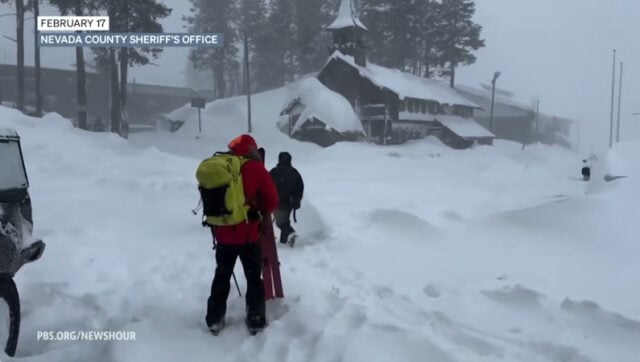
Despite the early alert, the rescue was anything but simple. More than 50 personnel from across Northern California and Nevada—including the Tahoe Nordic Search and Rescue team and units from Placer and Washoe counties—were deployed into a “high-risk” environment.
Rescuers utilized snowcats to get within two miles of the site before being forced to continue on skis through waist-deep snow and near-zero visibility. When they finally reached the survivors late Tuesday night—nearly 11 hours after the initial slide—they found a harrowing scene. The six survivors, including one guide, had constructed a makeshift shelter using tarps and their own gear to endure the sub-zero temperatures.
Tragically, the survivors had already located the bodies of three of their companions before help arrived. Rescuers discovered five more victims nearby, but the relentless storm forced teams to mark the locations with avalanche poles and evacuate the living before the bodies could be recovered.
A Community in Mourning
The impact of the tragedy has rippled through the tight-knit Lake Tahoe community. Officials confirmed that one of the deceased was the spouse of a long-time member of the Tahoe Nordic Search and Rescue team—the very group that responded to the call.
Additionally, Sugar Bowl Academy, a nearby elite ski-racing school, announced that several members of its community were among those lost. The victims, ranging in age from 30 to 55, included seven women and one man among the confirmed dead.
“This is a gut-punch to our entire region,” said Placer County Sheriff Wayne Woo. “These were experienced people, led by professionals, using the right equipment. It underscores just how unpredictable and unforgiving the backcountry can be during an atmospheric river event.”
Historical Context and Safety Warnings
The Castle Peak avalanche (rated a D2.5 on the destructive scale) has surpassed the infamous 1982 Alpine Meadows slide, which killed seven people, as the deadliest in state history. It also stands as the second-deadliest avalanche in U.S. history, behind only the 1981 Mt. Rainier disaster that claimed 11 lives.
The Sierra Avalanche Center had issued a “high” danger warning (Level 4 out of 5) on the morning of the accident. Experts noted that a “persistent weak layer” in the snowpack had been overloaded by the weight of several feet of new, heavy snow.
“We are in a cycle of extreme instability,” warned Brandon Schwartz, director of the Sierra Avalanche Center. “When you have a D2.5 slide, it has enough force to snap trees and destroy small buildings. A human being stands very little chance if they are in the direct path.”
As of Wednesday evening, the search for the ninth skier has transitioned to a recovery mission. Sheriff Moon stated that the individual is presumed deceased based on the “totality of the conditions” and the amount of time that has passed since the burial.
Looking Ahead
Blackbird Mountain Guides issued a brief statement expressing “profound heartbreak” and stating they are cooperating fully with authorities to investigate the decision-making process leading up to the incident.
For now, the focus remains on the mountainside. Recovery teams are waiting for a narrow window in the weather to retrieve the remaining victims. Until then, the Sierra Nevada remains a site of both immense natural power and deep, lingering sorrow.
Sources and Links
- SFGATE: 8 people in backcountry tour group dead in Tahoe avalanche
- CBS News Sacramento: 8 skiers dead after avalanche near California’s Lake Tahoe; 9th still missing
- The Guardian: Eight skiers dead after California avalanche, authorities say
- Ski Magazine: 8 Dead, One Missing After Historic Avalanche Near Lake Tahoe
- ABC News / Everett Post: 8 of 9 missing skiers found dead following California backcountry avalanche
- KUNR Public Radio: Eight confirmed dead in Lake Tahoe area avalanche, one missing
Disclaimer
Artificial Intelligence Disclosure & Legal Disclaimer
AI Content Policy.
To provide our readers with timely and comprehensive coverage, South Florida Reporter uses artificial intelligence (AI) to assist in producing certain articles and visual content.
Articles: AI may be used to assist in research, structural drafting, or data analysis. All AI-assisted text is reviewed and edited by our team to ensure accuracy and adherence to our editorial standards.
Images: Any imagery generated or significantly altered by AI is clearly marked with a disclaimer or watermark to distinguish it from traditional photography or editorial illustrations.
General Disclaimer
The information contained in South Florida Reporter is for general information purposes only.
South Florida Reporter assumes no responsibility for errors or omissions in the contents of the Service. In no event shall South Florida Reporter be liable for any special, direct, indirect, consequential, or incidental damages or any damages whatsoever, whether in an action of contract, negligence or other tort, arising out of or in connection with the use of the Service or the contents of the Service.
The Company reserves the right to make additions, deletions, or modifications to the contents of the Service at any time without prior notice. The Company does not warrant that the Service is free of viruses or other harmful components.