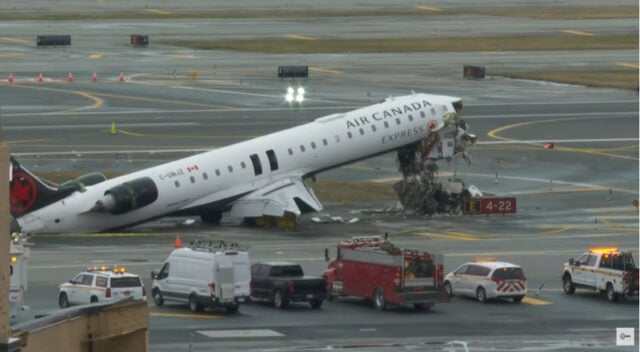
NEW YORK — A devastating collision between an arriving commercial airliner and a firefighting vehicle on a LaGuardia Airport runway late Sunday night has left two pilots dead, dozens injured, and the aviation community reeling. The tragedy, which marks the first fatal accident at the New York transit hub in more than three decades, has sparked intense scrutiny over chronic underfunding of the Federal Aviation Administration (FAA) and the critical need to upgrade air traffic control equipment and staffing.
WARNING - The first video is the actual collision. It is disturbing VIDEO.
WATCH: New video shows Air Canada flight crashing into rescue truck at New York airport pic.twitter.com/PZcyTSXI15
— BNO News (@BNONews) March 23, 2026
Operations at LaGuardia Airport officially resumed at 2:00 p.m. on Monday, concluding a massive emergency ground stop that triggered a cascade of flight cancellations nationwide. However, as the wreckage is cleared and the National Transportation Safety Board (NTSB) prepares to hold a preliminary briefing later today, the focus has rapidly shifted from the immediate rescue efforts to the systemic failures that may have allowed the fatal crash to occur.
A Night of Chaos on the Tarmac
The sequence of events leading to the collision began late Sunday night under challenging operational conditions. Air Canada Express Flight 8646, a Bombardier CRJ-900 operated by regional partner Jazz Aviation, was touching down after a routine flight from Montréal-Pierre Elliott Trudeau International Airport. The aircraft was carrying 72 passengers and four crew members.

Simultaneously, a separate emergency was unfolding on the ground. A United Airlines flight preparing for takeoff had aborted its departure after pilots reported an anti-ice warning light and a strange, noxious odor in the cabin that was reportedly sickening flight attendants. In response, LaGuardia’s air traffic control tower dispatched Port Authority Aircraft Rescue and Firefighting (ARFF) vehicles to intercept the United aircraft and assess the situation.
According to preliminary audio recordings broadcast from the air traffic control tower, one of the massive ARFF trucks was cleared to cross Runway 4 at the intersecting taxiway. Moments later, as the Air Canada Express jet hurtled down the same runway during its landing roll, the controller realized the impending disaster.
Transmissions captured the controller frantically attempting to halt the ground vehicle, shouting, “Stop, stop, stop! Truck 1, stop! Truck 1, stop!”
The warning came too late. Flight tracking data indicates the CRJ-900 aircraft, traveling at significant speed, slammed into the heavy rescue vehicle. The sheer force of the impact tore the nose and cockpit of the aircraft entirely open, exposing a shredded tangle of wires and flight controls, while sending the neon-yellow fire truck tumbling onto its side.
In the harrowing aftermath, the gravity of the mistake became apparent in the tower. Roughly twenty minutes following the collision, the controller was heard on the radio speaking to a colleague about the earlier United Airlines distraction, stating simply and tragically: “I messed up.”
Casualties and the Emergency Response
The collision immediately triggered a mass casualty response, drawing resources from across Queens and the broader New York City area.
Both the pilot and the co-pilot of the Air Canada Express jet—both Canadian nationals—were killed instantly in the impact. Their identities have been withheld pending full notification of their families. The loss of the flight crew has cast a dark shadow over the airline industry, which relies heavily on the safety and expertise of regional operators.
Emergency responders triaged passengers on the tarmac, setting up portable floodlights to illuminate the debris field. In total, 41 individuals were transported to local hospitals in Queens. The injured included 39 passengers and crew members from the aircraft, as well as the two Port Authority police officers who were manning the fire truck.
Port Authority Executive Director Kathryn Garcia provided a detailed update on the status of the victims and the airport’s operational recovery during a Monday morning briefing.
“At approximately 11:40 p.m., a tragic collision occurred on Runway 4 involving an arriving CRJ-900 and one of our Aircraft Rescue and Firefighting vehicles,” Garcia stated. “We immediately activated all emergency response protocols. I can confirm that 32 of the 41 individuals transported to local hospitals have been released this morning, though nine remain in serious condition. Our primary focus has been on supporting the victims, securing the site for the NTSB, and safely resuming operations. As of 2:00 p.m. today, LaGuardia has officially reopened, though passengers should expect residual delays as airlines work to reposition their fleets.”
The End of a 30-Year Safety Streak
The horrific events of Sunday night carry a heavy historical weight for LaGuardia. This incident marks the first fatal accident involving a commercial aircraft at the airport in over 30 years.
The last major fatal tragedy at LaGuardia occurred in 1992, when USAir Flight 405 crashed into Flushing Bay shortly after takeoff due to ice accumulation on its wings, claiming 27 lives. Since that time, the aviation industry has implemented sweeping safety reforms, and LaGuardia itself recently underwent a multi-billion-dollar infrastructure overhaul to modernize its terminals and ground operations.
However, experts argue that while the passenger terminals are state-of-the-art, the invisible infrastructure—the air traffic control technology and the human workforce that manages it—has been dangerously neglected due to federal funding lapses.
The Looming FAA Staffing and Equipment Crisis
As investigators descend on the wreckage, the conversation in Washington and New York has immediately pivoted to the well-documented vulnerabilities within the U.S. National Airspace System. The FAA has been grappling with severe controller shortages, forced overtime, and aging surface-management radar systems.
A recent federal funding lapse had already caused staffing impacts at security checkpoints and control towers across the country, leading to widespread delays in the days preceding the crash. The LaGuardia tower, managing one of the most complex and congested airspaces in the world, has not been immune to these pressures.
Scott Duffy, a prominent aviation safety advocate, did not mince words when discussing the systemic failures that preceded the collision.
“This isn’t just an isolated mistake; it’s the symptom of a system flashing red,” Duffy said. “For years, we have been sounding the alarm about the desperate need to upgrade FAA equipment and increase staffing levels in our control towers. You cannot run the world’s busiest airspace on a shoestring budget and outdated radar. The federal funding lapses have pushed our controllers to the brink of exhaustion. Tragically, we are now seeing the devastating, fatal consequences of that congressional neglect.”
Duffy’s sentiments highlight a growing frustration among aviation professionals who feel that surface safety technology—such as the Airport Surface Detection Equipment, Model X (ASDE-X), which is designed to alert controllers to potential runway conflicts—requires urgent modernization and integration.
Bryan Bedford, CEO of Republic Airways and a leading voice in the regional airline sector, echoed the need for comprehensive safety reviews while expressing his sorrow for the lost crew.
“The entire aviation community is in mourning today,” Bedford remarked. “As operators, we understand the immense complexities of navigating congested airspaces like New York. This tragedy at LaGuardia is a devastating blow. Our deepest condolences go out to the team at Jazz Aviation and the families of the pilots who perished. This event highlights that while we have made incredible strides in aviation safety over the last three decades, the margin for error on the ground remains razor-thin. We stand ready to support any industry-wide initiatives to enhance surface management technology and bolster ATC resources.”
Political Leaders Demand Federal Action
The political fallout from the crash has been swift, with New York’s top leaders demanding immediate answers and financial commitments from the federal government. The disruption of a major economic engine like LaGuardia, coupled with the loss of life, has unified state and city officials in their call for infrastructure resilience.
New York Governor Kathy Hochul addressed the media early Monday, praising the swift actions of the first responders while taking a hard line on the federal government’s responsibility to fund aviation safety.
“The events of last night are a stark reminder of the fragile nature of our aviation infrastructure,” Gov. Hochul stated. “My heart goes out to the families of the two pilots who tragically lost their lives, and to the dozens of passengers and first responders who were injured. New Yorkers are resilient, and our emergency personnel acted with incredible bravery under unimaginable circumstances, but they shouldn’t have to work in a system stretched this thin. We are demanding answers from the FAA, and more importantly, we are demanding the necessary federal funding to modernize our air traffic control systems so a tragedy like this never happens again in our state.”
New York City Mayor Zohran Mamdani also spoke to the press outside of a Queens hospital where several of the injured passengers were being treated. He emphasized the direct impact federal gridlock has on local lives.
“This is a profound tragedy that strikes at the very heart of our city’s vital transportation network,” Mayor Mamdani said. “We mourn the two pilots who lost their lives bringing people to our city, and we are keeping the injured firmly in our thoughts today. New York City relies on LaGuardia to connect us to the world, but more importantly, we rely on the federal government to ensure these hubs are safe. It is entirely unacceptable that outdated equipment and understaffed control towers are the accepted norm. We need immediate, uncompromising federal action to fund the FAA.”
The NTSB Investigation: Seeking Answers
The path to understanding exactly how a cleared fire truck and a landing passenger jet ended up on a collision course now rests with the National Transportation Safety Board. The agency deployed a highly specialized “Go Team” to LaGuardia in the early hours of Monday morning.
The NTSB is scheduled to hold a preliminary press briefing later today to outline the initial phases of their inquiry. The investigation will be multifaceted, focusing heavily on human factors, technological safeguards, and institutional procedures.
Key areas of the NTSB investigation are expected to include:
- Air Traffic Control Communications: Investigators will meticulously analyze the tower tapes to understand the timeline of the clearances given to both the ground vehicle and the arriving aircraft. They will also look into the controller’s workload, shift length, and potential fatigue.
- Flight Data and Cockpit Voice Recorders: The “black boxes” from the Air Canada Express CRJ-900 have been successfully recovered from the wreckage and will provide critical data on the aircraft’s speed, braking, and the crew’s final moments.
- Ground Radar Systems: The team will evaluate LaGuardia’s surface movement radar to determine whether it properly alerted the tower to an impending runway incursion.
- Emergency Protocols: Investigators will review the Port Authority’s ARFF procedures for responding to concurrent emergencies and traversing active runways.
As the NTSB pieces together the final moments of Flight 8646, the aviation industry faces a difficult reckoning. The loss of two pilots and the shattering of a 30-year safety record at LaGuardia serve as a grim catalyst for change. The demands from local leaders, union officials, and airline executives are clear: without immediate and sustained federal funding to upgrade the FAA’s technological capabilities and human workforce, the safety of the flying public remains at risk.
While the runways at LaGuardia are open once again and flights have resumed their normal cadence over the New York skyline, the scars of Sunday night’s collision will undoubtedly trigger long-lasting operational shifts across the national airspace system.
Sources and Links
- CTV News: Two pilots flying Air Canada jet killed in collision with fire truck at N.Y. airport – https://www.ctvnews.ca/world/article/2-people-killed-in-collision-between-jet-and-vehicle-at-new-yorks-laguardia-airport-source-says/
- Al Jazeera: Two killed when Air Canada jet hits fire truck at NYC’s LaGuardia Airport – https://www.aljazeera.com/news/2026/3/23/air-canada-jet-collides-with-ground-vehicle-at-new-york-airport
- The Guardian: Two pilots killed after Air Canada jet collision at LaGuardia in New York – https://www.theguardian.com/us-news/2026/mar/23/air-canada-plane-collides-with-ground-vehicle-at-new-yorks-laguardia-airport-halting-all-flights
- Hindustan Times: LaGuardia airport crash: What led to collision between aircraft and fire truck? – https://www.hindustantimes.com/world-news/us-news/laguardia-airport-crash-what-led-to-collision-between-the-air-canada-express-aircraft-and-fire-truck-united-airlines-101774256833263.html
- CBS News: 2 pilots killed as plane and fire-rescue truck collide at New York’s LaGuardia Airport, officials say – https://www.cbsnews.com/news/laguardia-airport-closed-arrving-air-canada-plane-ground-vehicle-collide/
- AP News: 2 pilots killed when jet collides with fire truck at New York’s LaGuardia Airport – https://apnews.com/article/new-york-laguardia-airport-air-canada-collision-6a3cbabbeed76125fa5f7aed32679fd8
- ClickOnDetroit: LaGuardia closed after deadly crash with plane, fire truck — What time will the airport reopen? – https://www.clickondetroit.com/news/local/2026/03/23/laguardia-closed-after-deadly-crash-with-plane-fire-truck-what-time-will-the-airport-reopen/
- Economic Times: Air Canada Express Plane Crash: Two dead in New York flight collision at LaGuardia Airport – https://m.economictimes.com/nri/latest-updates/air-canada-express-plane-crash-two-dead-in-new-york-plane-crash-at-laguardia-airport-closed-injured-pilot-passengers-fire-truck-faa-jazz-aviation/articleshow/129745496.cms
- Fox News: LaGuardia collision: 2 pilots killed after Air Canada jet hits fire truck, forcing airport closure – https://www.foxnews.com/live-news/new-york-laguardia-plane-crash-march-23
Disclaimer
Artificial Intelligence Disclosure & Legal Disclaimer
AI Content Policy.
To provide our readers with timely and comprehensive coverage, South Florida Reporter uses artificial intelligence (AI) to assist in producing certain articles and visual content.
Articles: AI may be used to assist in research, structural drafting, or data analysis. All AI-assisted text is reviewed and edited by our team to ensure accuracy and adherence to our editorial standards.
Images: Any imagery generated or significantly altered by AI is clearly marked with a disclaimer or watermark to distinguish it from traditional photography or editorial illustrations.
General Disclaimer
The information contained in South Florida Reporter is for general information purposes only.
South Florida Reporter assumes no responsibility for errors or omissions in the contents of the Service. In no event shall South Florida Reporter be liable for any special, direct, indirect, consequential, or incidental damages or any damages whatsoever, whether in an action of contract, negligence or other tort, arising out of or in connection with the use of the Service or the contents of the Service.
The Company reserves the right to make additions, deletions, or modifications to the contents of the Service at any time without prior notice. The Company does not warrant that the Service is free of viruses or other harmful components.