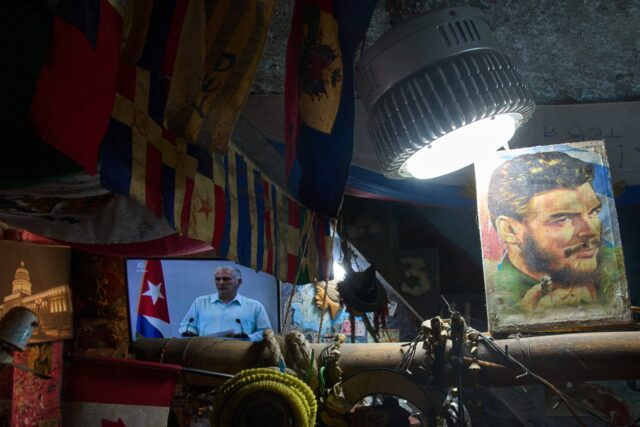
HAVANA — The island of Cuba plunged into a state of total atmospheric and literal darkness on Monday, March 16, 2026, as the national electrical grid suffered a “complete disconnection,” according to state energy officials. The collapse, which has left nearly 11 million people without power, marks the most severe energy crisis in the nation’s history and stands as the definitive climax of a high-stakes “maximum pressure” campaign orchestrated by the second Trump administration.
While Cuba’s electrical infrastructure has been fraying for decades, the current catastrophe is being directly attributed to a sophisticated and aggressive U.S.-led energy blockade initiated in early 2026. This strategy, centered on Executive Order 14380, has effectively paralyzed the island’s ability to import the fuel necessary to fire its aging thermoelectric plants. As night fell over Havana on Monday, the only lights visible were the dim flickers of candles and the occasional glow of expensive private generators, while the government struggled to find a path toward restoration.
The Mechanics of the Blockade
The seeds of this week’s blackout were sown on January 29, 2026, when President Donald Trump signed an executive order declaring a national emergency regarding the “malign actions” of the Cuban government. The order introduced a novel and punitive trade mechanism: the United States would impose massive ad valorem tariffs on any third-party country that continued to sell or provide oil to Cuba.
This “secondary blockade” targeted Cuba’s primary lifelines. Historically, Cuba has relied on subsidized oil from Venezuela and shipments from Mexico’s state-owned Pemex to meet roughly 60% of its energy needs. However, the geopolitical landscape shifted violently in early January 2026 following the removal of Venezuelan President Nicolás Maduro from power—an event the Trump administration championed as a victory for regional security. With the Maduro government gone and U.S. forces overseeing Venezuelan oil distribution, the primary flow of crude to Havana was severed overnight.

When Mexico and other regional partners attempted to fill the gap, the Trump administration responded with the threat of 25% to 35% tariffs on all their exports to the U.S. market. Faced with economic ruin, Mexican President Claudia Sheinbaum characterized the cessation of oil deliveries as a “sovereign decision,” though international observers viewed it as a direct capitulation to Washington’s pressure. By mid-February, ship-tracking data showed that only two small vessels had managed to discharge fuel at Cuban ports, leaving the island’s reserves at zero.
The technical failure on Monday was not a surprise to energy experts. Cuba’s power system is composed of eight large, Soviet-era thermoelectric plants, most of which have surpassed their 30-year useful life by several decades. These plants require a steady diet of heavy crude and fuel oil to maintain the constant pressure needed for steam turbines. Without consistent fuel, the plants have been forced to cycle on and off—a process known as “thermal stress”—which has led to frequent mechanical breakdowns.
The final blow came at 1:40 p.m. local time on Monday when the Antonio Guiteras Power Plant in Matanzas, the country’s most important generation facility, went offline due to a lack of fuel and a critical component failure. This caused a frequency drop that cascaded through the remaining smaller plants, tripping the entire national system (SEN).
“The grid operator, UNE, is working on ‘microsystems’ to restore power to hospitals and essential services, but the reality is that without a massive influx of fuel, we are simply rearranging the darkness,” said a technician in Havana who requested anonymity.
The Humanitarian Toll
The consequences of the blackout extend far beyond the absence of light. In a country already reeling from food shortages and record inflation, the loss of refrigeration is a death knell for many families. Reports from across the island describe a desperate scene where residents are cooking whatever meat and vegetables they have over open wood fires before the food spoils in the Caribbean heat.
- Public Health: The Ministry of Public Health confirmed on Friday that tens of thousands of elective surgeries have been postponed. Only emergency rooms are functioning, powered by dwindling diesel reserves in backup generators.
- Sanitation: In Havana, garbage collection has ground to a halt. The city’s fleet of trash trucks, already limited by a lack of spare parts, now sits idle without fuel. Piles of refuse are accumulating on street corners, sparking fears of a public health crisis and disease outbreaks.
- Water Access: Because Cuba’s water distribution system relies heavily on electric pumps to move water into building cisterns, the blackout has also cut off water for millions of residents in high-rise apartments.
“Our people are too old to keep suffering,” said Tomás David Velázquez, a 61-year-old Havana resident. “Everything we have to eat spoils, and we cannot even get a glass of water. It feels like the end.”
Trump’s “Make a Deal” Strategy
From the White House, the rhetoric has been one of calculated opportunism. President Trump has repeatedly taken to social media to proclaim that the Cuban government is on the verge of collapse. “THERE WILL BE NO MORE OIL OR MONEY GOING TO CUBA – ZERO!” he posted shortly after the Maduro ouster. His primary message to Havana has been simple: “Make a deal before it’s too late.”
While the administration hasn’t publicly detailed the terms of such a “deal,” analysts suggest it involves a total dismantling of the Communist Party’s control, the scheduling of multi-party elections, and the return of properties seized during the 1959 revolution. Secretary of State Marco Rubio has echoed these sentiments, framing the energy crisis as a result of “socialist incompetence” rather than U.S. policy, despite the clear impact of the January executive order.
In a surprising turn, Cuban President Miguel Díaz-Canel confirmed on March 13 that low-level diplomatic talks had begun with U.S. officials. However, the Cuban leadership maintains that it will not negotiate “under the boot of a blockade.” Díaz-Canel has accused the U.S. of “economic warfare” and “collective punishment,” calling the blockade a violation of the UN Charter.
International Reaction and the Path Forward
The international community is sharply divided over the 2026 blockade. UN human rights experts issued a statement from Geneva condemning the fuel blockade as a “serious violation of international law” and an “extreme form of unilateral economic coercion.” They warned that the measures are designed to create chaos and could lead to a massive migration crisis that would ultimately impact the United States.
Conversely, supporters of the policy in South Florida and Washington argue that the “maximum pressure” is the only way to break the 67-year-old regime. They point to the recent “cacerolazos”—protests where citizens bang pots and pans in the dark—as evidence that the Cuban people are reaching a breaking point.
As of Monday night, the restoration of the grid remains a distant hope. The Cuban government has announced that schools and non-essential businesses will remain closed indefinitely. For the 11 million people on the island, the coming days will be a test of survival in a world where the lights have finally gone out, and the geopolitical stalemate shows no signs of flickering back to life.
Sources and Links
- 2026 Cuban crisis, Wikipedia, March 16, 2026. https://en.wikipedia.org/wiki/2026_Cuban_crisis
- Fact Sheet: President Donald J. Trump Strengthens the Policy of the United States Toward Cuba, The White House, June 30, 2025. https://www.whitehouse.gov/fact-sheets/2025/06/fact-sheet-president-donald-j-trump-strengthens-the-policy-of-the-united-states-toward-cuba/
- Addressing Threats to the United States by the Government of Cuba, The White House, January 29, 2026. https://www.whitehouse.gov/presidential-actions/2026/01/addressing-threats-to-the-united-states-by-the-government-of-cuba/
- Cuba’s electrical grid collapses amid US oil blockade, The Guardian, March 16, 2026. https://www.theguardian.com/world/2026/mar/16/cuba-electrical-grid-collapses-amid-us-oil-blockade
- Cuban officials report an island-wide blackout as country struggles with energy crisis, WLRN, March 16, 2026. https://www.wlrn.org/americas/2026-03-16/cuban-officials-report-an-island-wide-blackout-as-country-struggles-with-energy-crisis
- Cuba begins restoring power after energy grid collapses in nationwide blackout, CBS News, March 16, 2026. https://www.cbsnews.com/news/cuba-national-energy-grid-nationwide-blackout/
- Cuba is left without power due to the complete collapse of its electrical grid, El País, March 16, 2026. https://english.elpais.com/international/2026-03-16/cuba-is-left-without-power-due-to-the-complete-collapse-of-its-electrical-grid.html
- Defend Cuba From US Efforts to Crush It, Jacobin, March 13, 2026. https://jacobin.com/2026/03/us-cuba-socialism-trump-tariffs
- After Maduro’s ouster, Trump warns Cuba to ‘make a deal’ before it’s too late, PBS News, January 11, 2026. https://www.pbs.org/newshour/world/after-maduros-ouster-trump-warns-cuba-to-make-a-deal-before-its-too-late
- UN experts condemn US executive order imposing fuel blockade on Cuba, OHCHR, February 12, 2026. https://www.ohchr.org/en/press-releases/2026/02/un-experts-condemn-us-executive-order-imposing-fuel-blockade-cuba
Disclaimer
Artificial Intelligence Disclosure & Legal Disclaimer
AI Content Policy.
To provide our readers with timely and comprehensive coverage, South Florida Reporter uses artificial intelligence (AI) to assist in producing certain articles and visual content.
Articles: AI may be used to assist in research, structural drafting, or data analysis. All AI-assisted text is reviewed and edited by our team to ensure accuracy and adherence to our editorial standards.
Images: Any imagery generated or significantly altered by AI is clearly marked with a disclaimer or watermark to distinguish it from traditional photography or editorial illustrations.
General Disclaimer
The information contained in South Florida Reporter is for general information purposes only.
South Florida Reporter assumes no responsibility for errors or omissions in the contents of the Service. In no event shall South Florida Reporter be liable for any special, direct, indirect, consequential, or incidental damages or any damages whatsoever, whether in an action of contract, negligence or other tort, arising out of or in connection with the use of the Service or the contents of the Service.
The Company reserves the right to make additions, deletions, or modifications to the contents of the Service at any time without prior notice. The Company does not warrant that the Service is free of viruses or other harmful components.