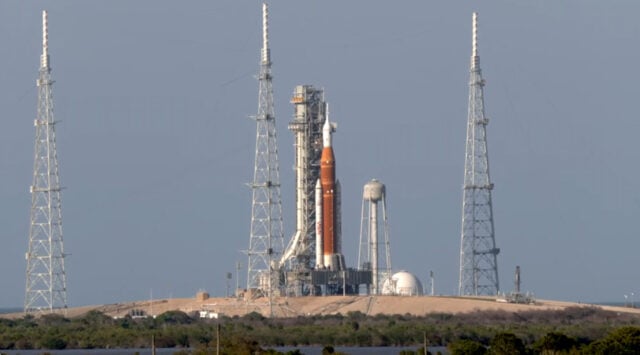
This evening, the marshy coast of Cape Canaveral will serve as the stage for a spectacle over half a century in the making. As the sun begins to set over the Florida horizon, the Space Launch System (SLS), the most powerful rocket ever successfully flown, will ignite its four RS-25 engines and twin solid rocket boosters, pushing the Orion spacecraft and its crew of four into the heavens. This mission, Artemis II, is not merely a flight; it is a declaration that humanity is no longer content to stay in low Earth orbit. We are going back to the Moon, and this time, we intend to stay.
The Weather: A “Go” for Liftoff
The anticipation surrounding the Artemis II launch has been matched only by the scrutiny of the Florida skies. NASA meteorologists and AccuWeather forecasters have been tracking a series of weather systems across the United States that threatened to interfere with the 6:24 p.m. EDT launch window. However, as of Tuesday, March 31, the outlook is overwhelmingly positive.
Forecasters currently predict an 80% chance of favorable weather conditions for the two-hour launch window. The primary concerns—cumulus clouds, thick cloud layers, and potential ground winds—appear to be dissipating or remaining within safety thresholds. While isolated showers have been noted in the central Florida region throughout the week, the risk of lightning or severe storms during the precise launch window remains low.
NASA’s criteria for a “Go” are stringent. Beyond the launch pad, teams must also consider the weather in the “abort zones” across the Atlantic Ocean. Should the Orion spacecraft need to separate from the SLS during ascent, the crew must splash down in waters calm enough for recovery operations. Current reports indicate that these trans-Atlantic conditions are also cooperating, providing the mission management team with the confidence needed to proceed with the countdown.

The Crew: Four Pioneers for a New Era
The Artemis II crew represents a deliberate shift in the demographic of lunar explorers. Unlike the Apollo era, which featured a narrow selection of male military test pilots, the Artemis generation is built on a foundation of diversity and international cooperation.
Commander Reid Wiseman (NASA): A veteran of the U.S. Navy and the International Space Station (ISS), Wiseman brings a wealth of leadership to the mission. Having spent 165 days in space during a 2014 mission, he is known for his calm demeanor and technical expertise. As the mission commander, Wiseman is responsible for the overall success of the flight and the safety of his crew.
Pilot Victor Glover (NASA): Glover, a naval aviator and former pilot of the SpaceX Crew-1 mission, will become the first person of color to travel to the vicinity of the Moon. His experience piloting the first commercial crew vehicle to the ISS makes him uniquely qualified to handle the controls of the Orion spacecraft. Glover has often spoken about the “heavy” responsibility of representing humanity’s progress on such a global stage.
Mission Specialist Christina Koch (NASA): Koch holds the record for the longest single spaceflight by a woman. An electrical engineer by training, she has completed six spacewalks and spent 328 days on the ISS. On Artemis II, she will become the first woman to venture into deep space, shattering one of the most enduring glass ceilings in the history of exploration.
Mission Specialist Jeremy Hansen (Canadian Space Agency): In a historic first for international relations, Hansen will be the first non-American to leave Earth’s orbit. A colonel in the Royal Canadian Air Force, Hansen’s inclusion highlights the “Artemis Accords,” a set of principles designed to guide sustainable space exploration through global partnership.
The Rocket: The Space Launch System (SLS)
Standing 322 feet tall, the SLS is a behemoth of modern engineering. While it shares some DNA with the Saturn V and the Space Shuttle, it is a vastly different machine. The Block 1 configuration used for Artemis II produces 8.8 million pounds of thrust at liftoff—15% more than the legendary Saturn V.
The core stage, a towering 212-foot orange cylinder, houses the liquid hydrogen and liquid oxygen tanks that fuel the four RS-25 engines. These engines are heritage hardware, many of which previously flew on Space Shuttle missions. They have been upgraded with new controllers and insulation to handle the higher pressures and temperatures required for lunar trajectories.
Flanking the core stage are two five-segment Solid Rocket Boosters (SRBs). These boosters provide over 75% of the initial thrust required to break the bonds of Earth’s gravity. Unlike the shuttle boosters, which had four segments, these five-segment versions are the largest and most powerful solid-propellant motors ever built for flight.
The Spacecraft: Orion and the European Service Module
Atop the SLS sits the Orion Multi-Purpose Crew Vehicle. Orion is designed to keep astronauts alive for weeks in the harsh radiation environment of deep space. It consists of two primary components: the Crew Module and the European Service Module (ESM).
The Crew Module, built by Lockheed Martin, is the pressurized habitat where the four astronauts will live and work. It is 16.5 feet in diameter, providing about 316 cubic feet of habitable space. While this may sound cramped for a 10-day mission, it is significantly larger than the Apollo Command Module. It features “glass cockpit” displays, advanced life-support systems, and a reinforced heat shield designed to withstand the 5,000-degree Fahrenheit temperatures of re-entry.
The ESM, provided by the European Space Agency (ESA) and built by Airbus, is the “powerhouse” of the spacecraft. It provides propulsion, power through its four solar wings, and life-support consumables like water and oxygen. The partnership with ESA marks the first time NASA has relied on an international partner for a critical mission-critical component of a human spacecraft.
The 10-Day Mission Profile
The Artemis II mission is a complex “High Earth Orbit” (HEO) demonstration. It is designed to test the spacecraft’s systems in stages before committing the crew to the moon.
Launch and Earth Orbit (Day 1): After reaching orbit, the crew will remain attached to the Interim Cryogenic Propulsion Stage (ICPS). They will spend approximately 24 hours in a highly elliptical Earth orbit. During this time, they will perform “proximity operations,” using the ICPS as a target to practice docking maneuvers. This is critical for future missions where Orion must dock with the Lunar Gateway or a HLS (Human Landing System) lander.
Trans-Lunar Injection (Day 2): Once all systems are verified, the ESM will fire its main engine for the Trans-Lunar Injection (TLI) burn. This maneuver will propel Orion out of Earth orbit and onto a trajectory toward the Moon.
The Journey Out (Days 3–5): As the crew travels the 240,000 miles to the Moon, they will conduct science experiments and test the spacecraft’s radiation shielding. They will also be the first humans to see the Earth recede into a small blue marble with their own eyes since 1972.
The Lunar Flyby (Day 6): Artemis II will use a “free-return trajectory.” The spacecraft will not enter lunar orbit; instead, it will use the Moon’s gravity to slingshot back toward Earth. At its closest point, the crew will be roughly 4,600 miles above the lunar surface. They will also travel approximately 5,000 miles beyond the far side of the Moon, further into deep space than any human has ever traveled.
The Return Trip (Days 7–9): After the flyby, the crew will begin the three-day journey home. This phase is largely passive, but the astronauts will spend time photographing the lunar far side and preparing for the high-speed re-entry.
Re-entry and Splashdown (Day 10): Orion will hit the Earth’s atmosphere at 25,000 miles per hour. The heat shield will bear the brunt of the friction, slowing the capsule down until its parachutes can deploy. The mission concludes with a splashdown in the Pacific Ocean, off the coast of San Diego, where U.S. Navy recovery teams will be waiting.
Lessons from Artemis I: Fixing the Heat Shield
One of the most critical aspects of Artemis II is the validation of the heat shield. Following the uncrewed Artemis I mission in 2022, engineers discovered that the “Avcoat” ablative material on the heat shield had charred and chipped away in a manner slightly different than predicted. While the spacecraft remained safe, NASA spent years analyzing the data to ensure the Artemis II crew would be protected.
The re-entry for Artemis II has been slightly modified to mitigate heat exposure, and the manufacturing process for the shield was refined. This mission is the ultimate test of those refinements. Success here is the “green light” for Artemis III, the mission that will actually land humans on the surface.
The “Artemis Generation” and the Path to Mars
The significance of Artemis II cannot be overstated. Since the end of the Apollo program, human spaceflight has been confined to Low Earth Orbit—a distance of only about 250 miles above the surface. Artemis II takes us nearly a thousand times further.
The goal of the Artemis program is not just to plant flags and leave footprints. NASA aims to establish a “sustained presence” on the Moon. This includes the construction of the Lunar Gateway—a small space station in lunar orbit—and the development of the Artemis Base Camp at the lunar South Pole.
The South Pole is of particular interest because of its “permanently shadowed regions,” which are believed to contain water ice. This ice is more than just a source of water for astronauts; it can be broken down into hydrogen and oxygen to create rocket fuel. By learning to “live off the land” on the Moon, NASA is practicing the skills necessary for the eventual human exploration of Mars.
A Global Endeavor
As we stand on the precipice of this launch, it is important to recognize the global effort involved. More than 3,000 companies across all 50 U.S. states and multiple European countries have contributed to the SLS and Orion. The Canadian Space Agency’s contribution of Jeremy Hansen and future robotic arms (Canadarm3) ensures that the lunar frontier is an international one.
The Artemis Accords, now signed by dozens of nations, provide a legal and ethical framework for this new era. They emphasize transparency, the peaceful exploration of space, and the sharing of scientific data. In a world often divided by terrestrial politics, the Moon remains a beacon of potential unity.
Conclusion: The Countdown to History
As the clock ticks down toward 6:24 p.m. tomorrow, the world’s eyes are on Launch Pad 39B. The weather is holding, the hardware is proven, and the crew is ready. Artemis II is the bridge between the glory of our past and the infinite potential of our future. When the SLS clears the tower, it will carry more than just four astronauts; it will carry the dreams of a generation that has waited too long to look at the Moon and see a destination rather than just a light in the sky.
Tomorrow, we go.
Sources Used and Links
- AccuWeather: “Artemis II: Weather ‘go’ for historic moon launch” – https://www.accuweather.com/en/space-news/artemis-ii-weather-go-for-historic-moon-launch/1877569
- NASA: “Artemis II Mission Overview” – https://www.nasa.gov/artemis-ii
- Space.com: “Here’s what the Artemis 2 astronauts will be doing on each day of NASA’s historic moon mission” – https://www.space.com/space-exploration/missions/artemis-2-breakdown-what-to-expect-from-each-day-of-nasas-historic-moon-mission
- Kennedy Space Center: “Artemis II – The First Crewed Mission” – https://www.kennedyspacecenter.com/landing-pages/artemis-ii/
- NASA Reference: “SLS (Space Launch System) RS-25 Core Stage Engine” – https://www.nasa.gov/reference/space-launch-system-rs-25-core-stage-engine/
- International Business Times (AU): “10 Key Facts About Artemis II Crew Ahead of Historic Moon Mission” – https://www.ibtimes.com.au/10-key-facts-about-artemis-ii-crew-ahead-historic-moon-mission-1864927
- KSL News: “NASA is shooting for the moon. A guide to the Artemis II mission” – https://www.ksl.com/article/51475423/nasa-is-shooting-for-the-moon-a-guide-to-the-artemis-ii-mission
- Wikipedia: “Orion (spacecraft) Technical Specifications” – https://en.wikipedia.org/wiki/Orion_(spacecraft)
- Navy.mil: “Naval Postgraduate School Alumni Lead NASA’s Artemis II Moon Mission” – https://www.navy.mil/Press-Office/News-Stories/display-news/Article/4443068/naval-postgraduate-school-alumni-lead-nasas-artemis-ii-moon-mission/
Disclaimer
Artificial Intelligence Disclosure & Legal Disclaimer
AI Content Policy.
To provide our readers with timely and comprehensive coverage, South Florida Reporter uses artificial intelligence (AI) to assist in producing certain articles and visual content.
Articles: AI may be used to assist in research, structural drafting, or data analysis. All AI-assisted text is reviewed and edited by our team to ensure accuracy and adherence to our editorial standards.
Images: Any imagery generated or significantly altered by AI is clearly marked with a disclaimer or watermark to distinguish it from traditional photography or editorial illustrations.
General Disclaimer
The information contained in South Florida Reporter is for general information purposes only.
South Florida Reporter assumes no responsibility for errors or omissions in the contents of the Service. In no event shall South Florida Reporter be liable for any special, direct, indirect, consequential, or incidental damages or any damages whatsoever, whether in an action of contract, negligence or other tort, arising out of or in connection with the use of the Service or the contents of the Service.
The Company reserves the right to make additions, deletions, or modifications to the contents of the Service at any time without prior notice. The Company does not warrant that the Service is free of viruses or other harmful components.