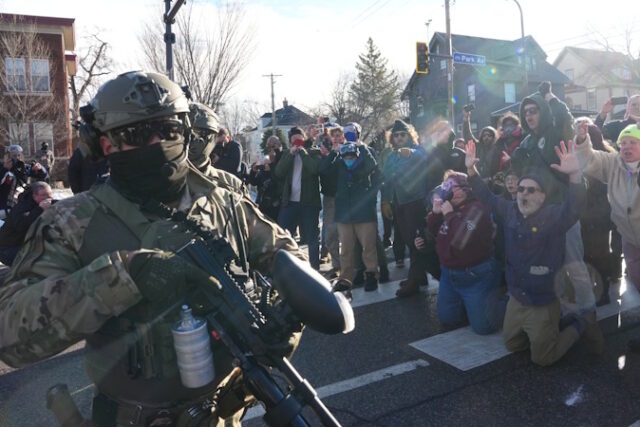
The Insurrection Act of 1807 is not a single law, but a collection of statutes—codified today as 10 U.S.C. §§ 251–255—that grants the President of the United States the extraordinary power to deploy the military domestically. While the Posse Comitatus Act of 1878 generally prohibits federal troops from acting as domestic law enforcement, the Insurrection Act serves as the primary statutory exception to that rule
Evolution of the Power
The Act’s roots date back to the Militia Acts of 1792, which President George Washington used to suppress the Whiskey Rebellion. At that time, the law required a federal judge to first certify that the situation was beyond the control of local authorities.
In 1807, at the request of Thomas Jefferson (who was concerned about the “Burr Conspiracy”), Congress expanded this authority. The new legislation allowed the President to use the regular U.S. Army and Navy, rather than just state militias, to put down domestic uprisings. By 1861, Abraham Lincoln further expanded the Act to wage the Civil War, and in 1871, Ulysses S. Grant used the “Ku Klux Klan Act” (now Section 253) to crush white supremacist terrorism in the South without state consent.
The Three Triggers for Deployment
Under current law, there are three primary legal pathways for a President to invoke the Act:

- Section 251 (State Request): The President may deploy troops if a state legislature or governor specifically requests help to suppress an insurrection. This is the most common use of the Act (e.g., the 1992 L.A. Riots).
- Section 252 (Federal Law Enforcement): The President can act unilaterally if “unlawful obstructions” or “rebellions” make it “impracticable” to enforce federal law through ordinary judicial proceedings.
- Section 253 (Constitutional Rights): Known as the “Civil Rights” provision, this allows the President to intervene without state consent to suppress “any insurrection, domestic violence, or unlawful combination” that deprives citizens of their constitutional rights, particularly when state authorities are “unable, fail, or refuse” to protect them.
Modern Precedents and Limits
The use of the Act without state consent is exceedingly rare. The most famous modern examples occurred during the Civil Rights Movement:
- 1957: President Eisenhower deployed the 101st Airborne to Little Rock, Arkansas, to enforce school integration after the Governor used the National Guard to block Black students.
- 1962/1963: President Kennedy used federal troops to integrate the Universities of Mississippi and Alabama.
- 1965: President Johnson federalized the Alabama National Guard to protect marchers in Selma after the state failed to do so.
Since 1965, the Act has only been used at the request of a governor, most recently in 1992 during the Los Angeles Riots.
While the Supreme Court ruled in Martin v. Mott (1827) that the President has broad discretion to decide when an emergency exists, later rulings like Sterling v. Constantin (1932) suggest that once troops are deployed, their specific actions remain subject to judicial review to ensure they do not violate the Bill of Rights.
Sources and References
- Brennan Center for Justice: The Insurrection Act, Explained https://www.brennancenter.org/our-work/research-reports/insurrection-act-explained
- National Defense University (NDU) Press: Calling Forth the Military: A Brief History of the Insurrection Act https://ndupress.ndu.edu/Media/News/News-Article-View/Article/2421411/calling-forth-the-military-a-brief-history-of-the-insurrection-act/
- Congressional Research Service (CRS): Defense Primer: Legal Authorities for the Use of Military Forces https://www.congress.gov/crs-product/IF10539
- PBS NewsHour: What is the Insurrection Act? History and Usage https://www.pbs.org/newshour/politics/what-is-the-insurrection-act-heres-what-trump-has-said-about-using-it
- Lawfare: How the Insurrection Act Limits Domestic Deployments https://www.lawfaremedia.org/article/how-the-insurrection-act-(properly-understood)-limits-domestic-deployments-of-the-u.s.-military
- Supreme Court of the United States: Trump v. Illinois (December 2025 Ruling) https://www.supremecourt.gov/opinions/25pdf/25a443_new_b07d.pdf
Disclaimer
Artificial Intelligence Disclosure & Legal Disclaimer
AI Content Policy.
To provide our readers with timely and comprehensive coverage, South Florida Reporter uses artificial intelligence (AI) to assist in producing certain articles and visual content.
Articles: AI may be used to assist in research, structural drafting, or data analysis. All AI-assisted text is reviewed and edited by our team to ensure accuracy and adherence to our editorial standards.
Images: Any imagery generated or significantly altered by AI is clearly marked with a disclaimer or watermark to distinguish it from traditional photography or editorial illustrations.
General Disclaimer
The information contained in South Florida Reporter is for general information purposes only.
South Florida Reporter assumes no responsibility for errors or omissions in the contents of the Service. In no event shall South Florida Reporter be liable for any special, direct, indirect, consequential, or incidental damages or any damages whatsoever, whether in an action of contract, negligence or other tort, arising out of or in connection with the use of the Service or the contents of the Service.
The Company reserves the right to make additions, deletions, or modifications to the contents of the Service at any time without prior notice. The Company does not warrant that the Service is free of viruses or other harmful components.