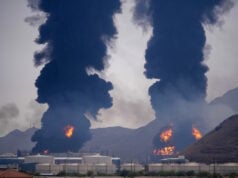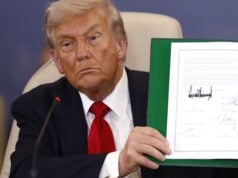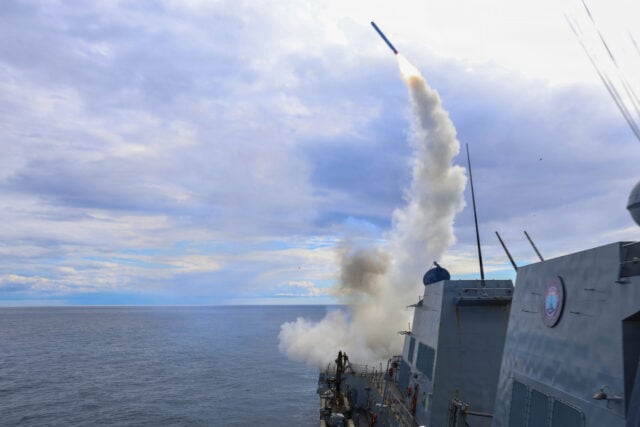
On March 2, 2026, the geopolitical landscape of the Middle East underwent its most significant shift in decades. Following a weekend of escalating tensions, President Donald Trump, in coordination with Israeli Defense Forces (IDF), authorized “Operation Epic Fury.” This massive military campaign, characterized by the administration as a “decisive mission” rather than an “endless war,” has targeted Iran’s nuclear infrastructure, ballistic missile sites, and senior Islamic Revolutionary Guard Corps (IRGC) leadership.
As the Secretary of War stated this morning, U.S. forces are hitting Iran surgically, overwhelmingly, and unapologetically. Operation Epic Fury is laser-focused on destroying Iranian offensive missiles. pic.twitter.com/0mwRSOPwUb
— U.S. Central Command (@CENTCOM) March 3, 2026
Operation Epic Fury involves the largest regional concentration of American military firepower in a generation. pic.twitter.com/YB8HRsBS3n
— U.S. Central Command (@CENTCOM) March 2, 2026
The Administration’s Stance
President Trump, communicating via recorded video messages and social media, asserted that the strikes were a necessary response to “imminent threats” from the Iranian regime. “The hour for your freedom is at hand,” Trump told the Iranian people in a Truth Social video, urging them to take over their government once the operation concludes. He stated that the US objective is to eliminate the nuclear threat and dismantle Iran’s missile stockpile and naval capabilities.
Secretary of State Marco Rubio defended the operation’s necessity, even as some intelligence officials suggested there was no specific imminent strike planned by Iran against the U.S. Rubio emphasized that the regime’s “stalling” during recent negotiations required a firm response. He addressed reports of civilian casualties—including a strike on a girls’ school in Minab—by stating that while such outcomes are “tragic,” the United States “will not deliberately target a school.”

Defense Secretary Pete Hegseth provided a stern briefing from the Pentagon, insisting that this is “not Iraq” and “not endless.” He emphasized that the mission has a “clear, devastating, decisive” goal: to destroy the missile threat, the Iranian navy, and ensure “no nukes.” Hegseth signaled a departure from “nation-building” and instead characterized the conflict as “retribution” for decades of Iranian aggression.
General Dan Caine, Chairman of the Joint Chiefs of Staff, warned that the operation “will not be a single overnight operation” and would involve “difficult and gritty work.” Caine confirmed that additional military personnel and tactical aviation assets are flowing into the theater. He somberly noted that the U.S. has already confirmed six service member deaths and expects to take “additional losses” as the campaign progresses.
Congressional Reaction: A House Divided
The strikes have ignited a firestorm on Capitol Hill, splitting both parties along interventionist and isolationist lines.
- Speaker Mike Johnson (R-LA): Praised the President’s “difficult decision,” arguing that limiting Trump’s authority via the War Powers Act during this time would be “dangerous.”
- Senator Tim Kaine (D-VA): Labeled the strikes a “unilateral escalation” and is partnering with Senator Rand Paul (R-KY) to author a War Powers Resolution. Kaine demands an immediate vote, arguing that Congress must opine on whether the U.S. enters another Middle Eastern war.
- Rep. Ro Khanna (D-CA) & Rep. Thomas Massie (R-KY): Are leading the charge in the House, predicting a “very close” vote on their own resolution to halt unauthorized military action.
- Senator Mark Warner (D-VA): Expressed skepticism regarding the “imminent threat” justification, stating there was a threat to Israel but not necessarily an imminent one to the U.S. mainland.
Economic Fallout: Markets and Commodities
The outbreak of open hostilities has caused immediate and severe volatility in global markets.
- Oil and Gas: Brent crude prices jumped by more than 10%, surging past $80 per barrel. Analysts warn that a prolonged conflict could push prices toward $100.
- Strait of Hormuz: Tanker traffic has effectively come to a halt in the Strait, a chokepoint for 20% of global oil. Shipping companies and insurers are refusing passage after multiple vessels were hit.
- Natural Gas: European gas prices surged over 20% to their highest levels since 2022 after QatarEnergy was forced to halt production following a drone attack attributed to Iran.
- Gasoline: U.S. retail gasoline prices are projected to rise by 10 to 30 cents per gallon in the coming days, with some regional spikes reaching much higher levels.
Critical Warning to Americans in the Middle East
The U.S. State Department has issued its highest-level warning, Level 4: Do Not Travel, for Iran and Iraq. Furthermore, Assistant Secretary Mora Namdar issued an urgent “DEPART NOW” order for Americans in over a dozen Middle Eastern nations, including Israel, Jordan, Lebanon, Kuwait, and the UAE.
“U.S. citizens in the region should shelter in place if they cannot find immediate commercial transportation out. The risk of retaliatory strikes on civilian infrastructure and U.S. military targets remains extreme.” — U.S. State Department Security Alert, March 2, 2026
Sources and Links
- PBS News: “Hegseth insists the Iran conflict is ‘not Iraq’ and is ‘not endless’.” Link
- The White House: “President Trump Launches Operation Epic Fury to Crush Iranian Regime.” Link
- The Jerusalem Post: “Pete Hegseth: US strikes on Iran won’t lead to endless war.” Link
- Military Times: “Additional troops to deploy as Gen. Caine says to expect ‘additional losses’.” Link
- The Guardian: “How escalating Iran conflict is driving up oil and gas prices.” Link
- The Times of Israel: “US State Department urges Americans to immediately leave over a dozen Mideast nations.” Link
- Politifact: “US attacks in Iran prompt renewed push in Congress over war powers.” Link
- NPR/TPR: “Hegseth: ‘We didn’t start this war but under President Trump we’re finishing it’.” Link
Disclaimer
Artificial Intelligence Disclosure & Legal Disclaimer
AI Content Policy.
To provide our readers with timely and comprehensive coverage, South Florida Reporter uses artificial intelligence (AI) to assist in producing certain articles and visual content.
Articles: AI may be used to assist in research, structural drafting, or data analysis. All AI-assisted text is reviewed and edited by our team to ensure accuracy and adherence to our editorial standards.
Images: Any imagery generated or significantly altered by AI is clearly marked with a disclaimer or watermark to distinguish it from traditional photography or editorial illustrations.
General Disclaimer
The information contained in South Florida Reporter is for general information purposes only.
South Florida Reporter assumes no responsibility for errors or omissions in the contents of the Service. In no event shall South Florida Reporter be liable for any special, direct, indirect, consequential, or incidental damages or any damages whatsoever, whether in an action of contract, negligence or other tort, arising out of or in connection with the use of the Service or the contents of the Service.
The Company reserves the right to make additions, deletions, or modifications to the contents of the Service at any time without prior notice. The Company does not warrant that the Service is free of viruses or other harmful components.