

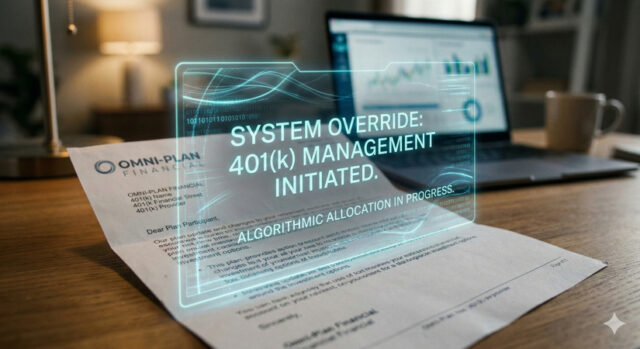
The American retirement dream has long been anchored by the 401(k)—a steady, predictable vehicle for building wealth over decades. However, as we move further into 2026, a new force is beginning to rattle the foundations of traditional financial planning. In a recent analysis, Forbes contributor William Baldwin issued a stark “Warning: AI Is Coming For Your 401(k),” signaling a paradigm shift in how individual investors must view their portfolios, tax liabilities, and career longevity.
For decades, the standard advice was simple: automate your contributions, pick a low-cost target-date fund, and let the compounding interest of the S&P 500 do the heavy lifting. But as artificial intelligence permeates every sector of the global economy, the “set it and forget it” era of retirement planning is facing an existential threat. The disruption is three-pronged, affecting the stocks we own, the jobs that fund our accounts, and the very tax structures that make 401(k)s attractive.
The Valuation Volatility
The first and most visible impact is within the equity markets. Artificial intelligence is no longer a speculative “tech” sector; it is the infrastructure of the modern economy. While this has led to meteoric rises for “Magnificent Seven” staples and specialized chipmakers, it has also created a top-heavy market. Many 401(k) plans are heavily weighted in broad-market index funds that are now dominated by a handful of AI-driven companies.
Forbes highlights that this concentration creates a “winner-take-all” dynamic that may not bode well for the diversification traditionally sought in retirement accounts. If the AI bubble—or at least the “valuation fever”—were to cool, the impact on 401(k) balances would be disproportionately severe. Investors who believe they are “diversified” may actually be hyper-exposed to the fortunes of a few algorithmic breakthroughs.

The Displacement Dilemma
Beyond the ticker symbols, the most personal threat AI poses to your 401(k) is its impact on your ability to contribute to it. A 401(k) is a tool of the employed. As Baldwin notes, the “silicon squeeze” is increasingly moving up the value chain. It isn’t just manufacturing or data entry at risk; high-skill professions—legal researchers, financial analysts, and middle management—are seeing their roles automated or “augmented” to the point where headcount is reduced.
When a 45-year-old professional is displaced by an AI system, the loss isn’t just their current salary; it is the “lost decade” of 401(k) contributions and employer matches. The compounding effect of missing even five years of contributions in the peak of one’s earning years can result in a six-figure deficit by age 65. AI is shortening the “earnings window” for many Americans, necessitating a more aggressive savings rate earlier in life than previous generations required.
Tax Code Turbulence
Perhaps the most complex warning involves the intersection of AI and taxation. In his Forbes column, Baldwin—an expert at the crossroads of taxation and portfolio management—suggests that the massive productivity gains (and subsequent wealth concentration) driven by AI are putting pressure on the federal government to find new revenue streams.
With AI-driven automation potentially shrinking the traditional payroll tax base, there is growing legislative chatter about “robot taxes” or shifts toward wealth-based taxation. For the 401(k) holder, this creates uncertainty. The “deferred” part of a tax-deferred account assumes that future tax rates will be manageable. However, if the government must pivot its tax strategy to account for an AI-dominated economy, the tax bite on those withdrawals 20 years from now could be significantly sharper than today’s rates.
The Rise of the “Algorithmic Advisor”
It isn’t all gloom, however. The same technology that threatens traditional roles is also democratizing sophisticated wealth management. We are seeing the rise of AI-driven portfolio optimizers that can perform tax-loss harvesting and “location optimization” (placing high-growth assets in Roth accounts vs. traditional 401(k)s) with a precision that human advisors once reserved for ultra-high-net-worth clients.
The “warning” issued by Forbes is not a call to abandon the 401(k), but rather a directive to modernize it. Baldwin suggests that investors can no longer rely on 20th-century assumptions. Modern savers need to consider:
- Hyper-Diversification: Moving beyond market-cap-weighted indexes that are over-concentrated in AI to include more value-oriented and international assets.
- The Roth Pivot: Given the uncertainty of future tax regimes in an AI-shifted economy, paying taxes now (via Roth 401(k) contributions) may be a hedge against future “wealth taxes.”
- Human Capital Hedging: Investing in “AI-resilient” skills to ensure the income stream that feeds the 401(k) remains uninterrupted.
Conclusion: Adapting to the New Reality
As we look toward the remainder of 2026, the message is clear: the machines are not just changing how we work; they are changing how we retire. The “Warning” from Forbes serves as a necessary wake-up call for the American worker.
The 401(k) remains a powerful tool, but in the age of artificial intelligence, it requires an active pilot, not an autopilot. By acknowledging the risks of market concentration, the reality of job displacement, and the potential for tax shifts, investors can insulate their golden years from the silicon storm. The future belongs to those who see the AI wave coming and adjust their sails, rather than those who wait for the tide to pull them under.
Source: Forbes
Disclaimer
Artificial Intelligence Disclosure & Legal Disclaimer
AI Content Policy.
To provide our readers with timely and comprehensive coverage, South Florida Reporter uses artificial intelligence (AI) to assist in producing certain articles and visual content.
Articles: AI may be used to assist in research, structural drafting, or data analysis. All AI-assisted text is reviewed and edited by our team to ensure accuracy and adherence to our editorial standards.
Images: Any imagery generated or significantly altered by AI is clearly marked with a disclaimer or watermark to distinguish it from traditional photography or editorial illustrations.
General Disclaimer
The information contained in South Florida Reporter is for general information purposes only.
South Florida Reporter assumes no responsibility for errors or omissions in the contents of the Service. In no event shall South Florida Reporter be liable for any special, direct, indirect, consequential, or incidental damages or any damages whatsoever, whether in an action of contract, negligence or other tort, arising out of or in connection with the use of the Service or the contents of the Service.
The Company reserves the right to make additions, deletions, or modifications to the contents of the Service at any time without prior notice. The Company does not warrant that the Service is free of viruses or other harmful components.









 models, requiring immediate adjustments to long-term savings strategies.)