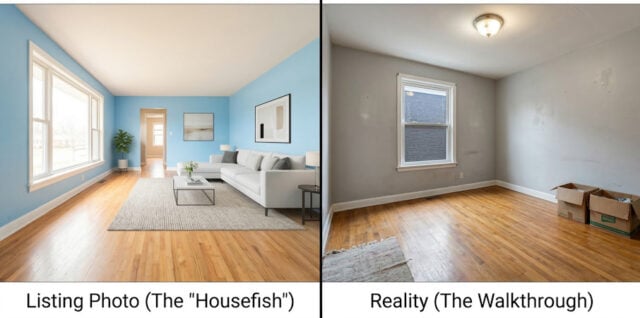
In the era of digital real estate, the first showing doesn’t happen at the front door; it happens on a smartphone screen. With a simple swipe, prospective buyers can tour a Victorian mansion in Maine or a sleek condo in San Diego. This convenience has birthed a phenomenon known as “housefishing.”
Much like “catfishing” in the world of online dating—where a person creates a false identity to lure others into a relationship—housefishing involves real estate agents or sellers using deceptive digital tactics to make a property appear significantly more attractive, spacious, or modern than it actually is. For homeowners and buyers alike, understanding this term is essential for navigating a 2026 market where “what you see” is rarely “what you get.”
Defining Housefishing: The Anatomy of a Digital Lure
At its core, housefishing is the strategic use of photography and digital manipulation to hide a home’s flaws. It goes beyond “staging” or “curb appeal.” Staging involves rearranging furniture to show a room’s potential; housefishing involves using software or misleading camera techniques to create a reality that does not exist.
Common tactics include:

- Extreme Wide-Angle Lenses: While standard in real estate to capture an entire room, extreme fish-eye or wide-angle lenses can make a cramped 10×10 bedroom look like a sprawling master suite.
- Virtual Staging Overload: High-end CGI furniture is added to empty rooms. While legal, it becomes “housefishing” when it obscures structural damage, water stains, or awkward layouts that wouldn’t accommodate actual furniture.
- Aggressive Color Correction & “Sky Replacement”: Using AI to turn a grey, overcast day into a vibrant sunset is common. However, when editors use these tools to brighten dingy walls or digitally “paint” a house a different color, they cross the line into deception.
- The “Omission” Angle: Photographers may carefully crop out the high-voltage power lines directly behind the backyard or the dilapidated neighboring property.
Why Housefishing is Trending in 2026
The prevalence of housefishing has surged due to the “Sight Unseen” culture. In competitive markets, many buyers—particularly investors and those relocating across the country—are making offers based solely on 3D tours and high-resolution galleries.
Sellers are under immense pressure to stand out in an increasingly crowded digital marketplace. As AI-powered photo editing tools like “Nano Banana 2” and other generative models become more accessible to the average homeowner, the barrier to entry for “polishing” a listing has dropped to nearly zero. What used to require a professional Photoshop expert can now be done with a “one-tap” enhancement feature on a mobile app.
The Consequences for Homeowners
For the seller, housefishing can be a double-edged sword. While it might drive a record number of clicks and initial tours, the “vibe shift” that occurs when a buyer walks into a disappointing reality can kill a deal instantly. Buyers who feel deceived are more likely to be hyper-critical during the inspection phase or walk away entirely out of a lack of trust.
For the buyer, the risks are more financial. Housefishing can lead to:
- Emotional Fatigue: Spending weekends visiting homes that look nothing like their photos leads to “buyer burnout.”
- Overpricing: Bidding wars can start over a “digitally perfected” home, leading the winner to pay a premium for a property that requires immediate, expensive cosmetic or structural repairs.
- Wasted Due Diligence Fees: In many states, once an offer is accepted, the buyer pays for inspections and appraisals. Discovering that a house was “fished” only after paying $500–$1,000 for an inspection is a costly lesson.
The Expert “Housefish” Detection Checklist
Before you get in the car or sign a contract, use this systematic checklist to audit any online listing. If a property triggers more than three of these “red flags,” proceed with extreme caution.
1. The Architectural Integrity Check
- Door and Window Alignment: Look at the vertical lines of door frames and windows. Do they bow outward? If so, an ultra-wide-angle lens was used to create an artificial sense of volume.
- Floor-to-Ceiling Ratio: Does the ceiling look unnaturally high compared to the height of the door? This is a common byproduct of digital stretching.
- Consistency of Light: Is the light coming through the window the same “temperature” (cool vs. warm) as the shadows in the room? Mismatched lighting usually indicates a “sky replacement” or a digitally brightened interior.
2. The Contextual Audit
- The “Missing” 180-Degree View: Does the gallery show the same three corners of a room while completely ignoring the fourth? That fourth corner often houses a massive radiator, a structural crack, or a poorly placed electrical panel.
- Satellite Verification: Open a satellite map and look at the roof. If the listing photos show a pristine lawn but the satellite shows a dirt patch or a massive commercial HVAC unit next door, you’ve been “fished.”
- Street View Comparison: Does the house number on the physical building match the listing? Check the age of the Street View image; if the house looks significantly worse in a three-year-old Google image than it does in the “new” listing, ask for the date the photos were taken.
3. The Digital Furniture Test
- Shadow Physics: Look at the “feet” of the furniture. Do they cast a realistic shadow on the floor? Virtually staged furniture often looks like it is “floating” or has perfectly uniform shadows that don’t match the overhead lighting.
- Proportions: Does the dining table look like it could actually fit eight people, or is the “staged” table actually the size of a coffee table to make the room look larger? Compare the furniture to the size of standard electrical outlets on the wall.
The Ethics of Modern Marketing
The real estate industry is currently grappling with where to draw the line. While “beautifying” a product is standard in every industry—from fast food to fashion—a home is the most significant investment a person will ever make.
Some real estate boards are beginning to mandate “Watermark Disclosure” for virtually staged images, requiring agents to clearly label photos that have been digitally altered. However, many “housefishing” techniques, like clever cropping or lighting, remain entirely unregulated. This puts the burden of truth squarely on the consumer.
The Long-Term Impact on Market Value
When housefishing becomes the norm, it creates a “trust tax” on the entire market. Buyers become more cynical, requiring more proof of condition before making offers, which slows down the transaction cycle. For homeowners, the best way to avoid being accused of housefishing is transparency. High-quality photography that highlights genuine beauty—rather than fabricated perfection—builds the trust necessary to close a deal quickly and at a fair price.
Conclusion: Trust, but Verify
In 2026, the digital storefront of a home is a curated gallery, not a literal reflection of reality. For homeowners looking to sell, the best strategy is enhanced honesty: use high-quality photos that highlight the home’s best features without erasing its character. For buyers, the mantra remains “trust, but verify.” Use the digital listing as a filter, but let the physical walkthrough be the final judge.
By understanding the tactics of housefishing, you can navigate the real estate market with your eyes wide open, ensuring that the dream home you see online is the same one you’ll actually be living in for years to come.
Sources
- National Association of Realtors (NAR): Guidance on the ethical use of virtual staging and digital manipulation in real estate photography. https://www.nar.realtor/
- Zillow Research: Trends in “sight unseen” home buying and the impact of high-quality photography on listing engagement. https://www.zillow.com/research/
- Redfin News: Analysis of how AI-powered photo editing tools are changing buyer expectations in 2026. https://www.redfin.com/news/
- Federal Trade Commission (FTC): General guidelines on deceptive advertising and consumer protection in digital marketplaces. https://www.ftc.gov/
- The New York Times Real Estate: Feature articles on the rise of “digital curb appeal” and its pitfalls. https://www.nytimes.com/section/realestate
- Forbes Real Estate: The impact of AI and generative imagery on property valuations and buyer trust. https://www.forbes.com/real-estate/
Disclaimer
Artificial Intelligence Disclosure & Legal Disclaimer
AI Content Policy.
To provide our readers with timely and comprehensive coverage, South Florida Reporter uses artificial intelligence (AI) to assist in producing certain articles and visual content.
Articles: AI may be used to assist in research, structural drafting, or data analysis. All AI-assisted text is reviewed and edited by our team to ensure accuracy and adherence to our editorial standards.
Images: Any imagery generated or significantly altered by AI is clearly marked with a disclaimer or watermark to distinguish it from traditional photography or editorial illustrations.
General Disclaimer
The information contained in South Florida Reporter is for general information purposes only.
South Florida Reporter assumes no responsibility for errors or omissions in the contents of the Service. In no event shall South Florida Reporter be liable for any special, direct, indirect, consequential, or incidental damages or any damages whatsoever, whether in an action of contract, negligence or other tort, arising out of or in connection with the use of the Service or the contents of the Service.
The Company reserves the right to make additions, deletions, or modifications to the contents of the Service at any time without prior notice. The Company does not warrant that the Service is free of viruses or other harmful components.