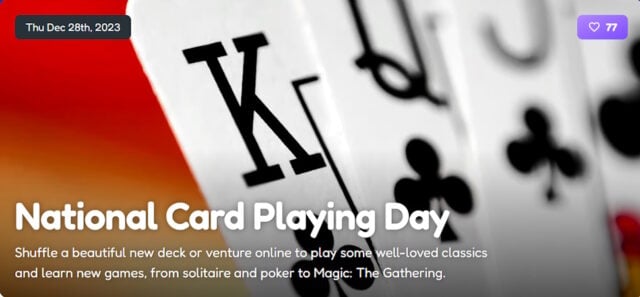
National Card Playing Day on December 28th encourages us to invite our friends to deal out a hand and play a game or two.
- 9th century – The Chinese began developing card games using money and other paper objects. These early playing cards bear no resemblance to the sturdier European playing cards that emerged a few centuries later.
- 1450 – Between 1418 and 1450, card makers in Augsburg, Nuremberg, and Ulm began making printed decks, allowing people to purchase packs of cards for the first time.
- 1470 – The oldest deck of cards in the world is the 15th-century Flemish Hunting Deck.
- 15th Century – The images found on most modern decks of cards can be attributed to French playing card creators in the 15th century. These card makers were the first to split a deck into red and black colors and implement the recognizable Clubs, Hearts, Spades, and Diamonds suits.
- 1628 – Playing cards hit the big time in 1628 with the founding of the Worshipful Company of Makers of Playing Cards. The organization, established by royal Charter, represented people across the industry. It was considered so important that even the king was involved!
- 18th Century – the ruling classes in France and England began cashing in on the surging popularity of playing cards by placing a tax on every deck of cards produced. To prove the tax was paid, each Ace of Spades would need to receive a special stamp.
- 1800s – Poker, as we know it today, begins to form in America as ‘poque’.
- 1828 – The English took this a step further by making manufacturers purchase a special Ace of Spades. These unique cards would generally be printed with lavish designs and the manufacturer’s name, a tradition that continues to this day—particularly in the custom playing card community.
- In an attempt to evade taxes, many would try to play card games without an Ace of Spades—eventually giving life to the popular phrase “not playing with a full deck.”
- Card games spread around the world in a variety of shapes and styles. From the elaborate Mamluk designs of Egypt to the appearance of the first playing cards during the Early Renaissance in Europe, the decks were divided into four suits of coins, cups, swords, and sticks or batons.
- It is from these four suits that today’s modern decks of playing cards developed. Theories range how the suits converted to hearts, spades, diamonds and clubs. One theory suggests the suits represent the different classes of the era – clergy, aristocracy, military, and peasantry.
- 2006 – The biggest poker tournament at the World Series of Poker (WSOP) takes place.
- In India, the ten-suited card game of Ganjifa became popular during the Moghul period. Traditionally, artists hand-painted a stunning scene on each of the 120 cards in the deck.
- Some of the top card games include Spades, Poker, Solitaire, Spite and Malice, Hearts, Spoons, Gin Rummy, Ridge, Black Jack, and Texas Hold’em. Of course, there are thousands of card games, some of which are regional favorites.
- A card sharp, or the more modern variation of card shark, describes a skilled or deceptive card player. They may use sleight of hand or other methods of cheating to win a game.
- The United States Playing Card Company (and the maker of Bicycle brand playing cards) is the largest playing card maker in the world.
- Sin City (Las Vegas) uses approximately 27 million decks every year.
- In an average year, the USPCC manufactures over 100,000,000 decks of cards! That equates to almost two decks of cards for every American child every single year!
- One of the most interesting facts about playing cards is undoubtedly its uncanny connections to a calendar year. While some scholars believe this is pure coincidence, others think that the standard deck of cards was intentionally crafted to symbolize a year of our lives.
- 2 Colors: The red and black suits are believed to represent day and night.
- 4 Suits: The four suits symbolize the four seasons: spring, summer, fall, and winter
- 13 Values: Within each suit is 13 values (Ace through King), just like there are roughly 13 lunar cycles in a year or 13 weeks in a quarter.
- 12 Court Cards: There are 12 Court Cards in a deck of cards and 12 months in a year.
- 52 Cards: Just like there are 52 weeks in a year, there are 52 cards in a deck.
- The King of Hearts is the only king without a mustache and is the only king with a sword through his head, otherwise known as the “Suicide King”.
- The Face Cards (King, Queen & Jack) are referred to as the “Court”.
- If you add up all the cards in a deck, starting with the Ace as 1 and the King as 13, you’ll get 364. Add in 1 Joker and that’s 365, or the number of days in a year. Add in the other Joker and you can even account for a leap year.
- There are more possible ways to shuffle a deck of cards than there are atoms that make up Earth.
- The math behind this is pretty easy to understand. It’s simply 52 factorial (52 x 51 x 50, and so on, all the way down to x 4 x 3 x 2 x 1.). If you do the math, you’ll end up with an 8 followed by 67 zeroes.
- Every time you pick up a shuffled deck of playing cards, it’s almost guaranteed that the exact order of the playing cards is one that’s never existed before. In fact, you could change the arrangement of the cards every second and it would still take you over a million years to achieve all the combinations.
- If you perform eight perfect Faro Out-Shuffles—a special shuffle where the cards are interwoven together one card at a time and the original top and bottom card remain in place—the deck will return to the order it started in. You can see someone accomplish this impressive feat in a video clip here.
- The French also modeled the Court Cards after noteworthy figures from history like Julius Caesar (King of Diamonds), Charlemagne (King of Hearts), King David from the Holy Bible (King of Spades) and Alexander the Great (King of Clubs).
- Contrary to popular belief, the Queen of Hearts is not supposed to be Queen Elizabeth I. Despite their striking resemblance, this design was crafted long before Elizabeth’s birth in 1533. All of the Queens actually have ancient inspiration, with the Queen of Hearts being based on a biblical figure named Judith.
- While we are all familiar with the jack, queen, and king cards, did you know that each of these faces represents a famous historical figure?
- King Charlemagne is said to be seen on the hearts card,
- King David on the spade,
- Cesar on the diamonds card, and
- Alexander the Great on the clubs.
- The queen cards are also said to be famous people as well.
- The queen of spades represents Athena,
- the biblical figure Judith is seen on the hearts card,
- Rachel from the bible is seen on the diamonds card, and
- Argine (Latin for queen) is depicted on the clubs’ card.
- During World War II, the United States government explored innovative methods to assist its soldiers who were in enemy prisoner-of-war camps.
- One ingenious way that they used was to send out specially designed playing cards. When the POW carefully peeled the backs off these cards, a map detailing an escape route would be printed inside, giving the prisoners important information on how they could attempt to flee their captors.
- Did you know that there is a hidden number eight somewhere within your deck of cards, and it is very likely that you have never noticed it before? If you look closely at the 8 of Diamonds, you may just be able to see it. Stare at the center of the card and allow your eyes to blur slightly. Within the card’s white space, you will see the number eight form. All of the points and edges of the diamonds come together perfectly to create this hidden number that so few know about.
- Research shows that card games are powerful brain stimulants and promote mental well-being.
- Casinos in Las Vegas sell or discard cards within 12 hours of use.
Sources:

Disclaimer
Artificial Intelligence Disclosure & Legal Disclaimer
AI Content Policy.
To provide our readers with timely and comprehensive coverage, South Florida Reporter uses artificial intelligence (AI) to assist in producing certain articles and visual content.
Articles: AI may be used to assist in research, structural drafting, or data analysis. All AI-assisted text is reviewed and edited by our team to ensure accuracy and adherence to our editorial standards.
Images: Any imagery generated or significantly altered by AI is clearly marked with a disclaimer or watermark to distinguish it from traditional photography or editorial illustrations.
General Disclaimer
The information contained in South Florida Reporter is for general information purposes only.
South Florida Reporter assumes no responsibility for errors or omissions in the contents of the Service. In no event shall South Florida Reporter be liable for any special, direct, indirect, consequential, or incidental damages or any damages whatsoever, whether in an action of contract, negligence or other tort, arising out of or in connection with the use of the Service or the contents of the Service.
The Company reserves the right to make additions, deletions, or modifications to the contents of the Service at any time without prior notice. The Company does not warrant that the Service is free of viruses or other harmful components.