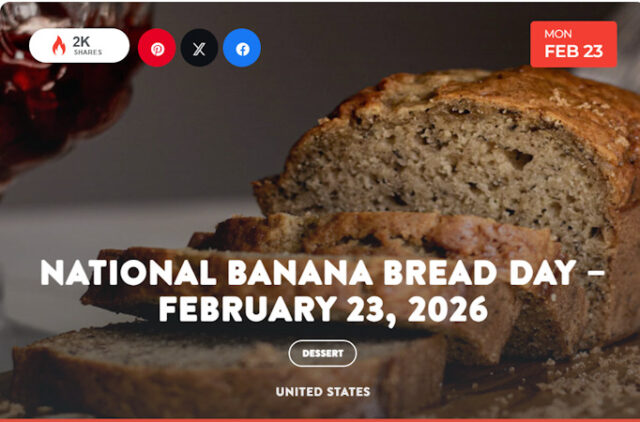
National Banana Bread Day celebrates a perfect pairing of fruit plus bread. Admit it, few things are quite as comforting as walking into the house and smelling a freshly baked loaf of banana bread. It’s certainly a dessert staple in many households, which is probably why so many of us have such a special place in our hearts for this delicious treat. The best things in life deserve an entire day devoted to celebrating their existence.
- 8000 BC – Possibly the world’s first cultivated fruit, bananas were likely domesticated during this era by people in Southeast Asia.
- 327 BC – When Alexander the Great takes his army to India, he discovers crops of bananas in the Indian Valley. From this trip, bananas make their way back to the Western world
- 1870 – The United States saw the arrival of bananas in the 1870′s, but it took a while before they appeared as an ingredient in desserts.
- 1893 – Due to the growing popularity of quick-rise items like baking soda and baking powder, Banana Bread (and other quick breads) became popular around this time. The first recipe is published in the St. Louis Post-Dispatch, but uses banana flour instead of fresh bananas.
- 1900s – Thanks to the invention of refrigeration techniques, transporting bananas to the U.S. became much easier.
- 1918 – Closer along the lines to what is called Banana Bread now, The Garden Island Paper publishes a recipe by Mrs. Dean. It still does not exactly reflect what is to come, as it contains cornmeal, but it’s moving in the right direction.
- 1927 – Unifruit (a wholesale produce company) offered a free cookbook called From the Tropics to Your Table, full of banana recipes, including banana muffins and breads.
- 1929 – Money was so tight during the Great Depression that people refused to throw away rotten food, thus ushering in the era of overly ripe bananas in banana bread.
- 1933- With the popularization of baking soda and baking powder, banana bread first became a standard feature of American cookbooks and appeared in Pillsbury’s 1933 Balanced Recipes cookbook.
- 1930s – The Unifruit cookbook was handy during the Great Depression. Throwing out overripe bananas was not something a family could afford.
- 1950 – Banana bread later gained further acceptance with the release of the original Chiquita Banana’s Recipe Book in 1950.
- 2024 – Banana bread was far and away the most-searched recipe in the United States; every single month, roughly 1 in 500 Americans searches for a banana bread recipe.
- Bananas contain naturally occurring radioactive isotopes, particularly potassium-40 (40K), one of several potassium isotopes.
- There are many different variations of the traditional banana bread, a few of which include Banana raisin bread – Banana nut bread – Chocolate chip banana bread.
- Banana trees are considered giant herbs, not ‘trees’ at all.
- A cluster of bananas is known as a hand, each banana are fingers.
- Rubbing the inside of a banana peel on bug bites is said to relieve itching and inflammation.
- Over 95% of American households purchase bananas at least once a month.
- Bananas are one of the only fruits harvested every day of the year. They do not grow in regions that have dramatic seasonal changes.
- Thanks to its star ingredient, banana bread helps normalize blood pressure and regulate heart function due to potassium.
- It’s estimated that the average American eats around 30 pounds of bananas per year!
- Due to the high potassium content, bananas have a slight amount of radioactivity.
Sources:
My Great Recipes

All Spice Online
Disclaimer
Artificial Intelligence Disclosure & Legal Disclaimer
AI Content Policy.
To provide our readers with timely and comprehensive coverage, South Florida Reporter uses artificial intelligence (AI) to assist in producing certain articles and visual content.
Articles: AI may be used to assist in research, structural drafting, or data analysis. All AI-assisted text is reviewed and edited by our team to ensure accuracy and adherence to our editorial standards.
Images: Any imagery generated or significantly altered by AI is clearly marked with a disclaimer or watermark to distinguish it from traditional photography or editorial illustrations.
General Disclaimer
The information contained in South Florida Reporter is for general information purposes only.
South Florida Reporter assumes no responsibility for errors or omissions in the contents of the Service. In no event shall South Florida Reporter be liable for any special, direct, indirect, consequential, or incidental damages or any damages whatsoever, whether in an action of contract, negligence or other tort, arising out of or in connection with the use of the Service or the contents of the Service.
The Company reserves the right to make additions, deletions, or modifications to the contents of the Service at any time without prior notice. The Company does not warrant that the Service is free of viruses or other harmful components.