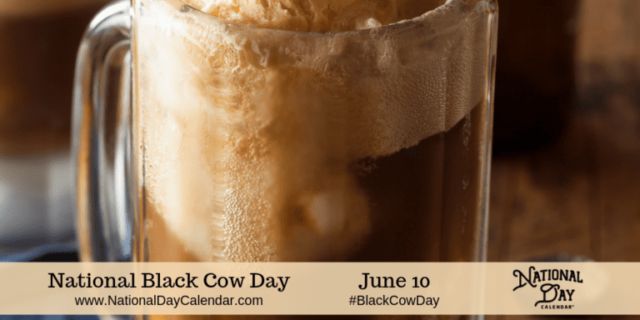
National Black Cow Day is observed each year on June 10. Are you in the mood for ice cream? We are all familiar with the Root Beer Float but did you know that it is also called the Black Cow?
- A Black Cow was originally made with root beer and vanilla ice cream. Now it is sometimes made with root beer and chocolate ice cream or cola and vanilla ice cream.
- Frank J. Wisner of Cripple Creek, Colorado, gets the credit for inventing the Black Cow way back in August of 1893.
- The full moon that night that was shining on the snow-capped Cow Mountain reminded him of a scoop of vanilla ice cream. He hurried back to his bar and added a spoonful of the creamy vanilla goodness to the children’s favorite flavor of soda, Myers Avenue Red Root Beer.
- Wisner named the new creation, Black Cow Mountain but the local children shortened the name to Black Cow.
- In 1960 safrole, the oily liquid extracted from the root-bark of sassafras plants and a key root beer ingredient, was banned by the U.S. Food and Drug Administration as a likely carcinogen.
- Both Benjamin Franklin and George Washington were fans of small beer, the precursor to root beer.
- Charles E. Hires was the first person to produce and market root beer throughout the United States.
- By 1876 Hires had changed the name of his beverage to Hires Root Beer, and he presented the drink at the Philadelphia Centennial Exhibition, celebrating America’s 100th birthday.
- In the 1880s, Hires began giving away trading cards with his root beer.
- In 1895 the Women’s Christian Temperance Union called for a nationwide bar of Hires Root Beer on suspicion that the soda contained alcohol. Their ban lasted for three years. Charles E. Hires, who did not drink alcohol, had an independent lab test his root beer’s alcohol content. The results presented in 1898 found that Hires Root Beer had the same alcohol content as half a loaf of bread.
- A&W is the number one selling brand of root beer in America.
- Roy Allen purchased the root beer formula for A&W root beer from an Arizona Pharmacist. The first batch was made in June of 1919.
- By 1960 there were more than 2000 A&W restaurants, more than the number of McDonald’s restaurants which existed at that time.
- According to A&W, the shelf life for its root beer in glass and cans is 39 weeks, 13 weeks for root beer in plastic bottles, and 13 weeks for all diet products.
- In 1927 John and Alice Marriott purchased an A&W franchise in Washington, D.C. The Marriott named their root beer restaurant The Hot Shoppe. Their restaurant expanded, and eventually led to the creation of Marriott Hotels.
- The Sonic chain of drive-in restaurants began as a hamburger and root beer stand in Shawnee, Oklahoma, in 1953.
- The first ice-cream soda was sold in 1874.
- The first patent for a glass blowing machine used to produce glass battles was issued in 1899.
- A different root beer float origin story attributes the dessert’s invention to Robert Green, a Philadelphian who replaced sweet cream with ice cream in soda water in the 1870s.
- A brown cow, which is a variation on a root beer float that uses chocolate ice cream instead of vanilla, is perfect for chocolate lovers.
Sources:

Disclaimer
Artificial Intelligence Disclosure & Legal Disclaimer
AI Content Policy.
To provide our readers with timely and comprehensive coverage, South Florida Reporter uses artificial intelligence (AI) to assist in producing certain articles and visual content.
Articles: AI may be used to assist in research, structural drafting, or data analysis. All AI-assisted text is reviewed and edited by our team to ensure accuracy and adherence to our editorial standards.
Images: Any imagery generated or significantly altered by AI is clearly marked with a disclaimer or watermark to distinguish it from traditional photography or editorial illustrations.
General Disclaimer
The information contained in South Florida Reporter is for general information purposes only.
South Florida Reporter assumes no responsibility for errors or omissions in the contents of the Service. In no event shall South Florida Reporter be liable for any special, direct, indirect, consequential, or incidental damages or any damages whatsoever, whether in an action of contract, negligence or other tort, arising out of or in connection with the use of the Service or the contents of the Service.
The Company reserves the right to make additions, deletions, or modifications to the contents of the Service at any time without prior notice. The Company does not warrant that the Service is free of viruses or other harmful components.