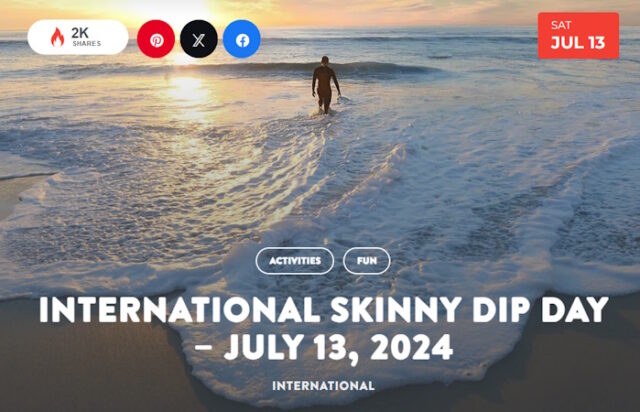
Long before we started celebrating International Skinny Dip Day, which takes place on July 13 this year, swimming in the nude was a thing. Even more noteworthy, people like Benjamin Franklin, Henry David Thoreau and Walt Whitman took part at a time when just the thought of swimming in the nude was considered uncouth and shameful. Back then, they didn’t even have a catchy name for it.
It wasn’t until 1947 that the phrase ‘skinny dip’ was first documented or uttered. Today, if you were at a party with friends, no one would react if someone suggested skinny dipping.
- 1819 – John Quincy Adams is famous for having skinny-dipped. Swimming was his primary source of exercise, as he explained in an 1819 diary entry. As was standard practice at the time, he left his clothing on a nearby rock, skinny dipping in the Potomac.
- 1885 – Thomas Eakins portrayed group skinny-dipping in his 1885 work “The Swimming Hole.”
- 1931 – Nudist clubs and societies gather in Germany to form an international nudist organization.
- 1940s – The term “skinny dip” is said to have originated somewhere in the 1940s – 1960s. The Merriam-Webster Dictionary says the first known use was in 1964.
- 1947 – For the first time in history, the term ‘skinny dip’ is recorded in the English language.
- 1947 – The ‘Free Beach’ movement starts in California, encouraging people to be nude there.
- 1954 – an article in Sheboygan, Wisconsin noted how 404 boys were “unhampered by bathing suits.”
- 1976 – a “meeting of the minds” took place in Los Angeles, between body-positivity trailblazers: Lee Baxandall (founder of The Naturist Society) and Eugene Callen (founder of Beachfront USA). According to The Naturist Society, “Both realized that to make steady inroads on the American public’s view of beach nudity, public relations and the media must be used to good effect. To that end, the two men developed the idea for a National Nude Weekend to be held each year in July by all interested groups.”
- 1986 – Women protest in New York over the issue of going topless in public.
- 1992 – The Naturist Society oversaw the expansion of the Weekend into a seven day Nude Recreation Week.
- 2000s – the American Association for Nude Recreation (AANR) began promoting skinny dipping on the Saturday of Nude Recreation Week.
- 2018 – The American Association for Nude Recreation hosts the first skinny dipping event.
- 2018 – The largest skinny dip gathering in 2018 in Ireland had 2,505 at Meaghermore Beach.
- A survey by “MissTravel” showed that more than 70% of travelers have gone skinny-dipping, while 38% have been seen doing it. Many people choose to go skinny dipping in the dark or secluded locations.
- It makes you stronger. A quick 15-minute dip where the sun can cover every inch of your skin can boost your immunity.
- British beaches allow nudity. You can swim at a beach of your choice in the buff in the U.K., as long as you follow the rules.
- More skin is exposed to sunlight and therefore, more Vitamin D.
- Swimming naked eliminates soggy, scratchy, or cold material sticking to your skin.
- Naked skin dries much quicker.
- In the early 50s, some YMCAs of Midwestern America enthusiastically promoted the skinny dip idea. The American Public Health Association even had an actual mandate about nekkid swimming from 1926 to 1962.
- “Skinny dip” means to swim in the nude… from the allusion of stripping down to one’s bare skin, rather than having anything to do with being skinny as in thin. (According to Idiom Origins)
Sources:

Disclaimer
Artificial Intelligence Disclosure & Legal Disclaimer
AI Content Policy.
To provide our readers with timely and comprehensive coverage, South Florida Reporter uses artificial intelligence (AI) to assist in producing certain articles and visual content.
Articles: AI may be used to assist in research, structural drafting, or data analysis. All AI-assisted text is reviewed and edited by our team to ensure accuracy and adherence to our editorial standards.
Images: Any imagery generated or significantly altered by AI is clearly marked with a disclaimer or watermark to distinguish it from traditional photography or editorial illustrations.
General Disclaimer
The information contained in South Florida Reporter is for general information purposes only.
South Florida Reporter assumes no responsibility for errors or omissions in the contents of the Service. In no event shall South Florida Reporter be liable for any special, direct, indirect, consequential, or incidental damages or any damages whatsoever, whether in an action of contract, negligence or other tort, arising out of or in connection with the use of the Service or the contents of the Service.
The Company reserves the right to make additions, deletions, or modifications to the contents of the Service at any time without prior notice. The Company does not warrant that the Service is free of viruses or other harmful components.