The Future of the US Dollar: Challenges, Risks, and the Rise of Alternatives
For nearly eight decades, the U.S. Dollar (USD) has reigned as the world’s undisputed reserve currency, providing the United States with what French officials famously termed “exorbitant privilege.” This status has allowed the U.S. to borrow cheaply, print the global medium of exchange, and wield financial sanctions as a primary tool of foreign policy.
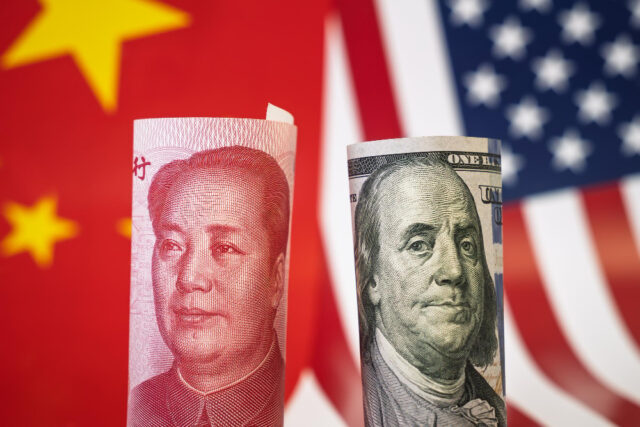
However, as of January 2026, the landscape is shifting. A combination of domestic fiscal volatility, a massive expansion of sovereign debt, and a concerted global push for “de-dollarization” has moved from the realm of fringe theory to a tangible market reality. While the dollar remains the most liquid and widely used currency, its share of global reserves has slipped from over 70% in 2001 to approximately 58% today. The erosion is no longer just a possibility; it is a gradual, persistent process.
Fiscal Fault Lines: Debt, Deficits, and Tariffs
The primary driver of this erosion is found within America’s own borders. The U.S. national debt, which climbed past $37.6 trillion in late 2025, now costs the federal government over $200 billion annually just to service—accounting for nearly 17% of total federal spending.
- The Moody’s Signal: In May 2025, Moody’s Investors Service downgraded U.S. sovereign debt from Aaa to Aa1, citing “fiscal recklessness” and the persistence of substantial budget deficits.
- The Tariff Shock: The 2025 implementation of sweeping universal tariffs—reaching an average effective rate of 18.6% by August—marked the highest protectionist barrier since the 1930s. While these tariffs generated significant revenue ($146 billion in the first eight months of 2025), they simultaneously unsettled international markets.
By weaponizing trade through IEEPA (International Emergency Economic Powers Act) measures, the U.S. has inadvertently signaled to allies and adversaries alike that the dollar-centric system is subject to the whims of domestic political shifts. This has forced nations to accelerate their search for “neutral” alternatives.

The Strategic Shift to Gold and Digital Yuan
As the “There Is No Alternative” (TINA) narrative fades, several assets have stepped into the vacuum:
1. The Yuan’s Strategic Ascent
The Chinese Yuan (CNY) has seen a dramatic rise in trade settlement. As of November 2025, China settles over 30% of its total trade in its own currency, up from 20% just three years ago. The development of the Cross-Border Interbank Payment System (CIPS) and the digital yuan (e-CNY) has provided a “parallel pipe” that bypasses the Western-led SWIFT system, shielding trade partners from U.S. sanctions.
2. Gold: The Ultimate Safe Haven
Central banks have pivoted toward gold at a record pace. In 2025, the share of gold in official reserve assets more than doubled to over 23%. Unlike the dollar, gold carries no counterparty risk and cannot be “frozen” by a single government’s executive order.
3. The Euro and Regional Blocs
Despite internal challenges, the Euro remains the primary alternative for Western-aligned nations looking to diversify. Additionally, the BRICS+ expansion has fueled discussions of a common settlement unit backed by a basket of commodities, further fragmenting the dollar’s traditional domain.
Geopolitical Weaponization and the “Grey Economy”
The aggressive use of financial sanctions against Russia and other nations has backfired as a long-term strategy. By cutting off major economies from the dollar ecosystem, the U.S. has incentivized the creation of a “grey economy.”
This shadow financial system relies on decentralized finance (DeFi), cryptocurrencies, and bilateral currency swaps. As more economic activity shifts to these non-dollar rails, the Federal Reserve’s ability to influence global liquidity through interest rate hikes is fundamentally weakened.
The “Grand Rebalancing”
Economists at Goldman Sachs and Morgan Stanley have dubbed this era “The Great Rebalancing.” This does not imply a sudden collapse of the dollar—no other currency yet possesses the depth of the U.S. Treasury market—but it does suggest a “multipolar” future.
In this new order, the dollar will likely remain the first among equals, but it will no longer be the only option. For investors, this means a necessary shift toward currency diversification and a departure from the “U.S. Exceptionalism” that defined the last decade of portfolio management.
“The way world trade has operated for the past eighty years may be of little relevance to the future. All norms have been overthrown.” — Howard Marks, Co-Chairman of Oaktree Capital Management (2025)
Conclusion: A New Era of Fragmentation
The challenges facing the U.S. Dollar are structural, not cyclical. High debt, protectionist trade policies, and the “weaponization” of finance have created a self-fulfilling prophecy where the world seeks to reduce its reliance on the greenback. While the transition will be measured in years rather than days, the trend is clear: the era of unquestioned dollar dominance is fading, replaced by a fractured landscape in which gold, the yuan, and regional currencies are claiming their share of the global stage.
Sources and References
- Federal Reserve Board (July 18, 2025): The International Role of the U.S. Dollar – 2025 Edition
- Goldman Sachs Asset Management (June 24, 2025): US Dollar’s Shifting Landscape: From Dominance to Diversification
- Yale University – The Budget Lab (Sept 2, 2025): Short-Run Effects of 2025 Tariffs So Far
- University of Oxford (Nov 3, 2025): Is the dollar’s dominance crumbling? Expert Comment
- Cambridge University Press (Nov 20, 2025): Dollar Diminished: The Unmaking of US Financial Hegemony
- U.S. Treasury Fiscal Data (Jan 2026): Understanding the National Debt
- Blackwell Global (Dec 17, 2025): How China’s Rising Yuan Could Impact the USD
Disclaimer
Artificial Intelligence Disclosure & Legal Disclaimer
AI Content Policy.
To provide our readers with timely and comprehensive coverage, South Florida Reporter uses artificial intelligence (AI) to assist in producing certain articles and visual content.
Articles: AI may be used to assist in research, structural drafting, or data analysis. All AI-assisted text is reviewed and edited by our team to ensure accuracy and adherence to our editorial standards.
Images: Any imagery generated or significantly altered by AI is clearly marked with a disclaimer or watermark to distinguish it from traditional photography or editorial illustrations.
General Disclaimer
The information contained in South Florida Reporter is for general information purposes only.
South Florida Reporter assumes no responsibility for errors or omissions in the contents of the Service. In no event shall South Florida Reporter be liable for any special, direct, indirect, consequential, or incidental damages or any damages whatsoever, whether in an action of contract, negligence or other tort, arising out of or in connection with the use of the Service or the contents of the Service.
The Company reserves the right to make additions, deletions, or modifications to the contents of the Service at any time without prior notice. The Company does not warrant that the Service is free of viruses or other harmful components.