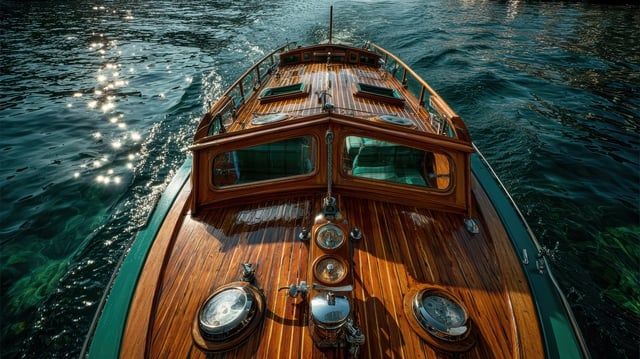
For decades, the deck of a multi-million dollar superyacht has been defined by one material: Tectona grandis, better known as Burmese teak. It is the gold standard of marine timber—velvety to the touch, naturally oily enough to resist rot, and possessed of a golden-brown hue that signifies ultimate luxury.
However, the “teak bridge” between the forests of Southeast Asia and the shipyards of Europe is collapsing. Yacht builders are currently ensnared in a complex web of geopolitical conflict, environmental degradation, and tightening international law that makes obtaining legal teak nearly impossible.
The Myanmar Monopoly
The heart of the problem lies in geography. While teak is grown in plantations across Africa and South America, “Old Growth” teak from Myanmar is unique. Because it grows slowly in natural forests, it possesses a tight grain and high silica content that plantation wood lacks. For a vessel exposed to salt spray, baking sun, and heavy foot traffic, plantation teak often warps or checks, whereas Burmese teak remains stable.
The crisis intensified following the February 2021 military coup in Myanmar. The state-owned Myanmar Timber Enterprise (MTE), which oversees all teak auctions, fell under the control of the military junta. This transformed a luxury commodity into “conflict timber.”

The Legal Tightrope
International regulators have moved aggressively to close the gates. The European Union Timber Regulation (EUTR) and the U.S. Lacey Act require “due diligence” to ensure timber isn’t illegally harvested. Since the coup, many Western authorities have argued that it is impossible to verify the legality of any wood coming from Myanmar.
- Sanctions: The U.S., UK, and EU have placed direct sanctions on the MTE.
- Seizures: In recent years, several high-profile shipments have been seized in ports like Rotterdam, leaving shipyards with empty warehouses and unfinished hulls.
- Reputational Risk: Owners of 100-meter “giga-yachts” are increasingly wary of the “blood teak” label. No billionaire wants their floating palace associated with the funding of a military regime.
The Search for Alternatives
With the supply of Burmese teak dwindling to a trickle of “pre-sanction” stockpiles, the industry is at a crossroads. Builders are experimenting with several paths:
- Composite and Synthetic Decking: Products like Esthec or Flexiteek offer durability and zero maintenance, though they lack the prestige and heat-dissipation qualities of real wood.
- Modified Woods: Materials like Accoya (acylated pine) or Kebony use chemical processes to make sustainable softwoods mimic the durability of hardwoods.
- Lignia: A resin-impregnated wood that was highly touted as a teak replacement, though its availability has fluctuated due to production challenges.
- Plantation Teak: While once dismissed, high-quality plantation teak from places like Costa Rica is being reconsidered, though it requires different cutting techniques to achieve the desired vertical grain.
The Future of the Foredeck
The yachting industry is notoriously traditional, but the teak crisis is forcing an evolution. Designers are now proposing “mixed-material” decks or “teak-free” zones to conserve what little high-grade timber remains. The days of wall-to-wall Burmese teak are likely over, replaced by a new era of sustainable luxury.
Sources and Links
- Environmental Investigation Agency (EIA): The Myanmar Timber Trade and Conflict
- SuperYacht Times: The Teak Shortage: What are the Alternatives?
- Justice For Myanmar: How Teak Pipelines Fund the Junta
- European Commission: Timber Regulation (EUTR) Guidance
- International Union for Conservation of Nature (IUCN): Red List of Threatened Species – Tectona grandis
- U.S. Department of the Treasury: Sanctions on Myanmar Timber Enterprise
Disclaimer
Artificial Intelligence Disclosure & Legal Disclaimer
AI Content Policy.
To provide our readers with timely and comprehensive coverage, South Florida Reporter uses artificial intelligence (AI) to assist in producing certain articles and visual content.
Articles: AI may be used to assist in research, structural drafting, or data analysis. All AI-assisted text is reviewed and edited by our team to ensure accuracy and adherence to our editorial standards.
Images: Any imagery generated or significantly altered by AI is clearly marked with a disclaimer or watermark to distinguish it from traditional photography or editorial illustrations.
General Disclaimer
The information contained in South Florida Reporter is for general information purposes only.
South Florida Reporter assumes no responsibility for errors or omissions in the contents of the Service. In no event shall South Florida Reporter be liable for any special, direct, indirect, consequential, or incidental damages or any damages whatsoever, whether in an action of contract, negligence or other tort, arising out of or in connection with the use of the Service or the contents of the Service.
The Company reserves the right to make additions, deletions, or modifications to the contents of the Service at any time without prior notice. The Company does not warrant that the Service is free of viruses or other harmful components.