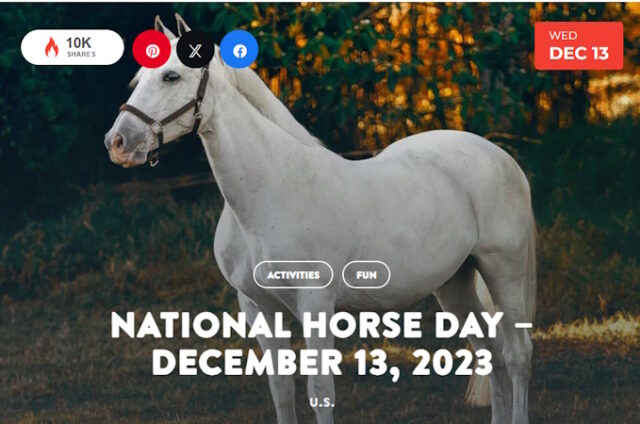
National Horse Day is celebrated every December 13. It’s a day to remember the economic, historic, and cultural contributions that horses have made. Equine enthusiasts across the country will get together on December 13 to show their appreciation for these majestic creatures. Whether you’re a seasoned rider or have never been on a horse in your life, check out some ways you can recognize the day!
- 5000 BC – The earliest evidence came from shin bones and bit gear found in Kazakhstan. By 3000 BC, domesticated horses were widespread.
- 1200 – They were well known for their speedy raids and horse-mounted archers. With the help of the horse, they were able to conquer much of the Asian continent.
- 1875 – May 17, The Kentucky Derby began. The horse Aristides, and his rider, Oliver Lewis, won the first ever Derby.
- 2018 – Equine specialists learned that horses see colors differently than humans. This information can be used to improve racecourse safety.
- How much horses contribute to the United States economy.
- 10.31 Conveniently and coincidentally, there’s 10.31 million horses in the United States. That means each horse contributes roughly one thousand dollars to the American economy every year
- Roughly 600 feral horses combined live on sparsely populated islands off the coast of Georgia and on North Carolina’s Outer Banks islands. Left centuries ago by settlers, these horses have flourished in these desolate lands.
- Scientists believe that horses have evolved from much smaller creatures over the past 50 years.
- It is believed that there are approximately 60 million horses around the world.
- there are more than 400 different horse breeds
- The quickest sprinting speed that has been recorded of a horse is 88 kph.
- Horses are capable of seeing almost 350 degrees at one time because their eyes are on the side of their head.
- Horses have larger eyes than any other type of mammal that is on the land.
- A 19th-century horse is said to have lived for 62 years; he was known as Old Billy. This is remarkable when you consider that domestic horses have a lifespan of approximately 25 years.
- Horses can sleep both standing up and lying down.
- It is thought that the first horses to be domesticated were in Asia between the years of 3000 and 4000 BC
- The earliest recorded member of the horse family is named Eohippus. The small ungulate lived 55 million years ago and stood only 10-17 inches tall.
- While you can’t tell the exact age of a horse by their teeth you can estimate their age.
- Appreciated by beginner riders and professional horsemen alike, the American Quarter Horse is the world’s most popular breed
- The standard measurement for determining the height of a horse is called a hand. One hand is equal to 4 inches. A pony is an equine under 14.2 hands. The only equines not measured in hands are miniature horses, which are measured in inches or centimeters.
- Horses Can Only Breathe Through Their Nose
- Horses with pink skin can get a sunburn.
- You can tell if a horse is cold by feeling behind their ears.
- Whinnying and neighing sounds are elicited when horses meet or leave each other.
- Stallions (adult male horses) perform loud roars as mating calls, and all horses will use snorts to alert others of potential danger.
- The first cloned horse was a Haflinger mare in Italy in 2003. Her name was Prometea.
- A fun horse fact is that horses are just that – funny! According to Dr. Sarah Ralston, VMD, PhD, DACVN, horses exhibit many “playful” behaviors throughout their life such as playing tag, mock fights, or nipping.
- The most expensive horse ever sold* was Fusaichi Pegasus. He was purchased for a staggering $70 million in 2000 by Coolmore Stud in Ireland.
- The horse trailer (“horse box”) was invented by Lord George Bentinck, a U.K. man who needed a more effective transport for getting his prize horse “Elis” from one racetrack to another.
- In 1872, Leland Stanford (1824-1893) made a bet that at some point in the gallop, all four of a horse’s legs were off the ground at the same time.
Sources:

Disclaimer
Artificial Intelligence Disclosure & Legal Disclaimer
AI Content Policy.
To provide our readers with timely and comprehensive coverage, South Florida Reporter uses artificial intelligence (AI) to assist in producing certain articles and visual content.
Articles: AI may be used to assist in research, structural drafting, or data analysis. All AI-assisted text is reviewed and edited by our team to ensure accuracy and adherence to our editorial standards.
Images: Any imagery generated or significantly altered by AI is clearly marked with a disclaimer or watermark to distinguish it from traditional photography or editorial illustrations.
General Disclaimer
The information contained in South Florida Reporter is for general information purposes only.
South Florida Reporter assumes no responsibility for errors or omissions in the contents of the Service. In no event shall South Florida Reporter be liable for any special, direct, indirect, consequential, or incidental damages or any damages whatsoever, whether in an action of contract, negligence or other tort, arising out of or in connection with the use of the Service or the contents of the Service.
The Company reserves the right to make additions, deletions, or modifications to the contents of the Service at any time without prior notice. The Company does not warrant that the Service is free of viruses or other harmful components.