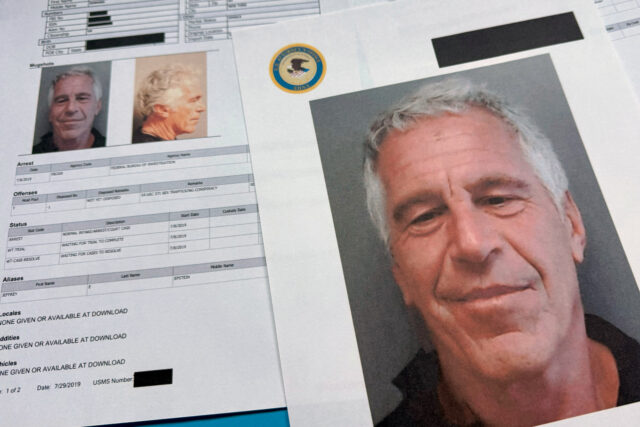
The saga of Jeffrey Epstein, the disgraced financier whose life and death have fueled a decade of conspiracy and legal battles, reached a chaotic fever pitch in early 2026. Following the passage of the Epstein Files Transparency Act in late 2025, the administration of President Donald Trump presided over the release of nearly 3.5 million pages of investigative material. However, what was promised as a “total declassification” has instead sparked a new firestorm of allegations regarding missing documents, selective redactions, and a Department of Justice (DOJ) accused of scrubbing files to protect the commander-in-chief.
The Great Release and the “Missing 53”
On January 30, 2026, the DOJ published a massive digital archive containing 3 million pages, 2,000 videos, and 180,000 images. Attorney General Pam Bondi and Deputy Attorney General Todd Blanche—both former personal attorneys for the President—framed the dump as a landmark in government transparency. Yet, within weeks, independent investigations and forensic digital analysis by organizations like NPR began to poke holes in the “complete” record.
An NPR investigation found that while the DOJ claimed full compliance, dozens of pages were cataloged but withheld. Specifically, researchers identified what is now called the “Missing 53”—a gap of 53 pages in FBI interview logs and notes. These missing documents appear to contain direct testimony from a woman who accused Donald Trump of sexual and physical assault when she was a minor in the early 1980s.
Direct Allegations Against Trump
While the DOJ insisted that missing files were merely duplicates or privileged, the content of the “gaps” has become the focal point of a congressional inquiry. According to a DOJ internal presentation from August 2025 titled “Prominent Names,” the withheld interviews detail an allegation that Epstein introduced the victim to Trump around 1983. The victim claimed Trump forced her to perform a sex act, and when she resisted, he allegedly punched her in the head.

While the DOJ published one interview with this woman from 2019 that did not mention the President, NPR discovered that at least three subsequent FBI interviews and accompanying notes—where the allegations against Trump were reportedly detailed—were excluded from the public database.
Administrative Shielding or Victim Privacy?
The Trump administration’s defense has been two-fold: legal necessity and the dismissal of “hoaxes.” Deputy Attorney General Todd Blanche insisted in February 2026 that no records were withheld for political sensitivity. Instead, the DOJ claims that any missing or temporarily removed files are the result of an ongoing review to protect victim identities or are part of “ongoing federal investigations.”
“By releasing thousands of pages of documents… and signing the Epstein Files Transparency Act, President Trump has done more for Epstein’s victims than anyone before him,” stated White House spokeswoman Abigail Jackson.
However, Representative Robert Garcia, the ranking Democrat on the House Oversight Committee, stated after reviewing unredacted logs that the DOJ “appears to have illegally withheld FBI interviews” with a survivor to protect the President. This perceived “weaponization” of transparency has led to calls for a federal judge to oversee the database personally, removing it from the hands of the executive branch.
The 6 Million Page Discrepancy
Perhaps the most significant “missing” element is the sheer volume of data. While the DOJ claims it has fulfilled its legal obligation with 3.5 million pages, its own internal memos from January 2026 identified over 6 million pages as potentially responsive to the Transparency Act. The DOJ argues the difference consists of duplicates and irrelevant materials, but critics note that the missing 2.5 million pages are currently classified as privileged under the “deliberative process” or “work-product” doctrines.
As the legal battles over the remaining pages move into the courts, the question remains: are the “missing” files a matter of bureaucratic caution, or are they the final shield for a President whose name appears in the unredacted master files over a million times?
Sources and Links
- NPR Investigative Report: Justice Department withheld and removed some Epstein files related to Trump (Feb 24, 2026)
- The Guardian Analysis: New Epstein files fail to quell outrage as advocates claim documents are being withheld (Feb 3, 2026)
- Times of Israel: US Justice Department withheld allegations against Trump from Epstein files, NPR finds (Feb 25, 2026)
- House Oversight Committee: Ranking Member Robert Garcia Statement on Withheld Epstein Files (Feb 24, 2026)
- Department of Justice (DOJ) Official Release: DOJ Publishes 3.5 Million Pages in Compliance with Epstein Files Transparency Act (Jan 30, 2026)
- Truthout News: New Report Indicates Trump-Linked Epstein Records Kept Out of DOJ Database (Feb 24, 2026)
Disclaimer
Artificial Intelligence Disclosure & Legal Disclaimer
AI Content Policy.
To provide our readers with timely and comprehensive coverage, South Florida Reporter uses artificial intelligence (AI) to assist in producing certain articles and visual content.
Articles: AI may be used to assist in research, structural drafting, or data analysis. All AI-assisted text is reviewed and edited by our team to ensure accuracy and adherence to our editorial standards.
Images: Any imagery generated or significantly altered by AI is clearly marked with a disclaimer or watermark to distinguish it from traditional photography or editorial illustrations.
General Disclaimer
The information contained in South Florida Reporter is for general information purposes only.
South Florida Reporter assumes no responsibility for errors or omissions in the contents of the Service. In no event shall South Florida Reporter be liable for any special, direct, indirect, consequential, or incidental damages or any damages whatsoever, whether in an action of contract, negligence or other tort, arising out of or in connection with the use of the Service or the contents of the Service.
The Company reserves the right to make additions, deletions, or modifications to the contents of the Service at any time without prior notice. The Company does not warrant that the Service is free of viruses or other harmful components.