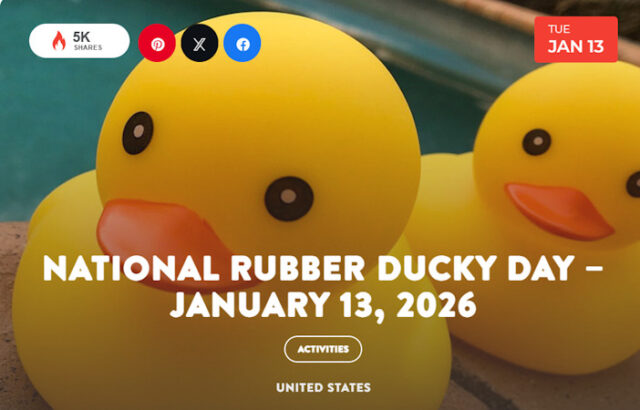
According to a 1973 Sesame Street calendar, Rubber Duckie’s Birthday is January 13th so around the country it’s National Rubber Ducky Day! A friend of Ernie and Big Bird, Duckie made his debut in a February 1970 episode.
- 1800s – The first rubber duckie was a chew toy.
- 1800s – Manufacturers used Charles Goodyear’s method to render rubber malleable.
- 19th Century – Rubber ducks weren’t initially bath toys. They emerged in the 19th century, when manufacturers experimented with rubber products such as tires and shoes. These early rubber duck toys weren’t designed to float. Instead, they were solid rubber, intended as chewable toys.
- 1928 – Landon Smart Lawrence received the earliest patent for a rubber duck toy. His clever design weighted the toy so that when it tipped, it returned to an upright position. The sketch included with the patent depicted a duck.
- 1940s – a marketing push linked rubber ducks with baths. Companies like Disney promoted Donald Duck bath toys, further strengthening the connection.
- 1970 – The Sesame Street Rubber Duckie song is the most popular Sesame Street song even today. It reached #16 on the Top 100 chart in 1970. The song was nominated for a Grammy Award. Since the Sesame Street crew can’t find a rubber duckie that makes the original squeak, the duck from 1970 is still used on recordings.
- 1992 – A cargo ship tipped over with 29,000 bathtub toys descending into the Pacific. Tracking their drift helped scientists study ocean currents and forecast storm patterns.
- 2001 – Sales of the iconic yellow rubber ducky we’ve come to know today soared in Britain in 2001. The British tabloid The Sun reported that Queen Elizabeth II had a rubber duck in her bathroom that wore an inflatable crown.
- 2007 – Dutch artist Florentijn Hofman created a 54-foot-tall rubber duck in 2007. His art piece toured major cities, symbolizing joy and unity. People loved it, and soon, other large rubber duck sculptures popped up worldwide, each attracting thousands of fans. These giant ducks highlight the simplicity of childhood joy on a massive, unforgettable scale.
- 2011 – Rubber ducks are collected by a small group of people, and the largest collection, as of 2011, was recognised by Guinness World Records, including 5631 unique ducks, owned by Charlotte Lee of the United States.
- 2013 – The rubber ducky became a Toy Hall of Fame inductee in 2013. Founded in 1998, the Hall of Fame has inducted only 52 other toys.
- Russian Sculptor Peter Ganine sculpted many animal figures. One, a duck, he later designed and patented as a floating toy that closely resembles the rubber ducky we are familiar with today.
- One popular myth claims that all rubber ducks are yellow. While yellow is the classic color, rubber ducks actually come in every shade imaginable. You’ll find them dressed as superheroes, historical figures, and even food items like burgers. There’s even a “Devil Duckie” edition, proving that rubber ducks are far more diverse than the yellow stereotype.
- In Tokyo, a pop-up museum once featured rubber ducks dressed as famous Japanese characters, adding a cultural twist.
- Rubber ducks are usually inexpensive, but a limited-edition rubber duck encrusted with Swarovski crystals sold for over $1,000.
Sources:

Disclaimer
Artificial Intelligence Disclosure & Legal Disclaimer
AI Content Policy.
To provide our readers with timely and comprehensive coverage, South Florida Reporter uses artificial intelligence (AI) to assist in producing certain articles and visual content.
Articles: AI may be used to assist in research, structural drafting, or data analysis. All AI-assisted text is reviewed and edited by our team to ensure accuracy and adherence to our editorial standards.
Images: Any imagery generated or significantly altered by AI is clearly marked with a disclaimer or watermark to distinguish it from traditional photography or editorial illustrations.
General Disclaimer
The information contained in South Florida Reporter is for general information purposes only.
South Florida Reporter assumes no responsibility for errors or omissions in the contents of the Service. In no event shall South Florida Reporter be liable for any special, direct, indirect, consequential, or incidental damages or any damages whatsoever, whether in an action of contract, negligence or other tort, arising out of or in connection with the use of the Service or the contents of the Service.
The Company reserves the right to make additions, deletions, or modifications to the contents of the Service at any time without prior notice. The Company does not warrant that the Service is free of viruses or other harmful components.