In the spring of 2026, the global financial landscape is no longer dominated solely by the hum of the New York Stock Exchange or the high-frequency algorithms of the NASDAQ. Instead, the world’s attention has shifted toward a more raw, visceral form of price discovery: the prediction market. What was once a niche hobby for “degens” and political junkies has exploded into a $20 billion-a-month juggernaut that is currently challenging the very foundations of how we perceive truth, probability, and the ethics of speculation.
From the front lines of the escalating U.S.-Iran conflict to the halls of Congress, prediction markets like Polymarket and Kalshi have become the “truth machines” of the modern era. However, this rise hasn’t been without its casualties. As of March 2026, the industry is caught in a pincer movement between explosive retail growth and a sudden, aggressive crackdown from state and federal lawmakers.
The $20 Billion Surge: Prediction Markets as the New Macro Indicator
The trajectory of prediction markets over the last twelve months is nothing short of vertical. In early 2025, monthly transaction volumes hovered around a respectable $1.2 billion. By January 2026, that figure surpassed $20 billion, driven by a user base that had tripled to over 840,000 unique active wallets.
The catalyst for this hypergrowth was two-fold: the integration of event contracts into mainstream brokerage platforms like Robinhood—which brought prediction markets to 27 million funded accounts—and the increasing unreliability of traditional polling and expert analysis during a period of extreme global volatility. When experts were divided on the likelihood of a U.S. airstrike or a sudden shift in Fed policy, the “wisdom of the crowd” provided a real-time, financially backed probability that often proved more accurate than any think tank report.

Wagering on the Fog of War: Iran and Troop Movements
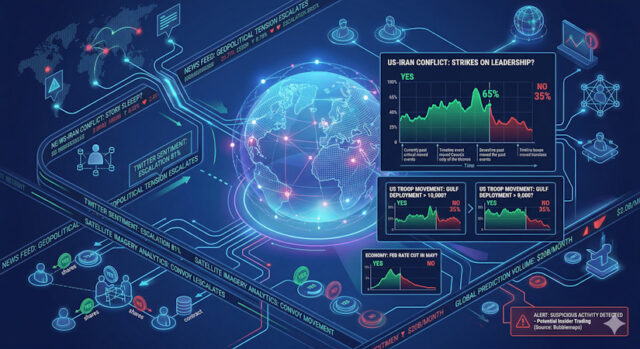
Nothing has highlighted the power—and the controversy—of these platforms more than the current geopolitical tension in the Middle East. In early 2026, markets tied to “Operation Epic Fury” and potential U.S. strikes against Iranian leadership became the most liquid contracts in the sector’s history.
On Polymarket, the contract “Will the US officially declare war on Iran?” reached over $73 million in volume by February. Traders weren’t just betting on broad outcomes; they were speculating on the minutiae of military strategy:
- US Troop Movements: Contracts tracking whether the U.S. would deploy more than 10,000 additional troops to the Persian Gulf by the end of March 2026.
- Targeted Strikes: Bets on the survival of specific high-ranking Iranian officials, with single-day volumes on these “death markets” occasionally exceeding $400 million.
- Strait of Hormuz: Real-time odds on whether Iran would attempt a total blockade, which fluctuated wildly based on satellite imagery and leaked diplomatic cables.
The efficiency of these markets has created a surreal reality where military families and defense contractors check Polymarket odds to gauge the likelihood of their loved ones being deployed. The markets have become so predictive that they are now integrated into Bloomberg terminals, used by hedge funds to hedge against “kinetic” risks that traditional insurance cannot cover.
The “Magamyman” Scandal and Insider Trading
With high stakes comes high temptation. The success of these markets has been marred by allegations of a new kind of “front-running.” In March 2026, a digital gambler known as “Magamyman” successfully netted $600,000 by betting on a U.S. strike against Iranian leadership just hours before the missiles were launched.
Blockchain analytics firm Bubblemaps identified clusters of wallets that showed a 93% win rate on geopolitical military operations. These wallets, often funded from the same sources, would buy “Yes” shares at 20 cents when the market thought an event was unlikely, only for the event to occur hours later. This has led to a growing consensus that defense contractors, government officials, or intelligence officers may be using their privileged access to profit from the very conflicts they are managing.
The Legal Battlefront: Arizona’s Criminal Charges
As the markets grow, so does the regulatory pushback. In a landmark move on March 17, 2026, Arizona Attorney General Kris Mayes filed criminal charges against KalshiEX LLC. This represents the first time a CFTC-registered prediction market has faced criminal prosecution in the United States.
Arizona’s argument is simple: these aren’t “derivatives” or “hedging instruments”; they are illegal gambling. The state’s 20-count indictment includes charges for “election wagering” and “unlawful betting” on sports and military outcomes. This has sparked a massive jurisdictional war between state gaming commissions and the federal Commodity Futures Trading Commission (CFTC).
While federal courts in Tennessee have granted injunctions to protect Kalshi—arguing that federal law preempts state gambling rules—other states like Massachusetts and Nevada have sided with regulators. The CFTC, under Chairman Michael Selig, has doubled down, asserting “exclusive jurisdiction” over these contracts to prevent a fragmented regulatory landscape.
Legislation: The 2026 Crackdown in Congress
The “wild west” era of prediction markets may be nearing its end as three major bipartisan bills move through the U.S. Senate and House:
- The Public Integrity in Financial Prediction Markets Act of 2026: Introduced by Senators Todd Young (R-Ind.) and Elissa Slotkin (D-Mich.), this bill specifically targets the “Magamyman” problem. It would ban all federally elected officials and government employees from wagering on event contracts, applying the same insider trading principles used in the stock market to prediction markets.
- The Event Contract Enforcement Act: Sponsored by Reps. Blake Moore (R-UT) and Salud Carbajal (D-CA), this bill seeks to give the CFTC explicit power to ban “problematic” contracts—specifically those related to terrorism, assassination, war, and illegal activity.
- The STOP Corrupt Bets Act: A more aggressive proposal from Senators Merkley and Raskin, which seeks to ban all gambling on elections and government actions entirely, arguing that such markets turn democracy into a “casino” and incentivize political sabotage.
The Ethical Crossroads: “Gamifying” Death?
Beyond the legal and financial metrics lies a deeper, more troubling question: Should we be allowed to profit from tragedy?
Critics like Alex Boris, a former gambling researcher, argue that these markets “gamify” war. When a U.S. airstrike becomes a source of profit for a trader in Manhattan or London, the human cost of that conflict is reduced to a “green or red” candle on a chart. Supporters counter that these markets are the only way to aggregate fragmented information and provide an honest assessment of risk in an era of propaganda. They argue that if a war is going to happen, having a market that accurately predicts it allows people to prepare, hedge their businesses, and potentially save lives by removing the element of surprise.
Conclusion: The Future of Truth
As we move toward the second half of 2026, the prediction market is at a crossroads. It has proven its utility as a “truth machine,” outperforming experts and providing liquidity for risks that were previously unhedgeable. Yet, the specter of insider trading and the moral weight of “war betting” have brought the industry to the brink of a massive regulatory overhaul.
Whether these platforms will remain the transparent, decentralized arbiters of truth or be relegated to the shadows of the “illegal gambling” world will likely be decided in the U.S. Supreme Court before the year is out. For now, the odds on Polymarket suggest a 65% chance that federal legislation will restrict “war betting” by December. If you’re a betting man, that might be the most important contract of all.
Sources Used and Links
- TRM Labs: “How Prediction Markets Scaled to USD 21B in Monthly Volume in 2026” (March 27, 2026). Link
- Morgan Lewis: “Arizona Files First Criminal Charges Against a Prediction Market” (March 25, 2026). Link
- U.S. Senate (Office of Sen. Todd Young): “Young, Slotkin Lead Bipartisan Bill to Stop Insider Trading from Government Officials” (March 26, 2026). Link
- Fox Business: “Blockchain analysts say traders may have used insider information to profit on Iran conflict bets” (March 3, 2026). Link
- The Debrief: “Experts Warn of Suspicious Trading Around Iran War and Global Events” (March 26, 2026). Link
- Holland & Knight: “Prediction Markets at a Crossroads: The Jurisdictional Battle Over Event Contracts” (February 20, 2026). Link
- Polymarket: “Will the US officially declare war on Iran before August?” (2025-2026 Archive). Link
- J.P. Morgan Global Research: “2026 Market Outlook” (December 9, 2025). Link
- Gambling Insider: “Prediction Market Forecast 2026: Experts on What to Expect Next” (March 13, 2026). Link
- J&Y Law Blog: “Prediction Markets: Should People Be Allowed to Bet on War?” (March 12, 2026). Link
Disclaimer
Artificial Intelligence Disclosure & Legal Disclaimer
AI Content Policy.
To provide our readers with timely and comprehensive coverage, South Florida Reporter uses artificial intelligence (AI) to assist in producing certain articles and visual content.
Articles: AI may be used to assist in research, structural drafting, or data analysis. All AI-assisted text is reviewed and edited by our team to ensure accuracy and adherence to our editorial standards.
Images: Any imagery generated or significantly altered by AI is clearly marked with a disclaimer or watermark to distinguish it from traditional photography or editorial illustrations.
General Disclaimer
The information contained in South Florida Reporter is for general information purposes only.
South Florida Reporter assumes no responsibility for errors or omissions in the contents of the Service. In no event shall South Florida Reporter be liable for any special, direct, indirect, consequential, or incidental damages or any damages whatsoever, whether in an action of contract, negligence or other tort, arising out of or in connection with the use of the Service or the contents of the Service.
The Company reserves the right to make additions, deletions, or modifications to the contents of the Service at any time without prior notice. The Company does not warrant that the Service is free of viruses or other harmful components.