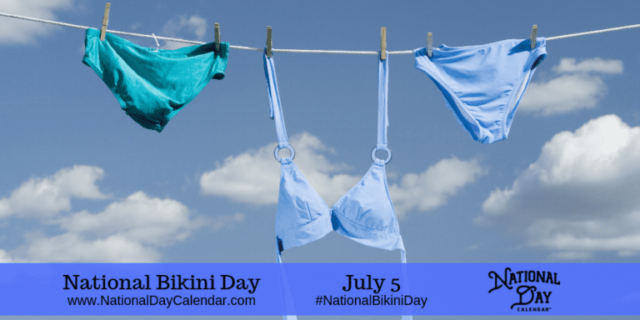
Since July 5, 1946, women have been hitting the beaches and poolsides in bikinis. National Bikini Day marks the anniversary of the invention of the revealing two-piece bathing suit.
Named after the Bikini Atoll where the United States conducted atomic tests, the two-piece bathing suit made its debut in Paris. French designer Louis Réard wanted to name revealing bits of fabric “atom.”
- The original bikini was created by automobile engineer Louis Reard (1897-1984) and consisted of only 30 square inches.
- Reard declared it wasn’t a real bikini unless it could be “pulled through a wedding ring.”
- By World War II, sunbathers cast aside the chaste one-piece bathing costumes for modest two-piece bathing suits. However, nothing prepared the United States for the revealing bikini when it hit the beaches on July 5, 1946. The skimpy strips of fabric were seen as less than a women’s unmentionables. While Europe enthusiastically donned the bikini after a long and arduous world war, American’s sense of decency kept them from accepting the bikini until the 1960s.
- The bikini wasn’t the first two-piece. Just a few months before Réard launched his version of the bikini, another French designer, Jacques Heim, unveiled a similar two-piece ensemble. Dubbed the Atome, Heim’s swimsuit was self-described as “the world’s smallest bathing suit,” though it still covered the naval and was conservative compared to what Reard had to offer.
- Though the bikini was introduced to the world in the late 1940s, it wasn’t until 1957 that celebrities and mainstream media began to accept the skin-bearing new fashion trend. It was in that year that French actress Brigitte Bardot appeared at Cannes Film Festival in a floral two-piece. And once Bardot made it acceptable to wear a bikini, celebrities like Marilyn Monroe and Esther Williams quickly followed suit.
- The infamous Dr. No bikini sold in auction for more than $50,000. In 2011, the white bikini that Ursula Andress wore in 1962’s Dr. No sold for £41,125, which comes out to just over $54,000 with today’s exchange rates.
- The first woman to ever model a bikini was a nude dancer. Her name was Micheline Bernardini, and Réard hired her after every model he approached turned him down (on account of his “bikini” being too revealing).
- The oldest recordings of a two-piece set date back to Ancient Roman times.As far as we know, the first depiction of a two piece comes from a 1,700-year-old Roman mosaic called Chamber of the Ten Maidens, in which several women are seen playing sports and exercising in what could be considered a modern-day bikini.
- The most expensive bikini in the world is made of diamonds. The most expensive bikini in the world was created specifically for Sports Illustrated and Molly Sims in 2012. Designed by jeweler Susan Rosen, the two-piece is made of over 150 carats of flawless diamonds set in Platinum, and it is valued at more than $30 million.
- The thong might not cover much skin, but it’s better than being naked, at least according to New York Mayor Fiorello LaGuardia. In 1939, he ordered exotic dancers and strip club performers to wear the new undergarment in order to dress more modestly for the World’s Fair. This date, you might have noticed, precedes the invention of the bikini, which is why some historians credit LaGuardia with popularizing (and even inventing) the G-string.
- The bikini was born in part thanks to World War II rations. Rationing during World War II affected every industry, fashion included. When the war started, the government passed a law that required a 10 percent reduction in the fabric used for women’s swimsuits. In response to this new legislation, swimsuit makers began to design two-pieces, though these versions of the two-piece swimsuits bared no skin.
- The largest-selling swimwear company in the world is Speedo, which caters to both men and women, and which is over 100 years old.
- Speedo is currently the world’s largest-selling swimwear brand. The company was founded in 1914 by hosiery manufacturer Alexander McRae. The name was created by a Captain Jim Parsons who won a company competition with the slogan “Speed on in your Speedos.”
- The seamless Speedo polyurethane LZR (“laser”) suit, designed in coordination with NASA, has helped swimmers break over 200 records in just 23 months after it was introduced in February 13, 2008. The Fédération Internationale de Natation (FINA) banned the LZR and other high-tech suits on January 1, 2010.
- In 1907, when Australian swimmer Annette Kellerman (1887-1975) wore a one-piece suit in Boston that revealed her arms and legs, she was promptly arrested for indecent exposure.
- Women’s swimwear makes up about 70% of the swimwear market. Children’s swimwear constitutes 13%, and men’s approximately 17%
- Because the expansion of the railroad in the 1800s allowed more people to visit the seaside, the railroad was a major factor in creating a need for swimwear.
Sources:

Disclaimer
Artificial Intelligence Disclosure & Legal Disclaimer
AI Content Policy.
To provide our readers with timely and comprehensive coverage, South Florida Reporter uses artificial intelligence (AI) to assist in producing certain articles and visual content.
Articles: AI may be used to assist in research, structural drafting, or data analysis. All AI-assisted text is reviewed and edited by our team to ensure accuracy and adherence to our editorial standards.
Images: Any imagery generated or significantly altered by AI is clearly marked with a disclaimer or watermark to distinguish it from traditional photography or editorial illustrations.
General Disclaimer
The information contained in South Florida Reporter is for general information purposes only.
South Florida Reporter assumes no responsibility for errors or omissions in the contents of the Service. In no event shall South Florida Reporter be liable for any special, direct, indirect, consequential, or incidental damages or any damages whatsoever, whether in an action of contract, negligence or other tort, arising out of or in connection with the use of the Service or the contents of the Service.
The Company reserves the right to make additions, deletions, or modifications to the contents of the Service at any time without prior notice. The Company does not warrant that the Service is free of viruses or other harmful components.