The Northeast is currently a landscape defined by towering snowbanks, quieted city streets, and the rhythmic sound of shovels scraping against pavement. After a “blockbuster” blizzard buried the region under several feet of snow this past weekend—unloading a staggering 37 inches in some areas and causing over 9,000 flight cancellations—residents might have hoped for a reprieve. However, the atmosphere has other plans. According to the latest analysis from AccuWeather, the break in the weather will be short-lived as a series of new systems threatens to complicate recovery efforts and add to the already historic snow totals.
The Immediate Aftermath: A Frozen Landscape
The departure of the weekend’s nor’easter did not bring warmth. Instead, it pulled a corridor of arctic air into its wake, flash-freezing the slush and standing water left behind. As many residents began the grueling process of digging out, they were met with “heart attack snow”—a heavy, moisture-laden pack that is notoriously difficult to move.
AccuWeather meteorologists noted that while the February sun provides some help during the daylight hours, the mercury is struggling. High temperatures in major hubs like Philadelphia, New York City, and Boston are hovering right around the freezing mark. “As the storm departs, blustery cold air has moved in behind it, causing some untreated areas of slush and standing water to freeze,” AccuWeather reported. This creates a treacherous environment for commuters and road crews alike, as the melting that occurs during the day quickly turns into “black ice” once the sun sets.
A Midweek “Clipper” Brings New Risks
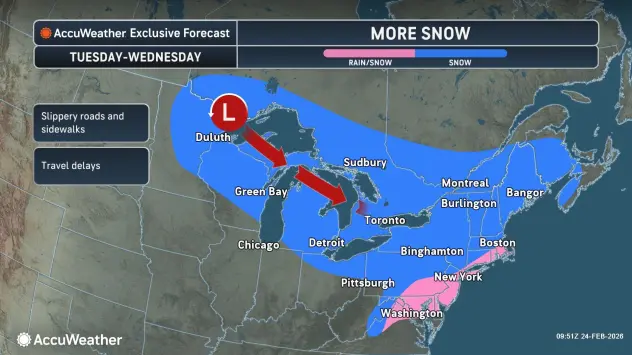
The first of the follow-up storms is a “clipper” system originating from the Great Lakes. While clippers are generally moisture-starved compared to massive nor’easters, their timing is particularly problematic for a region already at its breaking point.

Moving through Tuesday and Wednesday, this system is expected to spread a swath of snow from northern Minnesota across to New England. For the Mid-Atlantic’s major metropolitan areas, the forecast is more complex. In Washington, D.C., Philadelphia, and New York City, the precipitation is expected to be a messy mix of rain and snow.
AccuWeather warns that even a small amount of new accumulation can be impactful. “While snow totals will not be as significant as the nor’easter, any streets and sidewalks that have already been cleared of any snow can become snow covered again,” the weather service noted. This “reset” of snow removal efforts can be demoralizing for residents and taxing for municipal budgets that have already been depleted by the weekend’s blockbuster event.
The One-Two Punch: A Second System Arrives Thursday
Close on the heels of the midweek clipper, a second, more robust storm is projected to track from the Midwest into the eastern United States by Thursday night. This system presents a classic winter forecasting challenge: the “rain-snow line.”
With cold air firmly entrenched to the north, a stripe of steady snow is expected to develop. However, for those on the southern fringe of this cold air, the forecast calls for a volatile mix of rain, snow, and ice. AccuWeather experts are keeping a close eye on this “southern side of the storm,” where warmer air could even trigger thunderstorms. For most of the Northeast, however, the primary concern remains the accumulation of ice and additional snow on top of the existing snowpack.
The weight of this additional precipitation is a significant concern for structural safety. With over three feet of snow already sitting on roofs in parts of New England and Rhode Island, the addition of rain or heavier snow increases the risk of roof collapses.
Why This Pattern Is So Persistent
The current weather pattern is a result of a “blocked” atmosphere, where high pressure over the North Atlantic acts like a dam, forcing a series of storms to take a similar track over the United States. This “parade of storms” is common in active winters, but the intensity of the 2026 season has caught many by surprise.
The blizzard that just passed was a historic event by any measure. In Providence, Rhode Island, totals topped 37 inches, effectively shutting down the city’s infrastructure. The sheer scale of the disruption—thousands of cancelled flights and a total standstill of the I-95 corridor—means that the supply chain and travel networks are still reeling. The arrival of new storms, even smaller ones, prevents these systems from fully recovering.
Looking Ahead: Is Relief in Sight?
While midweek temperatures are expected to briefly climb into the 40s—a “balmy” change relative to the weekend’s deep freeze—this brings its own set of problems. Rapid melting combined with the potential for rain and clogged storm drains can lead to localized flooding. Furthermore, the freeze-thaw cycle is the primary driver of potholes, meaning drivers should expect deteriorating road conditions well after the snow is gone.
For those weary of the white stuff, the long-range forecast offers little comfort. AccuWeather’s long-range team is already monitoring signals for more winter storms lining up through the beginning of March. The “Winter Center” at AccuWeather suggests that the active track will remain open, potentially bringing several more opportunities for significant accumulation before spring officially arrives.
Safety and Preparation
In light of the ongoing threats, meteorologists urge residents to remain vigilant. The risk of overexertion while shoveling remains high, especially as new snow falls on top of old, compacted drifts. Additionally, the fluctuating temperatures mean that “black ice” will remain a persistent threat during the morning commute for the foreseeable future.
“It will take time for cities in the Northeast to recover from this past weekend’s blockbuster blizzard,” AccuWeather emphasized. The message to the public is clear: keep the shovels handy and the salt buckets full. The Blizzard of 2026 may be in the history books, but the winter of 2026 is far from over.
As the Northeast prepares for the next round, the focus remains on safety, patience, and the hope that the “balmy” 40-degree temperatures predicted for midweek will provide enough of a window for crews to make a dent in the mountains of snow currently lining the streets. Until then, the region remains at the mercy of a relentless atmosphere.
Source: AccuWeather
Disclaimer
Artificial Intelligence Disclosure & Legal Disclaimer
AI Content Policy.
To provide our readers with timely and comprehensive coverage, South Florida Reporter uses artificial intelligence (AI) to assist in producing certain articles and visual content.
Articles: AI may be used to assist in research, structural drafting, or data analysis. All AI-assisted text is reviewed and edited by our team to ensure accuracy and adherence to our editorial standards.
Images: Any imagery generated or significantly altered by AI is clearly marked with a disclaimer or watermark to distinguish it from traditional photography or editorial illustrations.
General Disclaimer
The information contained in South Florida Reporter is for general information purposes only.
South Florida Reporter assumes no responsibility for errors or omissions in the contents of the Service. In no event shall South Florida Reporter be liable for any special, direct, indirect, consequential, or incidental damages or any damages whatsoever, whether in an action of contract, negligence or other tort, arising out of or in connection with the use of the Service or the contents of the Service.
The Company reserves the right to make additions, deletions, or modifications to the contents of the Service at any time without prior notice. The Company does not warrant that the Service is free of viruses or other harmful components.