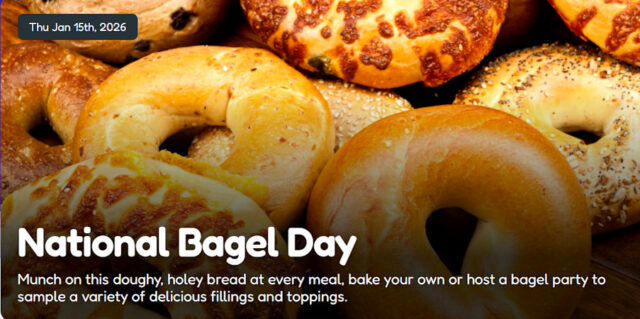
Toast up your favorite flavor on National Bagel Day. On January 15th, don’t forget to pick your favorite schmear, too. Make it for breakfast, lunch, a snack or all of the above!
- 13th Century – The earliest known mention of a boiled-then-baked ring-shaped bread can be found in a 13th-century Arabic cookbook, where they are referred to as ka’ak
- 14th Century – While the origins of bagels are not entirely clear, it is thought that they developed from German immigrants who eventually reshaped pretzel twists into the round shape of bagels.
- 1610 – Linguist Leo Rosten wrote in “The Joys of Yiddish” about the first known mention of the Polish word “bajgiel,” derived from the Yiddish word “bagel,” in the “Community Regulations” of the city of Krakow in 1610, which stated that the item was given as a gift to women in childbirth.
- 1683 – Bagels were first created in 1683 to honor King John III Sobieski of Poland after he protected Austria’s people from an attack by Turkish invaders.
- 19th Century – When European Jews began emigrating to the United States, bagels came along for the ride.
- 1900 – Around 1900, the “bagel brunch” became popular in New York City. The bagel brunch consisted of a bagel topped with lox, cream cheese, capers, tomato and red onion.
- 1907 – It didn’t take long for the bakers to organize. In 1907, they created the International Beigel Bakers’ Union. For decades, Bagel Bakers Local 338 held contracts with nearly all bagel bakeries in and around the city for its workers.
- 1918 – First invented in 1918 by Canadian baker Meyer Thompson, the bagel machine was introduced to the U.S. in the 1960s.
- 1950s – Bagels are sold in supermarkets across the nation and surpass the donut as an essential breakfast item.
- 1960 – Frozen bagels were introduced in 1960.
- 1989 – In Japan, BagelK from New York introduced the first kosher bagels.
- 1995 – The First Einstein Brothers’ bagel store opens. Featuring freshly baked bagels all day long, the chain opens its first store in Ogden, Utah, and will eventually become the largest bagel chain in the United States.
- 1999 – This year, Americans will spend more than three-quarters of a billion dollars on bagels, but only half a billion dollars on donuts.
- 2004 – In August 2004, Bruegger’s Bagels produced a gigantic 868-pound bagel and displayed it at the New York State Fair, according to the Guinness Book of World Records.
- The larger-than-life creation required 11,00 pounds of dough, 900 gallons of water, and took 10 hours to bake. It holds the record for the biggest bagel to date.
- 2007 – North Carolina molecular scientist Robert Bohannon developed Buzz Donuts and Buzzed Bagels- caffeinated donuts and bagels in 2007. They contain the caffeine equivalent of 2 cups of coffee.
- 2008 – Astronaut Gregory Chamitoff brought 18 sesame bagels from a bakery in Montreal, Canada with him on his journey to space in 2008!
- 2018 – In honor of National Bagel Day, Thomas Bagels released an emoji keyboard in early 2018. Forty breakfast-centric emojis were on it, including an avocado-topped bagel. Later that year, Apple finally released the bagel emoji on its own platform—but not without controversy. After people complained that the plain bagel had nothing on it, it got redesigned with cream cheese during the iOS 12.1 beta 4 cycle release.
- 2019 – Thomas’ is the largest producer of grocery store bagels in the United States. In 2019, Thomas’ sold more than 160 million bagels.
- The bagel originated in Poland and was designed for Lent.
- Polish-Jewish immigrants introduced the bagel to the United States.
- Until the 1960s, bakeries made bagels by hand. Then Daniel Thompson invented the bagel maker, and along came a heated debate of man versus the machine.
- Credit for the bagels spread across the country goes in part to the efforts of bagel baker Harry Lender, his son, Murray Lender and Florence Sender. Their pioneering efforts led to the automated production and distribution of frozen bagels in the 1960s. Murray also invented pre-slicing the bagel.
- Its name derives from the Yiddish word ‘bengal’, meaning ‘ring’ or ‘bracelet’.
- The hole in the center of the bagel allows multiple bagels to be threaded onto a dowel, making them easier to transport.
- Bagels are the only breads that are boiled before baking.
- Despite the myriad bagel flavors available from blueberry to the “everything” bagel, the most popular choice is plain, followed closely by sesame.
- What sets Montreal’s bagels apart from others is that they are poached in honey water before baking in a wood-fired oven. The result is a chewy, golden bagel that folks in Montreal boast about
- To make Thomas’ popular Limited-Edition Pumpkin Bagels, it takes 133,500 pounds of pumpkin puree.
- It would take 2,231 bagels to go once around Grand Central Station Main concourse’s inside perimeter, which is 790 feet.
- The 10 most popular bagel toppings nationwide are cream cheese, butter, flavored cream cheese, cheese, jelly/jam, eggs, deli meat, margarine, peanut butter or other nut butter, and bacon.
- The average person eats more than 38 bagels per year.
- 202.07 million Americans consumed bagels in 2020. This figure is projected to increase to 205.34 million in 2024.
- Bagel, Biegel, or Bougel. If you see the word beigel, then it’s not a typo, bagels are also known as beigels, it’s just the old-fashioned spelling. The name bagel itself also comes from the German for ‘bracelet’, which translates to ‘bougel’.
- 54% Of Americans eat fresh bagels. While it may be convenient to stock up on store-bought, it’s clear we have a preference for freshly baked bagels.
- 75% of bagel eaters prefer theirs warm and will gladly buy a fresh, hot one over anything cold.
- An estimated 40% of Americans eat bagels at least once per week.
- With nearly 90 percent of users adding cream cheese, butter, or some kind of topping, it’s clear that the contrast between hot and cold is the preferred way to eat bagels.
Sources:

Tons of Facts
Disclaimer
Artificial Intelligence Disclosure & Legal Disclaimer
AI Content Policy.
To provide our readers with timely and comprehensive coverage, South Florida Reporter uses artificial intelligence (AI) to assist in producing certain articles and visual content.
Articles: AI may be used to assist in research, structural drafting, or data analysis. All AI-assisted text is reviewed and edited by our team to ensure accuracy and adherence to our editorial standards.
Images: Any imagery generated or significantly altered by AI is clearly marked with a disclaimer or watermark to distinguish it from traditional photography or editorial illustrations.
General Disclaimer
The information contained in South Florida Reporter is for general information purposes only.
South Florida Reporter assumes no responsibility for errors or omissions in the contents of the Service. In no event shall South Florida Reporter be liable for any special, direct, indirect, consequential, or incidental damages or any damages whatsoever, whether in an action of contract, negligence or other tort, arising out of or in connection with the use of the Service or the contents of the Service.
The Company reserves the right to make additions, deletions, or modifications to the contents of the Service at any time without prior notice. The Company does not warrant that the Service is free of viruses or other harmful components.