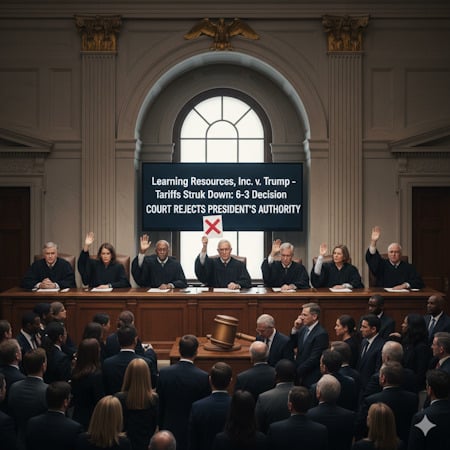
The Supreme Court’s 2026 ruling against the use of the International Emergency Economic Powers Act (IEEPA) for broad tariffs was a significant hurdle, but it did not leave the President’s trade agenda entirely toothless. Legal experts and administration officials have already pivoted to a “Plan B,” which involves a patchwork of existing trade statutes. While these authorities are slower and more targeted, they provide the executive branch with enough leverage to maintain significant pressure on global trading partners.
The New Legal Arsenal
The administration is expected to rely on three primary pillars of trade law that were either untouched by the Supreme Court’s ruling or are being rapidly “re-activated” through new investigations.
1. Section 232: The “National Security” Vault
Under the Trade Expansion Act of 1962, the President can impose tariffs if a product is imported in quantities that “threaten to impair national security.” Unlike IEEPA, Section 232 has been tested and largely upheld by courts.
- Current Status: The administration has already launched 17 new investigations since early 2025.
- Targeted Sectors: Semiconductors, robotics, pharmaceuticals, and critical minerals are at the top of the list. By defining “national security” to include “industrial resilience,” the administration can effectively tax the most vital components of the modern economy.
2. Section 301: Punishing “Unfair” Practices
Section 301 of the Trade Act of 1974 allows the U.S. Trade Representative (USTR) to retaliate against countries that engage in “unreasonable or discriminatory” trade practices.

- The China Strategy: Most tariffs on Chinese goods fall under this category. While the 2025 global IEEPA tariffs are gone, the 301 tariffs on Chinese technology and manufacturing remain in force.
- Future Use: The USTR can initiate new 301 investigations into other countries—such as those in the EU or South America—by alleging they unfairly disadvantage U.S. exporters.
3. Section 122: The “Balance-of-Payments” Emergency
Perhaps the most potent “sleeping” power is Section 122 of the Trade Act of 1974. This allows the President to impose temporary tariffs of up to 15% for 150 days to address “large and serious” balance-of-payments deficits.
- The Loophole: While temporary, the administration could theoretically re-impose these tariffs every 150 days, creating a “rolling” tax that mimics a permanent tariff.
Comparison of Presidential Tariff Authorities
| Statute | Primary Trigger | Speed of Implementation | Limitations |
| IEEPA (Struck Down) | National Emergency | Instant | Ruled “too broad” for taxing power. |
| Section 232 | National Security | Medium (requires investigation) | Must link product to security/defense. |
| Section 301 | Unfair Trade Practices | Slow (requires 6-12 month probe) | Country-specific; subject to WTO rules. |
| Section 122 | Trade Deficits | Instant | Capped at 15% and 150-day duration. |
The Political and Legal Reality
The shift from IEEPA to these alternative authorities means the “overnight” global trade war has been replaced by a “war of attrition.” Every new tariff will now require a formal investigation, public hearings, and detailed evidentiary findings. This makes it harder for the administration to use tariffs as a sudden bargaining chip in diplomatic negotiations, but it creates a more durable legal foundation that is harder for courts to strike down.
Infographic: Active Section 232 Investigations (as of February 2026)
The following 17 product categories are currently under investigation by the Department of Commerce for their potential impact on U.S. national security, potentially leading to new tariffs under Section 232.
Disclaimer
Artificial Intelligence Disclosure & Legal Disclaimer
AI Content Policy.
To provide our readers with timely and comprehensive coverage, South Florida Reporter uses artificial intelligence (AI) to assist in producing certain articles and visual content.
Articles: AI may be used to assist in research, structural drafting, or data analysis. All AI-assisted text is reviewed and edited by our team to ensure accuracy and adherence to our editorial standards.
Images: Any imagery generated or significantly altered by AI is clearly marked with a disclaimer or watermark to distinguish it from traditional photography or editorial illustrations.
General Disclaimer
The information contained in South Florida Reporter is for general information purposes only.
South Florida Reporter assumes no responsibility for errors or omissions in the contents of the Service. In no event shall South Florida Reporter be liable for any special, direct, indirect, consequential, or incidental damages or any damages whatsoever, whether in an action of contract, negligence or other tort, arising out of or in connection with the use of the Service or the contents of the Service.
The Company reserves the right to make additions, deletions, or modifications to the contents of the Service at any time without prior notice. The Company does not warrant that the Service is free of viruses or other harmful components.