Updated February 26, 2024
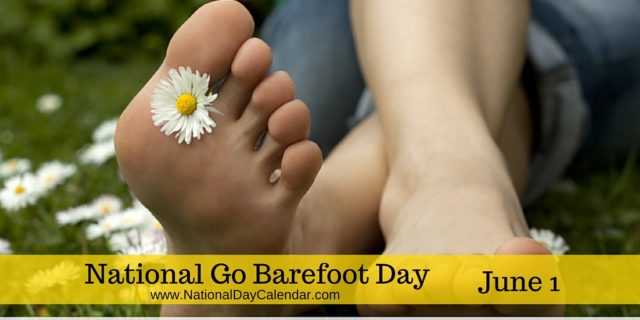
National Go Barefoot Day is observed on June 1. This day is an opportunity to kick off your shoes and run barefoot through the cool grass! More importantly, it is a day to help support a charity that provides millions of underprivileged children all around the world with shoes.
- 1300s – In Britain, King Edward II declares barleycorn as a means to measure shoe sizes.
- 1837 – Shoemaker Joseph Sparkes Hall invents the first women’s boots for Queen Victoria.
- 1883 – Jan Ernst Matzeliger invents the lasting machine that can produce 700 pairs of shoes daily, making footwear accessible to everyone.
- 1887 – The term ‘sneakers’ is used for the first time when this type of shoe, which doesn’t make much noise is introduced.
- 2004 – National Go Barefoot Day was created by the people at Soles4Souls. The holiday got its start after the Tsunami disaster in 2004 to support those affected by the event. However, donations have continued to come in and over 19 million of pairs of shoes have been donated worldwide since 2005.
- 2014 – Feet are spreading to support extra weight as our populations pack on the pounds. According to a 2014 study by the College of Podiatry in the UK, the average foot has increased two sizes since the 1970s.
- 2015 – In a study published in 2015, researchers synthesized data from 17 previous studies that included the penis measurements of more than 15,000 men from around the world. The results: There is little evidence that penis size is linked to height, body mass, or shoe size.
- Foot bones make up about a quarter of all the bones in our bodies.
- When did humans begin wearing shoes, anyway? About 40,000 years ago, according to research from Washington University in St. Louis that analyzed foot bones from Neanderthals and early humans. Older specimens had thicker, stronger toes, likely from gripping the ground as they walked barefoot. That’s around the same time that the archaeological record shows a burst of artistic and technological advancements among early humans, including the first stone tools, which may have aided in the production of shoes.
- The oldest preserved shoe, incidentally, is 5500 years old and was found in an Armenian cave, buried in sheep dung.
- Feet are one of the most ticklish parts of the body.
- The average person walks about 110,000 miles in a lifetime.
- Your two feet have 250,000 sweat glands that are capable of producing half a pint of sweat in a single day!
- Eighty percent of Americans over 21 have reported having a foot ailment.
- The Achilles tendon is the strongest tendon in the body.
- Feet function best in their bare, or natural, state.
- Women are four times more likely to have foot problems compared to men.
- Plantar fasciitis is one of the most common forms of foot pain. It affects more than 2 million people a year.
- Each foot takes 1.5 times your body weight while you walk.
- When running, your feet take up to five times your weight.
- 1 in 1,000 babies is born with an extra toe or finger. The condition is called polydactyly.
Sources:

Disclaimer
Artificial Intelligence Disclosure & Legal Disclaimer
AI Content Policy.
To provide our readers with timely and comprehensive coverage, South Florida Reporter uses artificial intelligence (AI) to assist in producing certain articles and visual content.
Articles: AI may be used to assist in research, structural drafting, or data analysis. All AI-assisted text is reviewed and edited by our team to ensure accuracy and adherence to our editorial standards.
Images: Any imagery generated or significantly altered by AI is clearly marked with a disclaimer or watermark to distinguish it from traditional photography or editorial illustrations.
General Disclaimer
The information contained in South Florida Reporter is for general information purposes only.
South Florida Reporter assumes no responsibility for errors or omissions in the contents of the Service. In no event shall South Florida Reporter be liable for any special, direct, indirect, consequential, or incidental damages or any damages whatsoever, whether in an action of contract, negligence or other tort, arising out of or in connection with the use of the Service or the contents of the Service.
The Company reserves the right to make additions, deletions, or modifications to the contents of the Service at any time without prior notice. The Company does not warrant that the Service is free of viruses or other harmful components.