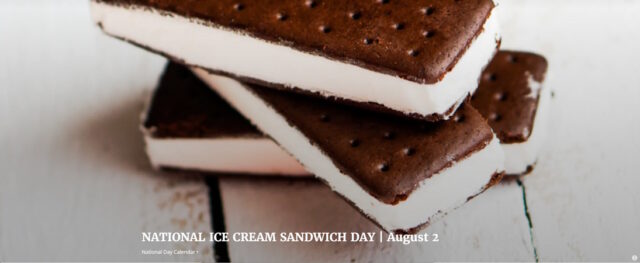
Celebrated every year on August 2, National Ice Cream Sandwich Day conjures up visions of our favorite summer treat. It’s a simple thing, really, but oh, what deliciousness! In our American version, take two rectangular or circular flat cookies made of chocolate or oatmeal and match them with your favorite flavor of ice cream. Then, make it into a neat little sandwich. There’s nothing better than the taste of sugary sweet, ice-cold creaminess and sometimes, chocolate all together in one outrageously-good dessert!
- 1894 – The first known record for an ice cream sandwich was in 1894 and used sponge cake with ice cream.
- 1900 – The original ice cream sandwich sold for a penny in 1900 from a pushcart in the Bowery neighborhood of New York.
- 1902 – The vendor’s idea became commercially popular by 1902 and the peddler was busy making sandwiches to order.
- 1905 – Pictures from the Jersey Shore circa 1905 “On the beach, Atlantic City”, show Ice Cream sandwiches were popular at 1c each.
- 1928 – The dynamic duo of ice cream and cookies was started in San Francisco.
- 1940 – grocers sold sandwiches made with crispy wafers.
- 1945 – One account claims the modern ice cream sandwich with the chocolate wafer was invented in 1945 by Jerry Newberg. The ice cream maker sold his creation at Forbes Field in Pittsburgh, PA. At the time, the storied location was home to the Pittsburgh Pirates and Steelers.
- 1945 – Although ice cream sandwiches were made by hand and distributed by New York street vendors in the early 1940s, it wasn’t until 1945 that the first ice cream sandwiches were mass-produced.
- 1963 – The rectangular chocolate cookies with ice cream between were patented in 1963 by Jack Delaney, Tim Jones, John Defillippio, and Sam West.
- 1978 – The “Chipwich”, an ice cream sandwich made with two chocolate chip cookies and vanilla ice cream rolled in mini chocolate chips, was created in 1978 by Richard LaMotta.
- The average number of ice cream sandwiches eaten per second nationally is 48.
- If all the ice cream sandwiches made yearly were placed end to end, they would circle Earth 3 1/2 times.
- The 30-44 age group buys the most ice cream sandwiches.
- The ice cream sandwich is so American it is sold at the Smithsonian Institute in Washington, D.C.
- Ice cream sandwiches are the second best-selling novelty ice cream in America.
- Walmart’s ice cream sandwiches have a history of not melting. A YouTube video by Consumer Reports that when brought out in 100-degree heat and placed on a plastic tray, the ice cream sandwich was left unbothered for 30 minutes, and barely melted in an hour.
- The eastern part of the country consumes almost 50% of ice cream sandwiches in America.
- Around the world:
- In Australia, ice cream sandwiches are called giant sandwich.
- In Iran, they are called bread ice cream and are made with two wafers and with traditional Iranian ice cream.
- In Israel, they are called Kasata and are a variation on the Italian dessert cassata. It is ice cream between layers of sponge cake
- In Mexico they are called tortas de nieve or emparedado de nieve and they literally are a sandwich. They are ice cream in a roll or between two pieces of bread.
- In the Philippines, pushcarts sell ice cream sandwiches with the bread called pandesal.
- In Singapore, they are called Potong which has two wafers holding together a block of ice cream.
- In Vietnam they are called bánh mì kẹp kem is commonly sold on the street as a snack. It consists of scoops of ice cream stuffed inside a bánh mì, topped with crushed peanuts.
- In Scotland and Ireland, they’re called “Sliders”
Sources:

Disclaimer
Artificial Intelligence Disclosure & Legal Disclaimer
AI Content Policy.
To provide our readers with timely and comprehensive coverage, South Florida Reporter uses artificial intelligence (AI) to assist in producing certain articles and visual content.
Articles: AI may be used to assist in research, structural drafting, or data analysis. All AI-assisted text is reviewed and edited by our team to ensure accuracy and adherence to our editorial standards.
Images: Any imagery generated or significantly altered by AI is clearly marked with a disclaimer or watermark to distinguish it from traditional photography or editorial illustrations.
General Disclaimer
The information contained in South Florida Reporter is for general information purposes only.
South Florida Reporter assumes no responsibility for errors or omissions in the contents of the Service. In no event shall South Florida Reporter be liable for any special, direct, indirect, consequential, or incidental damages or any damages whatsoever, whether in an action of contract, negligence or other tort, arising out of or in connection with the use of the Service or the contents of the Service.
The Company reserves the right to make additions, deletions, or modifications to the contents of the Service at any time without prior notice. The Company does not warrant that the Service is free of viruses or other harmful components.