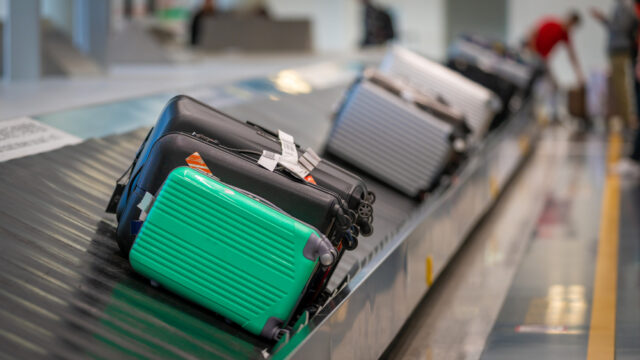
The golden age of “cheap” ancillary services is coming to a grinding halt. As of April 2026, the American traveler is facing a new reality at the check-in counter: the fifty-dollar suitcase. In a rapid-fire series of announcements, major US carriers, including United Airlines, JetBlue, and American Airlines, have overhauled their baggage fee structures, pushing prices to historic highs. While these increases are often viewed by the public as “nickel-and-diming,” the underlying economic drivers are far more complex, rooted in a volatile global energy market and a geopolitical crisis that has sent jet fuel prices into a vertical climb.
The 2026 Energy Shock: A Systemic Crisis
The primary catalyst for this shift is not corporate greed alone, but a massive disruption in the global energy supply chain. Following the escalation of conflict in the Middle East in late February 2026—specifically the closure of the Strait of Hormuz—the aviation industry has been plunged into an energy crisis.
The Strait of Hormuz is a critical maritime chokepoint through which approximately 20% of the world’s oil supply flows. Its closure led to an immediate and violent spike in Brent crude prices, but for airlines, the “crack spread”—the cost of refining that crude into usable jet fuel—has been even more damaging.
Jet Fuel Price Trajectory (Early 2026)
| Period | Price Per Gallon (USD) | Change |
| January 2026 | $2.11 | Baseline |
| Early March 2026 | $3.40 | +61% |
| April 3, 2026 | $4.88 | +131% |
According to the Argus US Jet Fuel Index, prices at major hubs such as Chicago, Houston, and Los Angeles reached $4.88 per gallon this week. For an industry where fuel typically accounts for 25% to 30% of total operating expenses, a doubling of costs in a matter of weeks is catastrophic. United Airlines CEO Scott Kirby recently noted that the fuel surge has added approximately $400 million to monthly operating costs—a figure that could exceed the airline’s most profitable annual margins if sustained.

The Fee Hike Rollout: Who is Charging What?
United Airlines became the latest major carrier to adjust its pricing on Friday, April 3, 2026, following similar moves by JetBlue and American earlier in the quarter.
1. United Airlines
Effective for tickets purchased starting today, United has implemented a $10 across-the-board increase for first and second checked bags on routes within the US, Canada, Mexico, and Latin America.
- First Bag: $45 (prepaid) or $50 (at the airport).
- Second Bag: $55 (prepaid) or $60 (at the airport).
- Third Bag: Prices have jumped by as much as $50, with some routes now costing $200 for a third piece of luggage.
2. JetBlue Airways
JetBlue led the charge in late March 2026, introducing “peak and off-peak” baggage pricing. During peak travel periods, a first checked bag now costs $49, making it one of the most expensive standard fees in the domestic market. JetBlue officials defended the move as a way to “keep base fares competitive” while ensuring that those who use the extra services cover the associated fuel burn.
3. American Airlines
Earlier in February 2026, American Airlines raised its second-bag fee to $50 for airport payments, while maintaining a slight discount for online payments. While American has yet to match United’s $10 increase on the first bag today, industry analysts expect a “cascading effect” in which Delta and American align their pricing within the next 14 days.
4. The Southwest Shift
Perhaps the most telling sign of the times is the shift at Southwest Airlines. Historically known for its “Bags Fly Free” policy, Southwest implemented its first-ever checked bag fee for certain fare classes in late 2025. By April 2026, the carrier has maintained a $35 fee for those outside its primary loyalty tiers, signaling that even the most consumer-friendly brands cannot ignore the $5-per-gallon reality of jet fuel.
The Economics of the “Fuel Surcharge” via Bag Fees
Why raise bag fees instead of simply increasing the ticket price? The answer lies in the psychology of the modern traveler and the technicalities of airline revenue management.
Ancillary Revenue vs. Base Fares
Airlines are caught in a “race to the bottom” on search engines like Google Flights and Expedia. If United raises its base fare by $20 to cover fuel, it may drop to the second or third page of search results, losing thousands of bookings to a competitor whose base fare is $5 lower.
By keeping the base fare steady and increasing the “optional” baggage fee, the airline remains competitive in search rankings. This strategy has turned ancillary revenue—fees for bags, seats, and Wi-Fi—into a lifeline. In 2026, ancillary revenue is projected to hit $145 billion globally, accounting for nearly 14% of total industry income.
Weight and Fuel Burn
There is also a physical reality to the bag fee: weight equals fuel. At $4.88 per gallon, every extra pound on an aircraft costs the airline significantly more than it did a year ago. A Boeing 737 carrying 150 bags that each weigh 50 pounds adds 7,500 pounds of weight. Over a four-hour flight, that weight requires hundreds of additional gallons of fuel. The fee is, in a very literal sense, a weight-based fuel surcharge.
Consumer Impact and the Battle for the Overhead Bin
The result of these fee hikes is a predictable, if chaotic, shift in passenger behavior. As checked bag fees approach $50, travelers are increasingly “stuffing” their carry-ons to avoid the charge.
The “Gate Checked” Crisis
Airlines are reporting record numbers of “gate-checked” bags—suitcases that are brought to the boarding gate because the passenger didn’t want to pay the fee, only to find the overhead bins are full. This leads to:
- Delayed Departures: Boarding takes longer as flight attendants struggle to find space.
- Customer Friction: Increased tension between passengers and crew over bin space.
- Regulatory Scrutiny: The Department of Transportation (DOT) has begun looking into whether “forced” gate-checking (due to lack of space) should entitle passengers to a refund of their “carry-on privilege” if they were forced to pay for a specific fare class.
The Path Forward: Will Fees Ever Come Down?
History suggests that once an airline fee is introduced or raised, it rarely retreats. Even if the conflict in the Middle East stabilizes and the Strait of Hormuz reopens, airlines are unlikely to lower bag fees. Instead, they will likely use the extra revenue to pay down the massive debt incurred during the 2026 energy shock and to fund the transition to Sustainable Aviation Fuel (SAF).
The International Air Transport Association (IATA) has estimated that reaching net-zero carbon emissions by 2050 will require billions in investment. High bag fees in 2026 are essentially funding the “green transition” and providing a buffer against future geopolitical volatility.
For the traveler, the message is clear: the era of the “all-inclusive” airfare is dead. In 2026, the price you see on the screen is only the beginning of the journey. If you want to bring your belongings with you, be prepared to pay the “fuel tax” disguised as a baggage fee.
Sources Used
- Aerospace Global News: “United Airlines raises bag fees by $10 as jet fuel prices surge” (April 3, 2026) https://aerospaceglobalnews.com/news/united-airlines-bag-fee-increase-fuel-prices/
- Fox 9 Minneapolis-St. Paul: “United Airlines checked bag fees climbs $10-50 as fuel prices nearly double since Iran war” (April 3, 2026) https://www.fox9.com/news/united-airlines-checked-bag-fees-climbs-10-50-fuel-prices-nearly-double-since-iran-war
- far Magazine: “Two U.S. Airlines to Charge More for Checked Baggage as Oil Prices Surge” (April 3, 2026) https://www.afar.com/magazine/united-and-jetblue-airlines-to-raise-baggage-fees
- Airlines For America / Argus Media: “Daily Jet Fuel Spot Prices | Argus US Jet Fuel Index” (April 3, 2026) https://www.airlines.org/dataset/argus-us-jet-fuel-index/
- Fast Company: “United just made your suitcase more expensive, Here’s how much” (April 3, 2026) https://www.fastcompany.com/91521485/united-just-made-your-suitcase-more-expensive-heres-how-much
- IATA: “Airline Profitability Stabilizes with 3.9% Net Margin Expected in 2026” (December 9, 2025) https://www.iata.org/en/pressroom/2025-releases/2025-12-09-01/
Disclaimer
Artificial Intelligence Disclosure & Legal Disclaimer
AI Content Policy.
To provide our readers with timely and comprehensive coverage, South Florida Reporter uses artificial intelligence (AI) to assist in producing certain articles and visual content.
Articles: AI may be used to assist in research, structural drafting, or data analysis. All AI-assisted text is reviewed and edited by our team to ensure accuracy and adherence to our editorial standards.
Images: Any imagery generated or significantly altered by AI is clearly marked with a disclaimer or watermark to distinguish it from traditional photography or editorial illustrations.
General Disclaimer
The information contained in South Florida Reporter is for general information purposes only.
South Florida Reporter assumes no responsibility for errors or omissions in the contents of the Service. In no event shall South Florida Reporter be liable for any special, direct, indirect, consequential, or incidental damages or any damages whatsoever, whether in an action of contract, negligence or other tort, arising out of or in connection with the use of the Service or the contents of the Service.
The Company reserves the right to make additions, deletions, or modifications to the contents of the Service at any time without prior notice. The Company does not warrant that the Service is free of viruses or other harmful components.