

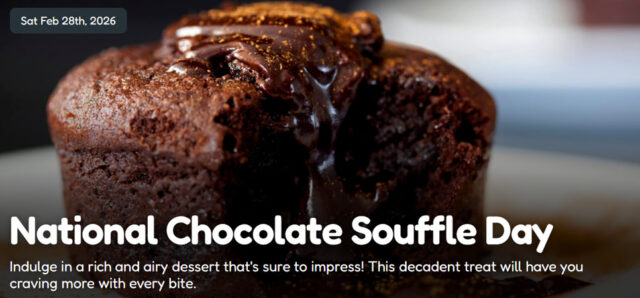
Get your spoons ready, February 28 is National Chocolate Soufflé Day! The chocolate soufflé is the height of French decadence — and deliciousness. The dessert is often associated with momentous occasions, so it’s only fitting that it has its own day to be celebrated.
- 1703 – French cook François Massialot includes an early version of a soufflé in his cookbook, signaling the start of this airy egg-based dish in French culinary histor
- 1742 – The first recipe for soufflé appeared in Vincent La Chapelle’s Le Cuisinier Moderne
- 19th Century – French painter Henri Toulouse-Lautrec created a dessert he called “mayonnaise de chocolat,” which we now know as chocolate mousse.
- 1813 – The word soufflé first appeared in English in Louis Ude’s The French Cook, 1813.
- 1814 – Antoine Beauvilliers details how to make a soufflé in his book “L’Art du Cuisinier.”
- 1820s – Antonin Carême creates numerous soufflé recipes and is credited with perfecting and popularizing the soufflé
- 1845 – Soufflé was so widely accepted that, in Eliza Acton’s Modern Cookery (1845), a recipe for soufflé was included as just another recipe.
- 1861 – Isabella Beeton’s “Book of Household Management” includes a chocolate soufflé recipe, helping bring this formerly restaurant-focused dessert into middle-class British homes.
- 1903 – As the soufflé evolved, the number of variations grew. By the time Auguste Escoffier published “Le Guide Culinaire” in 1903, which codified the classic recipes of French cuisine, more than 60 soufflé variations were in common use.
- 1954 – Sabrina (played by Audrey Hepburn) is critiqued by the master chef at a Parisian culinary school for her poor attempts at making soufflé.
- 1961 – In “Mastering the Art of French Cooking,” their profoundly influential 1961 cookbook, Julia Child, Simone Beck and Louisette Bertholle describe the soufflé as the “epitome and triumph of the art of French cooking.”
- 2000 – Food magazine Saveur publishes “Puff Piece,” tracing the journey from early savory meat soufflés to refined sweet versions like chocolate soufflé in modern kitchens
- 2016 – Cincinnati Magazine runs “The Soufflé: A History,” outlining key milestones from 18th‑century French origins to contemporary restaurant chocolate soufflés worldwide.
- 2016 – The most expensive soufflé ever commercially sold was made in New York City from quail eggs and caviar. This dish sold for $ 2,500 and was also made with flambé Hennessy Richard and decorated with gold leaf.
- The word soufflé is the past participle of the French verb souffler, which means “to blow up” or more loosely “puff up,” which describes a soufflé perfectly.
- A soufflé is a lightly baked cake made with egg yolks and beaten egg whites, combined with other ingredients to make it either a savory main dish or a sweet dessert.
- Due to soufflés’ tendency to collapse quickly upon removal from the oven, the media frequently depicts the dessert in sitcoms, cartoons, children’s programs, and movies as a source of humor.
- Another kind of dish entirely is soufflé potatoes, which are puffed-up sautéed potato slices, traditionally served with a Chateaubriand steak.
- The Guinness Book of World Records lists the largest soufflé ever made as in Nablus, Palestine. It measured 243 feet long and weighed more than 3800 pounds.
Sources:

Disclaimer
Artificial Intelligence Disclosure & Legal Disclaimer
AI Content Policy.
To provide our readers with timely and comprehensive coverage, South Florida Reporter uses artificial intelligence (AI) to assist in producing certain articles and visual content.
Articles: AI may be used to assist in research, structural drafting, or data analysis. All AI-assisted text is reviewed and edited by our team to ensure accuracy and adherence to our editorial standards.
Images: Any imagery generated or significantly altered by AI is clearly marked with a disclaimer or watermark to distinguish it from traditional photography or editorial illustrations.
General Disclaimer
The information contained in South Florida Reporter is for general information purposes only.
South Florida Reporter assumes no responsibility for errors or omissions in the contents of the Service. In no event shall South Florida Reporter be liable for any special, direct, indirect, consequential, or incidental damages or any damages whatsoever, whether in an action of contract, negligence or other tort, arising out of or in connection with the use of the Service or the contents of the Service.
The Company reserves the right to make additions, deletions, or modifications to the contents of the Service at any time without prior notice. The Company does not warrant that the Service is free of viruses or other harmful components.





, a recipe for soufflé was included as just another recipe.)