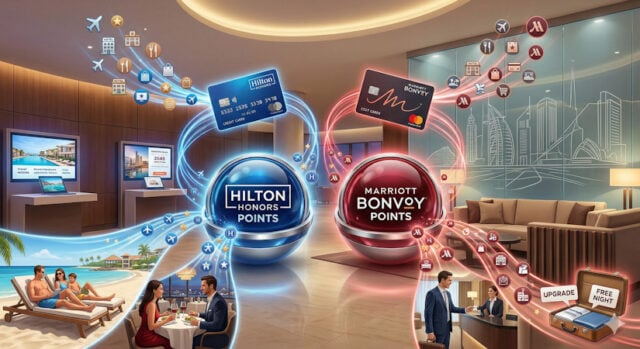
In the rarefied air of corporate balance sheets, a multi-billion dollar debt is usually a cause for alarm. But in the hyper-competitive world of global hospitality, the staggering “IOU” currently held by the industry’s titans is being hailed as their greatest competitive advantage. According to recent financial disclosures and analysis from Skift, the combined loyalty liabilities of Marriott International and Hilton Worldwide have surged to a combined $7 billion. When expanded to include the seven largest global hotel groups, that figure balloons to a monumental $11 billion.
This “loyalty IOU”—the estimated cost of future room nights and rewards that members have earned but not yet redeemed—is more than just a line item; it is a testament to the “shadow banking” power of modern travel rewards. For Marriott, which sits on a $4 billion point mountain, and Hilton, which carries a $3 billion liability, these numbers are not a sign of fiscal distress. Instead, they represent a captive audience of hundreds of millions of travelers and a massive, low-interest loan provided by the very customers who are most likely to return.
The Anatomy of the $7 Billion Debt
To understand how Marriott and Hilton reached this $7 billion threshold, one must look at the sheer scale of their respective programs. Marriott Bonvoy and Hilton Honors have evolved from simple “stay ten nights, get one free” schemes into sprawling financial ecosystems.
Marriott alone accounts for $4 billion of the total liability. This reflects the program’s massive reach, with over 210 million members as of early 2026. The liability represents the “fair value” of the points that Marriott expects will eventually be redeemed. Because Marriott operates on an asset-light model—owning very few of the hotels that fly its flags—this liability is a central component of its financial relationship with franchisees.

Hilton follows closely with a $3 billion liability. While Hilton Honors has a slightly smaller footprint than Bonvoy, its membership growth has been explosive, recently approaching the quarter-billion member mark. The growth in these liabilities has outpaced room supply significantly. While hotel room inventory grew by roughly 6.7% globally over the past two years, loyalty memberships surged by over 14%. This disparity creates a “points density” that forces hotel giants to constantly recalibrate the value of their currency.
Why an IOU is a “Sign of Strength”
In traditional accounting, a liability is something you owe. In loyalty accounting, it is a leading indicator of future revenue. There are three primary reasons why Sean O’Neill of Skift and other industry analysts view the $11 billion industry-wide debt as a positive metric:
- Guaranteed Future Demand: Every point sitting in a member’s account is a “pre-paid” trip. Data shows that loyalty members spend approximately 22.4% more than non-members and stay 28% longer. The $7 billion in points represents a massive reservoir of future occupancy that Marriott and Hilton can tap into during economic downturns.
- The Co-Branded Credit Card Engine: A significant portion of these points are not earned through hotel stays but through “selling” points to banks like JPMorgan Chase and American Express. These banks pay billions of dollars to the hotel groups to distribute points to credit card holders. This is high-margin, recurring revenue that is independent of hotel occupancy rates.
- Low-Cost Capital: Effectively, members are lending the hotel groups billions of dollars interest-free. As long as the hotel groups can manage the “redemption “inflation”—adjusting how many points a room costs—they can control the cost of this debt.
The Friction Point: The Franchisee’s Burden
While the $11 billion IOU looks great for the corporate entities in Bethesda and McLean, the view from the individual hotel owner’s desk is more complicated. The “asset-light” model means that while Marriott and Hilton manage the points, the individual franchisees bear the cost of the “free” stays.
Recent data from Whitesky Hospitality indicates that loyalty program costs for owners have grown by 53.6% since 2022, far outpacing the 44.1% growth in room revenue over the same period. Today, loyalty fees average roughly $5.46 per occupied room. For a luxury property, these costs can reach upwards of $1,288 per available room annually.
The primary source of friction is the reimbursement rate. When a guest redeems points for a “free” night, the corporate brand compensates the hotel owner. However, if the hotel is not nearly full, that reimbursement can be as low as “30 cents on the dollar” compared to the average daily rate (ADR). This means an owner might receive only $30 to $40 for a stay that would normally cost $150. While the brand argues that a point guest is better than an empty room, owners are increasingly pushing back against the rising “loyalty tax.”
Strategic Recalibration in 2026
To manage this $11 billion liability without alienating owners or devaluing the currency so much that members quit, Marriott and Hilton are undergoing a “strategic recalibration.” This is manifesting in three key trends:
1. The Rise of “Lifestyle” Redemptions
To take the pressure off hotel room inventory, brands are encouraging members to spend points on “experiences” and “ancillary services.” In 2025 and 2026, Marriott expanded its retail partnerships, positioning Bonvoy as a “life partner” where points can be used for everything from luxury goods to exclusive concert access. Hilton’s new partnership with Ascenda allows for more seamless point transfers, further diversifying how the “IOU” is settled.
2. The “Platform” Model
Hilton’s 2026 strategy has shifted toward becoming a “platform of brands.” A prime example is the deal with Yotel to join the “Select by Hilton” brand. This allows Hilton to bring existing, third-party hotels into its ecosystem to provide more redemption options without the capital expenditure of building new properties. By expanding the “redemption net,” they ensure the $3 billion IOU doesn’t create a bottleneck at popular resorts.
3. Dynamic Pricing and Personalization
Both giants have moved away from fixed award charts toward dynamic pricing. This allows the point cost of a room to fluctuate with the cash price, helping to protect margins. Furthermore, AI-powered systems are now being used to offer “targeted” redemptions—offering a member a discounted point stay at a property that is projected to have low occupancy, effectively “burning” the liability at the lowest possible cost to the system.
The Future of the “Point Economy”
As we move through 2026, the $11 billion loyalty IOU will likely continue to grow. Marriott’s 2026 RevPAR (Revenue Per Available Room) forecast of 1.5% to 2.5% suggests a moderating travel market, which often leads to higher point accumulation as travelers look to maximize value.
The introduction of new lodging categories, such as “Apartment Collection by Hilton” and Marriott’s continued push into all-inclusive resorts, provides new “valves” to release the pressure of unredeemed points. These segments often have different margin profiles, allowing for more flexible reimbursement structures for owners.
In conclusion, the $7 billion owed by Marriott and Hilton is not a debt to be feared, but a currency to be managed. It represents the ultimate “lock-in” effect. In an era where discovery is shifting to AI and social media, having $11 billion in “travel credits” sitting in the pockets of the world’s most frequent travelers is the strongest possible moat against disruption.
Sources and Links
- Skift: The $7 Billion Loyalty IOU: What Marriott and Hilton Owe Members
- Skift Newsletters: Hotels’ $11 Billion IOU
- TravelPulse: Hilton, Hyatt, and Marriott Financial Results: What It Means for 2026
- Whitesky Hospitality: The State of Hotel Loyalty 2025: Trends, Challenges, and Strategic Opportunities
- OysterLink: Hotel Loyalty Program Statistics & Trends for 2026
- Hilton Corporate: Hilton 2025 Year in Review | 2025 Annual Report
- The Points Guy: What are points and miles worth? TPG’s April 2026 monthly valuations
- Upgraded Points: Travel Points and Miles Valuations: April 2026
Disclaimer
Artificial Intelligence Disclosure & Legal Disclaimer
AI Content Policy.
To provide our readers with timely and comprehensive coverage, South Florida Reporter uses artificial intelligence (AI) to assist in producing certain articles and visual content.
Articles: AI may be used to assist in research, structural drafting, or data analysis. All AI-assisted text is reviewed and edited by our team to ensure accuracy and adherence to our editorial standards.
Images: Any imagery generated or significantly altered by AI is clearly marked with a disclaimer or watermark to distinguish it from traditional photography or editorial illustrations.
General Disclaimer
The information contained in South Florida Reporter is for general information purposes only.
South Florida Reporter assumes no responsibility for errors or omissions in the contents of the Service. In no event shall South Florida Reporter be liable for any special, direct, indirect, consequential, or incidental damages or any damages whatsoever, whether in an action of contract, negligence or other tort, arising out of or in connection with the use of the Service or the contents of the Service.
The Company reserves the right to make additions, deletions, or modifications to the contents of the Service at any time without prior notice. The Company does not warrant that the Service is free of viruses or other harmful components.