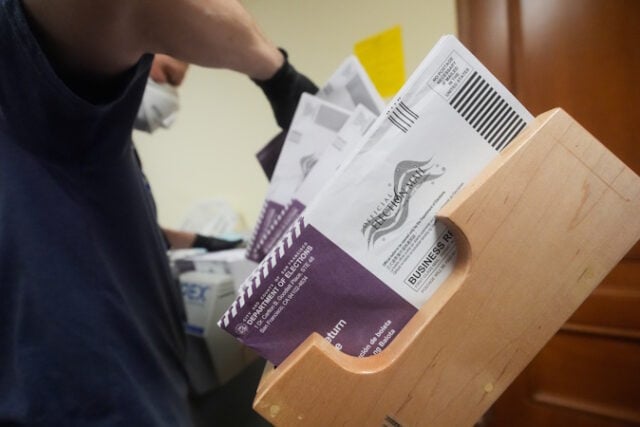
WASHINGTON — The United States Supreme Court is set to hear oral arguments in a case that could fundamentally reshape the landscape of American elections just months before the 2026 midterms. The dispute, Watson v. Republican National Committee, centers on a Mississippi law that allows mail-in ballots to be counted as long as they are postmarked by Election Day and received within five business days.
The outcome of this case carries immense implications for millions of voters and the administrative stability of the upcoming elections, where control of both the House and Senate is expected to be decided by razor-thin margins. At the heart of the legal battle is a fundamental disagreement over the meaning of a single word in federal law: “election.”
The Legal Battleground: When Does an Election End?
The case arrived at the nation’s highest court following a controversial ruling by the U.S. Court of Appeals for the 5th Circuit. A three-judge panel of that court struck down Mississippi’s grace period, concluding that federal law—which sets the Tuesday after the first Monday in November as “Election Day”—mandates that the entire process of voting, including the receipt of ballots by officials, must be completed by that date.
Mississippi Secretary of State Michael Watson, a Republican, has defended the state’s law, arguing that the “election” refers to the act of the voter making their choice. Under this interpretation, as long as a voter casts their ballot and mails it by the deadline, they have participated in the election on the federally mandated day. The subsequent delivery by the U.S. Postal Service and the counting by election officials are merely administrative steps that follow the conclusion of the “choice.”

Conversely, the Republican National Committee (RNC) and the Libertarian Party of Mississippi contend that federal statutes envision a “single, uniform day” for the election. They argue that an election is not complete until the ballots are in the state’s possession. By allowing ballots to “trickle in” days or weeks after the deadline, they argue, states are effectively extending the election beyond the window permitted by Congress.
Bloomberg’s Analysis: A Political Double-Edged Sword
While the legal arguments focus on statutory interpretation, the political ramifications are equally intense. Bloomberg News has highlighted the potential risks for the very party leading the challenge. According to a recent Bloomberg report, “A push by President Donald Trump to tighten mail-in voting rules could backfire on the Republican Party, which increasingly depends on voters who use that option to win elections.”
This internal tension within the GOP is palpable. While many in the party’s leadership, fueled by the “Stop the Count” rhetoric of the 2020 and 2024 cycles, view late-arriving ballots with suspicion, grassroots organizers note that rural voters, the elderly, and military personnel—key Republican constituencies—rely heavily on mail-in voting. If the Supreme Court rules that all ballots must be received by Election Day, it could lead to the mass disenfranchisement of voters in deep-red rural areas where mail delivery is notoriously slow.
The Specter of 2020 and 2024
The case is inextricably linked to the political movement led by President Donald Trump to curtail mail-in voting. Since returning to the White House, the Trump administration has made “election integrity” a cornerstone of its domestic policy. The administration’s Solicitor General has filed a brief in support of the RNC, arguing that “Election Day has meant the day the ballot box closes—and when election officials must be in receipt of all ballots.”
Critics, however, point to the lack of evidence regarding fraud in late-arriving ballots. Data from the 2020, 2022, and 2024 elections consistently show that mail-in voting fraud is exceedingly rare. Civil rights organizations, including the League of United Latin American Citizens (LULAC), have warned that a ruling against Mississippi would create a “chaotic and confusing” environment for the 2026 midterms.
Impact on the 2026 Midterms
If the Supreme Court aligns with the 5th Circuit, the fallout will be immediate. Approximately 28 states currently have some form of grace period for receiving mail-in ballots. These range from a few days to over two weeks in states like Washington. A broad ruling could invalidate these laws instantly, forcing state legislatures to convene emergency sessions to rewrite election codes with only months to go before the November 2026 contests.
Election officials have expressed deep concern about the logistical nightmare of such a sudden shift. “Local election officials would need to process thousands of ballots in an extremely short timeframe,” a group of administrators told the court in an amicus brief. “Simultaneously, they would need to contend with longer lines at in-person voting sites when voters who realize that their mail-in ballots will not be received in time flock to the polls to vote in person.”
Constitutional History and Precedent
The Supreme Court will have to reconcile its decision with nearly 160 years of American tradition. Proponents of grace periods point to the Civil War, when states first enacted widespread absentee voting to ensure that soldiers on the front lines could participate in democracy. Historically, these laws recognized that the “act of voting” was the priority, and the “receipt of the vote” was a secondary logistical matter.
The Justices must also navigate the “Elections Clause” of the Constitution, which grants states the primary power to set the “Times, Places and Manner” of elections, while giving Congress the authority to “make or alter” such regulations. The question is whether Congress, by setting a single day for the election in 1845, intended to occupy the field so entirely that states could not even allow for postal delays.
Conclusion: A Court Under the Microscope
As the Justices take the bench on Monday, they do so under intense public scrutiny. The conservative majority of the court has shown an increasing willingness to revisit long-standing election practices, as seen in previous rulings on the Voting Rights Act and gerrymandering. However, Chief Justice John Roberts has often expressed a desire to avoid “judicial chaos” during election cycles—a concern that may weigh heavily as the 2026 midterms loom.
The decision in Watson v. RNC will likely be released by June 2026. Whether it reinforces the current system or triggers a nationwide overhaul of mail-in voting remains to be seen. What is certain is that the ruling will be a defining moment for the Roberts Court and a pivotal factor in the outcome of the next struggle for control of the United States Congress.
Source: Bloomberg: https://www.bloomberg.com/news/articles/2026-03-22/supreme-court-hears-mail-in-ballot-deadline-case-before-2026-election.
Disclaimer
Artificial Intelligence Disclosure & Legal Disclaimer
AI Content Policy.
To provide our readers with timely and comprehensive coverage, South Florida Reporter uses artificial intelligence (AI) to assist in producing certain articles and visual content.
Articles: AI may be used to assist in research, structural drafting, or data analysis. All AI-assisted text is reviewed and edited by our team to ensure accuracy and adherence to our editorial standards.
Images: Any imagery generated or significantly altered by AI is clearly marked with a disclaimer or watermark to distinguish it from traditional photography or editorial illustrations.
General Disclaimer
The information contained in South Florida Reporter is for general information purposes only.
South Florida Reporter assumes no responsibility for errors or omissions in the contents of the Service. In no event shall South Florida Reporter be liable for any special, direct, indirect, consequential, or incidental damages or any damages whatsoever, whether in an action of contract, negligence or other tort, arising out of or in connection with the use of the Service or the contents of the Service.
The Company reserves the right to make additions, deletions, or modifications to the contents of the Service at any time without prior notice. The Company does not warrant that the Service is free of viruses or other harmful components.