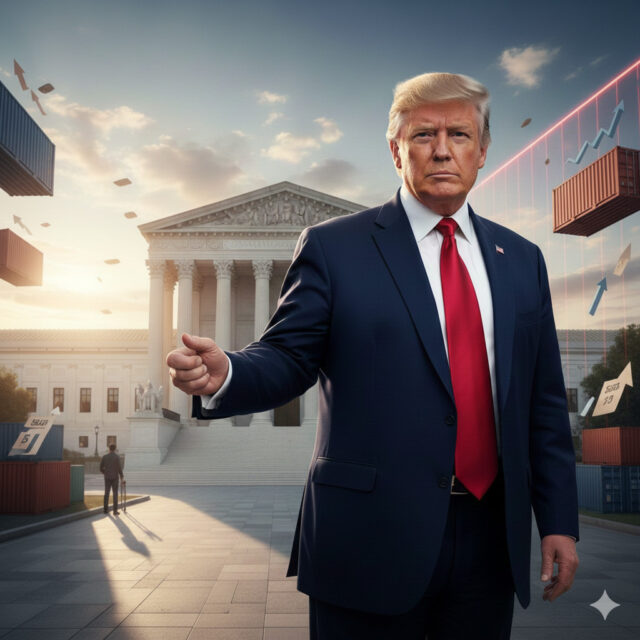
The U.S. stock market is standing at a precarious crossroads as the Supreme Court prepares to issue a definitive ruling on the legality of President Donald Trump’s sweeping global tariffs. After months of legal battles and market turbulence, the decision—expected as early as this week—is poised to be the most significant catalyst for equities since the administration first invoked emergency powers to overhaul American trade policy in April.
The case centers on whether the president overstepped his constitutional authority by bypassing Congress to impose broad duties on a vast array of imported goods. While the S&P 500 has proven remarkably resilient, rebounding nearly 40% from the lows seen during the initial “tariff shock” earlier this year, analysts warn that the calm may be deceptive.
“A decision to strike down the tariffs would remove a massive cloud of uncertainty that has hung over corporate America,” Bloomberg Intelligence analysts noted in a recent report. Conversely, a ruling in favor of the administration could cement a new era of protectionism, forcing companies to permanently restructure supply chains that have been in flux for months.
According to data compiled by Bloomberg, the sectors most sensitive to the ruling include retail, automotive, and industrial manufacturing. Companies like Nike Inc. and Mattel Inc., which rely heavily on overseas production, are viewed by analysts as the primary beneficiaries of a potential reversal. If the court finds the tariffs unlawful, these firms could not only see immediate margin relief but may also be eligible for billions of dollars in refunds for duties already paid.

The industrial sector is also on high alert. Large manufacturers such as Caterpillar Inc. and Deere & Co. have struggled with rising input costs since the levies were introduced. Bloomberg reports that Wall Street strategists expect a “relief rally” in these capital-intensive stocks if the court rules against the White House. Wells Fargo estimates that striking down the tariffs could lift S&P 500 earnings by as much as 2.4% in the coming year.
However, the legal victory for free-trade advocates might be short-lived. Even if the Supreme Court rules the current application of the International Emergency Economic Powers Act (IEEPA) was an overreach, trade experts suggest the administration is already preparing a “Plan B.”
“The White House is unlikely to surrender its trade agenda without a fight,” Bloomberg News noted, citing sources familiar with the administration’s strategy. Government lawyers have reportedly been drafting alternative justifications for the tariffs under Section 301 or Section 122 of the Trade Act of 1974, which could allow the president to re-impose similar levies under different statutory authority.
The bond market is also showing signs of nerves. Yields on the 10-year Treasury have spiked recently as investors weigh the fiscal implications of the ruling. The tariffs have provided a significant, albeit controversial, revenue stream for a government grappling with a $30 trillion debt pile. A sudden loss of that income could pressure the Treasury to increase bond issuance, further spooking a market that remains wary of inflationary pressures.
As the 10:00 a.m. opinion window approaches in Washington, the consensus on Wall Street is “cautious optimism,” tempered by the reality of a transformed global trade landscape. Whether the court upholds the president’s authority or demands a return to the status quo, the ripple effects will be felt across every corner of the global economy. For now, traders are keeping their eyes fixed on the high court, ready to hit the buy or sell button on a moment’s notice.
Disclaimer
Artificial Intelligence Disclosure & Legal Disclaimer
AI Content Policy.
To provide our readers with timely and comprehensive coverage, South Florida Reporter uses artificial intelligence (AI) to assist in producing certain articles and visual content.
Articles: AI may be used to assist in research, structural drafting, or data analysis. All AI-assisted text is reviewed and edited by our team to ensure accuracy and adherence to our editorial standards.
Images: Any imagery generated or significantly altered by AI is clearly marked with a disclaimer or watermark to distinguish it from traditional photography or editorial illustrations.
General Disclaimer
The information contained in South Florida Reporter is for general information purposes only.
South Florida Reporter assumes no responsibility for errors or omissions in the contents of the Service. In no event shall South Florida Reporter be liable for any special, direct, indirect, consequential, or incidental damages or any damages whatsoever, whether in an action of contract, negligence or other tort, arising out of or in connection with the use of the Service or the contents of the Service.
The Company reserves the right to make additions, deletions, or modifications to the contents of the Service at any time without prior notice. The Company does not warrant that the Service is free of viruses or other harmful components.