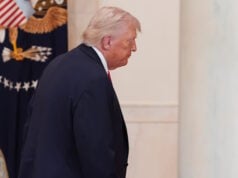
WASHINGTON — The Supreme Court of the United States appeared highly skeptical Wednesday as it heard arguments on the legality of President Trump’s sweeping global tariffs, a central pillar of his trade agenda.
Over two and a half hours, justices aggressively questioned both government lawyers defending the tariffs and the attorneys representing states and small businesses challenging them. At issue is whether Trump lawfully invoked the International Emergency Economic Powers Act (IEEPA) to impose broad import-tax measures without explicit Congressional approval.
Several justices raised pointed concerns. For example, Neil Gorsuch asked why the statute would permit the president to shut down all trade but not levy a 1 percent tariff, calling it “an odd doughnut hole”. Meanwhile, Amy Coney Barrett pressed challengers on how businesses would be refunded if the tariffs are overturned.
Beyond the legal minutiae, the case carries enormous economic weight: the ruling could reshape U.S. trade policy, impact inflation, and signal how far executive power extends in economic emergencies. With conservative-leaning justices questioning the broad scope of the president’s tariff authority, analysts suggest the court may curb at least parts of the programme. A decision could come months from now — but the tone set Wednesday suggests major limits on the use of emergency powers for economic policy may be on the horizon.

Sources:
Disclaimer
Artificial Intelligence Disclosure & Legal Disclaimer
AI Content Policy.
To provide our readers with timely and comprehensive coverage, South Florida Reporter uses artificial intelligence (AI) to assist in producing certain articles and visual content.
Articles: AI may be used to assist in research, structural drafting, or data analysis. All AI-assisted text is reviewed and edited by our team to ensure accuracy and adherence to our editorial standards.
Images: Any imagery generated or significantly altered by AI is clearly marked with a disclaimer or watermark to distinguish it from traditional photography or editorial illustrations.
General Disclaimer
The information contained in South Florida Reporter is for general information purposes only.
South Florida Reporter assumes no responsibility for errors or omissions in the contents of the Service. In no event shall South Florida Reporter be liable for any special, direct, indirect, consequential, or incidental damages or any damages whatsoever, whether in an action of contract, negligence or other tort, arising out of or in connection with the use of the Service or the contents of the Service.
The Company reserves the right to make additions, deletions, or modifications to the contents of the Service at any time without prior notice. The Company does not warrant that the Service is free of viruses or other harmful components.