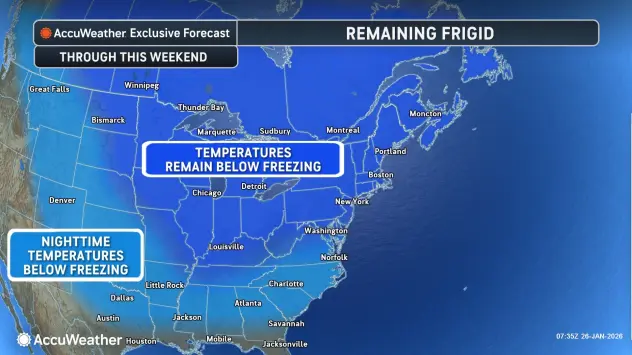
In the wake of a historic winter storm that has paralyzed the Southern United States, a new and more insidious threat is emerging: a prolonged Arctic blast. After a weekend of heavy sleet and thick freezing rain that snapped power lines and brought life to a standstill, meteorologists warn that the hardship is far from over. Millions of residents from Texas to Virginia are now bracing for a week of dangerously low temperatures that will hinder recovery efforts and turn melting slush into lethal sheets of ice.
According to AccuWeather, the scale of the destruction is significant, with at least one million utility customers left in the dark as of Sunday afternoon. The storm, which many are calling the most significant winter event to hit the region in five years, has encased entire communities in a thick glaze of ice. In some of the hardest-hit areas, such as Oxford, Mississippi, “1 to 2 inches of freezing rain has accrued on exposed surfaces,” causing scores of trees to topple onto homes and vehicles.
Video Courtesy DWS
- 8.5 inches of snow in St. Louis, Missouri
- 11.4 inches in Central Park, New York
- 18.0 inches in Simsbury, Connecticut
- 16.7 inches in Boston, Massachusetts
- 14.2 inches in Batesville, Indiana
- 12.0 inches in Pittsburgh, Pennsylvania
- 12.0 inches in Hilliard, Ohio
- 0.5 of an inch in Nashville, Tennessee
- 0.75 of an inch in Dunbar, West Virginia
- 0.75 of an inch in Gary City, Texas
- 0.75 of an inch in Chatham, Louisiana
- 1.0 inch in Oxford, Mississippi
- 1.0 inch in Idabel, Oklahoma
- 1.0 inch in Greenville-Spartan, South Carolina
A Week of Glacial Conditions
While the precipitation has largely moved out of the southeastern quarter of the country, the departing clouds are revealing a landscape transformed into a frozen tundra. The primary concern for emergency management officials is now the “thaw-and-freeze” cycle. Even with daytime sunshine, temperatures in many regions will struggle to climb above freezing. Whatever snow or ice manages to melt during the afternoon will promptly refreeze as sun-down approaches, creating “black ice” that is nearly invisible to the naked eye.
“Where there is some melting, areas made wet or slushy will freeze solid in the evening and may put up even more resistance to natural melting the next day,” AccuWeather senior meteorologist Alex Sosnowski noted. This cycle creates a compounding hazard for road crews, who may find that their supplies of salt and sand are quickly exhausted as they are forced to treat the same stretches of highway every single morning.

The Danger of the Dark
For those without electricity, the arrival of the Arctic air mass is more than an inconvenience—it is a life-threatening crisis. Nighttime temperatures across the ice-affected zones are forecast to plummet into the 20s, teens, and even single digits in high-elevation areas. Without central heating, the risk of hypothermia and cardiac stress increases dramatically, particularly for the elderly and vulnerable populations.
Public health officials are also sounding the alarm regarding carbon monoxide poisoning. During prolonged blackouts, residents often turn to portable generators, charcoal grills, or gas ovens to stay warm. AccuWeather experts warn that these “generator mistakes can be deadly,” urging everyone to keep combustion-based heat sources outdoors and well away from windows to prevent the buildup of odorless, lethal gas.
Travel and Infrastructure at a Standstill
The impact on transportation has been immediate and severe. In the southern Appalachians, travel remained shut down through Monday morning, and officials continue to urge motorists to stay off the roads. “For motorists inexperienced in snow or ice driving, braking is significantly reduced on hard-packed snow compared to wet conditions,” AccuWeather reports, adding that “even a thin sheet of ice may offer no braking traction at all.”
The infrastructure damage is not limited to the roads. The weight of the ice—which reached up to 5 inches of sleet in some mountainous pockets—has left telecommunications and power grids in shambles. Repair crews are working around the clock, but the treacherous conditions mean that some remote areas might not see the lights come back on until early February.
Looking Ahead
As the South struggles to dig out, the reach of the cold is extending further than many expected. Freezing temperatures are forecast to push as far south as the north-central Florida Peninsula, with the potential for frost reaching into the interior of the Sunshine State later this week. This poses a secondary threat to the region’s agricultural interests, specifically citrus and winter vegetable crops that are sensitive to even brief freezes.
While much of the coming week is expected to remain dry, offering a brief window for cleanup, the relief may be short-lived. AccuWeather meteorologists are already monitoring the potential for another storm system to develop in the Eastern U.S. by next weekend. For a region already pushed to its breaking point by the current “glaciated” conditions, the prospect of more winter weather is a sobering one.
For now, the focus remains on survival and restoration. Residents are encouraged to check on neighbors, conserve what heat they have, and remain patient as utility workers navigate the frozen maze of downed timber and power lines. In the South, where winter storms are often fleeting, this particular event serves as a chilling reminder of the power of the elements.
Source: AccuWeather
Disclaimer
Artificial Intelligence Disclosure & Legal Disclaimer
AI Content Policy.
To provide our readers with timely and comprehensive coverage, South Florida Reporter uses artificial intelligence (AI) to assist in producing certain articles and visual content.
Articles: AI may be used to assist in research, structural drafting, or data analysis. All AI-assisted text is reviewed and edited by our team to ensure accuracy and adherence to our editorial standards.
Images: Any imagery generated or significantly altered by AI is clearly marked with a disclaimer or watermark to distinguish it from traditional photography or editorial illustrations.
General Disclaimer
The information contained in South Florida Reporter is for general information purposes only.
South Florida Reporter assumes no responsibility for errors or omissions in the contents of the Service. In no event shall South Florida Reporter be liable for any special, direct, indirect, consequential, or incidental damages or any damages whatsoever, whether in an action of contract, negligence or other tort, arising out of or in connection with the use of the Service or the contents of the Service.
The Company reserves the right to make additions, deletions, or modifications to the contents of the Service at any time without prior notice. The Company does not warrant that the Service is free of viruses or other harmful components.