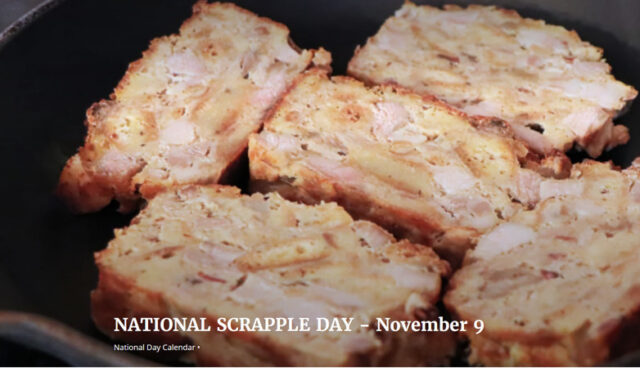
National Scrapple Day is observed annually on November 9th. Scrapple is arguably the first pork food invented in America. For those who are not familiar with scrapple, also known by the Pennsylvania Dutch name “pon haus,” it is traditionally a mush of pork scraps and trimmings combined with cornmeal, wheat flour, and spices. (The spices may include sage, thyme, savory, and black pepper.) The mush is then formed into a semi-solid loaf, sliced, and pan-fried.
-
- 800 BC – The process of making dishes similar to Scrapple can be found in pre-Roman Europe
- 1602 – German immigrants brought the dish to Pennsylvania.
- 19th Century – Meatloaf in the contemporary American sense did not appear in cookbooks until the late 19th century.
- 1863 – Habbersett, the first brand to market scrapple, is created. Originally located in Media, Penn., Habbersett Pork Products first started selling scrapple to the masses in 1863, and you can still get that same product — with some minor recipe tweaks — in stores today.
- 1926 – Rapa, a Delaware-based company in competition with Habbersett, begins the mass production of scrapple.
- The immediate ancestor of scrapple was the Low German dish pangas, which was adapted to use locally available ingredients. In parts of Pennsylvania, it is still called Pannhaas, panhoss, pon hoss, or pannhas.
- Scrapple can be found in supermarkets, both in the refrigerated and frozen cases.
- Home recipes for beef, chicken, and turkey scrapple are available.
- Scrapple is sometimes deep-fried or broiled instead of pan-fried.
- Scrapple is typically eaten as a breakfast side dish.
- Condiments are sometimes served with scrapple, some of which include apple butter, ketchup, jelly, maple syrup, honey, horseradish or mustard.
- Scrapple is a dish made out of the leftover butchering of different animals such as pigs, chickens, and cows, more specifically the entrails and internal organs, which are boiled, minced and mixed with cornbread, wheat flour, and spices.
- Other cities have their own variations of scrapple. While Philly may lay claim as the official hometown of scrapple, other cities have their own regional specialties that strongly resemble it: goetta, made with ground meat and oats, is popular around the Cincinnati area, as is livermush (mmmm!!!!), scrapple’s liver-laden cousin popular in the South.
- The Apple-Scrapple Festival in Bridgeville, Del., celebrates all things scrapple and apples and attracts more than 25,000 visitors each year.
- Meatloaf is a traditional German, Scandinavian, and Belgian dish, and it is a cousin to the Dutch meatball.
- American meatloaf has its origins in scrapple, a mixture of ground pork and cornmeal served by German-Americans in Pennsylvania since Colonial times.
Sources:

Disclaimer
Artificial Intelligence Disclosure & Legal Disclaimer
AI Content Policy.
To provide our readers with timely and comprehensive coverage, South Florida Reporter uses artificial intelligence (AI) to assist in producing certain articles and visual content.
Articles: AI may be used to assist in research, structural drafting, or data analysis. All AI-assisted text is reviewed and edited by our team to ensure accuracy and adherence to our editorial standards.
Images: Any imagery generated or significantly altered by AI is clearly marked with a disclaimer or watermark to distinguish it from traditional photography or editorial illustrations.
General Disclaimer
The information contained in South Florida Reporter is for general information purposes only.
South Florida Reporter assumes no responsibility for errors or omissions in the contents of the Service. In no event shall South Florida Reporter be liable for any special, direct, indirect, consequential, or incidental damages or any damages whatsoever, whether in an action of contract, negligence or other tort, arising out of or in connection with the use of the Service or the contents of the Service.
The Company reserves the right to make additions, deletions, or modifications to the contents of the Service at any time without prior notice. The Company does not warrant that the Service is free of viruses or other harmful components.