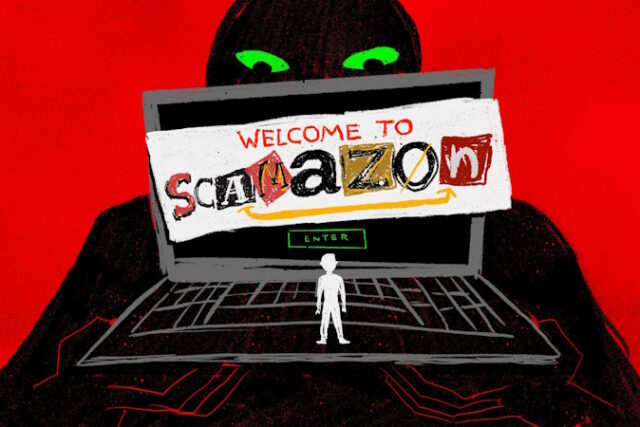
Scammers are impersonating well-known companies to siphon hundreds of millions of dollars out of the wallets of unsuspecting Americans.
Often posing as representatives from Best Buy’s Geek Squad, Amazon, PayPal and several other big brand names, fraudsters stole over $660 million through business-impersonation schemes in 2023 alone, according to a new report from the Federal Trade Commission.
Such scams have become increasingly prevalent since the onset of the pandemic, FTC data suggests. For example, in the first three months of 2020, the FTC received about 26,000 complaints related to business impersonation fraud. Complaints of business imposters peaked at roughly 130,000 between July and September of 2023, and the scheme remains by far the most common type of imposter scam today.

“Because the vast majority of frauds are not reported to the government, these figures reflect just a small fraction of the public harm,” the FTC report says.
In fact, a 2021 study found that less than 5% of fraud victims lodge complaints with the Better Business Bureau or a government agency.
Most common business-imposter scams
The FTC report shows that scammers love to impersonate certain businesses, especially popular technology and banking brands. But the most common scams aren’t always the most lucrative for the fraudsters.
Here’s a look at the 10 most commonly impersonated businesses in 2023:
- Best Buy/Geek Squad: 52,000 complaints resulting in $15 million in theft
- Amazon: 34,000 complaints; $19 million theft
- PayPal: 10,000 complaints; $16 million theft
- Microsoft: 7,000 complaints; $60 million theft
- Publishers Clearing House: 7,000 complaints; $49 million theft
- Norton/Lifelock: 6,000 complaints; $11 million theft
- Apple: 5,000 complaints; $17 million theft
- Comcast/Xfinity: 4,000 complaints; $2 million theft
- Bank of America: 4,000 complaints; $8 million theft
- Wells Fargo: 3,000 complaints; $11 million theft
Known techniques include fake Geek Squad emails that try to get you to renew a service that you never signed up for; pop-up security alerts seemingly from Microsoft that prompt you to call a hotline for help; and phone calls from someone pretending to be from Publishers Clearing House saying you need to pay fees to collect your winnings from a non-existent sweepstakes.
The FTC also says that scammers most commonly request payments via PayPal, Cash App or Zelle or gift cards from Apple, Target or eBay.
Scammers may deploy a variety of schemes to steal your money. In addition to posing as familiar businesses, imposters also frequently pretend to be a family member, a friend, a government worker or an online love interest.
Collectively, the FTC received more than 850,000 imposter scam complaints in 2023, resulting in a loss of at least $2.7 billion.
Scammers are constantly changing their tactics and coming up with evermore convincing ploys. Familiarizing yourself with the trends outlined above can certainly help you identify well-known scams, though the list is far from exhaustive.
Especially with the introduction of generative artificial intelligence, scammers can easily create persuasive scripts, graphics and even replicas of a family member’s voice.
Avoiding scams requires vigilance. If you ever find yourself in a situation where someone (even if you think it is someone you know) is demanding money quickly, take a second to think things through. The FTC recommends getting confirmation about the requester’s identity and situation first.
“Anyone who’s rushing you into sending money, buying gift cards, or investing in cryptocurrency is almost certainly a scammer,” the agency says.
Another golden rule: Never click links from unexpected texts or emails. And don’t answer calls from unknown numbers.
Even caller ID is not to be trusted, the FTC says, as phone numbers can be spoofed with relative ease. Instead, use a contact method you know to be true — like an email address or phone number (better yet, ask in person) — to verify the request that the business or person contacting you is legit.
Of course, payment requests via gift card, crypto or money transfers should set off immediate alarm bells.
“Only scammers say there’s only one way to pay,” the FTC says.
Disclaimer
Artificial Intelligence Disclosure & Legal Disclaimer
AI Content Policy.
To provide our readers with timely and comprehensive coverage, South Florida Reporter uses artificial intelligence (AI) to assist in producing certain articles and visual content.
Articles: AI may be used to assist in research, structural drafting, or data analysis. All AI-assisted text is reviewed and edited by our team to ensure accuracy and adherence to our editorial standards.
Images: Any imagery generated or significantly altered by AI is clearly marked with a disclaimer or watermark to distinguish it from traditional photography or editorial illustrations.
General Disclaimer
The information contained in South Florida Reporter is for general information purposes only.
South Florida Reporter assumes no responsibility for errors or omissions in the contents of the Service. In no event shall South Florida Reporter be liable for any special, direct, indirect, consequential, or incidental damages or any damages whatsoever, whether in an action of contract, negligence or other tort, arising out of or in connection with the use of the Service or the contents of the Service.
The Company reserves the right to make additions, deletions, or modifications to the contents of the Service at any time without prior notice. The Company does not warrant that the Service is free of viruses or other harmful components.