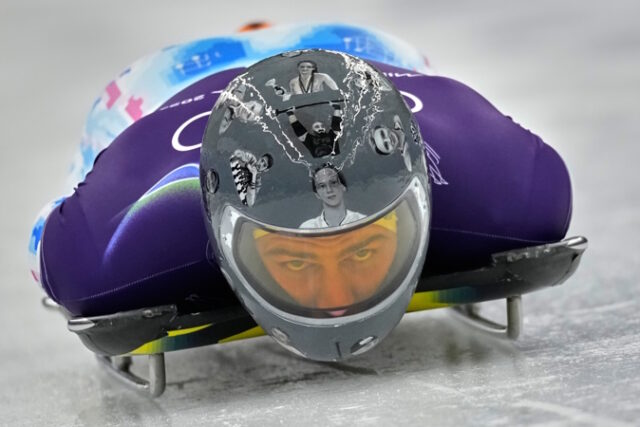
The icy track at Cortina d’Ampezzo was supposed to be the stage for Vladyslav Heraskevych’s greatest sporting achievement. Instead, on February 12, 2026, it became the site of a profound moral stand that reverberated far beyond the world of winter sports. Just minutes before the men’s skeleton event was set to begin, the International Olympic Committee (IOC) officially barred Heraskevych from competing. The reason was not a performance-enhancing drug or a technical safety violation, but a piece of equipment: his “Helmet of Memory.”
The Controversy of the “Helmet of Memory”
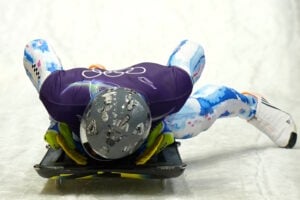
Heraskevych, 27, arrived at the Milano Cortina 2026 Winter Games with a custom-painted helmet featuring the portraits of 24 Ukrainian athletes and coaches who have been killed since the Russian invasion of Ukraine began in 2022. Among the faces were teenage weightlifter Alina Peregudova and boxer Pavlo Ishchenko—individuals Heraskevych described as “Olympic family.”
To the athlete, the helmet was a silent act of remembrance for friends and colleagues who would never again have the chance to compete. To the IOC, however, the gear violated Rule 50 of the Olympic Charter, which prohibits any form of “political, religious, or racial propaganda” on the field of play.
A Failed Compromise
The tension between the athlete and officials built over several days. While the IOC permitted Heraskevych to wear the helmet during training runs, they issued a firm ultimatum for the competition itself. IOC President Kirsty Coventry met with Heraskevych at the top of the track just 75 minutes before his scheduled start time in a final, emotional attempt to find common ground.

The IOC offered several compromises:
- Wearing a plain black armband or ribbon during the race.
- Carrying the tribute helmet through the “mixed zone” for media interviews.
- Displaying the helmet only after the competition had concluded.
Heraskevych refused. He argued that the helmet contained no political slogans or text and was purely a commemorative gesture. “I never wanted a scandal,” Heraskevych said in a social media video. “But to remove it would be a betrayal to those who gave their lives.”
Coventry, a former Olympic swimming champion, was seen leaving the meeting in tears. She later told reporters, “No one—especially me—is disagreeing with the messaging. It is a powerful message of memory. But this is literally about the rules. Sadly, that means no messaging is allowed on the field of play.”
The Price of Dignity
Following his refusal to switch helmets, the International Bobsleigh and Skeleton Federation (IBSF) jury removed Heraskevych from the starting list. His Olympic accreditation was briefly rescinded before being reinstated for non-competitive purposes, effectively ending his quest for a medal. Based on his recent training times, Heraskevych had been considered a legitimate contender for a podium finish—potentially Ukraine’s first of the 2026 Games.
“Emptiness,” Heraskevych replied when asked how he felt. “I was at many funerals in Ukraine. Because of their sacrifice, we are here today. This is the price of our dignity.”
Global Reaction and Political Fallout
The disqualification sparked immediate and fierce debate. Ukrainian President Volodymyr Zelenskyy championed the athlete’s stance, stating that “sport shouldn’t mean amnesia” and that the IOC’s decision played “into the hands of aggressors.” Other athletes also showed solidarity; during the luge team relay, the Ukrainian team took a knee and hoisted their helmets skyward in a silent protest.
Critics of the IOC pointed to perceived inconsistencies in the enforcement of Rule 50. Heraskevych noted that US figure skater Maxim Naumov was recently allowed to hold a photo of his late parents during his scores, and others questioned the presence of Russian flags in the stands despite official bans.
In a press conference in Milan, IOC spokesman Mark Adams defended the decision by citing the need for neutrality. “There are 130 conflicts going on in the world,” Adams said. “If we have no rules, we have no sport. We cannot have 130 different conflicts featured on the field of play.”
The Legacy of the Stand
Heraskevych has since appealed the disqualification to the Court of Arbitration for Sport (CAS), arguing that the exclusion was “disproportionate” and caused “irreparable sporting harm.” Regardless of the legal outcome, Heraskevych’s “Helmet of Memory” has become one of the defining images of the 2026 Winter Olympics.
While he will not leave Italy with a medal, his supporters believe he has achieved something more lasting. As Ukrainian skier Kateryna Kotsar posted on Instagram: “Vladyslav, for us and for the whole world, you are a champion. Even without starting.”
Sources and Links
- The Guardian: ‘It’s emptiness’: banned Ukrainian athlete accuses IOC of fuelling Russia’s propaganda
- Washington Post: Ukrainian athlete appeals ban from Olympic skeleton event over helmet images
- Associated Press: Ukraine’s Vladyslav Heraskevych out of Winter Olympics because of banned helmet
- CBS News: Ukrainian Olympian banned from Winter Games over helmet showing compatriots killed in Russia’s war
- IOC Official Press Release: Skeleton pilot Vladyslav Heraskevych not allowed to participate at Milano Cortina 2026
Disclaimer
Artificial Intelligence Disclosure & Legal Disclaimer
AI Content Policy.
To provide our readers with timely and comprehensive coverage, South Florida Reporter uses artificial intelligence (AI) to assist in producing certain articles and visual content.
Articles: AI may be used to assist in research, structural drafting, or data analysis. All AI-assisted text is reviewed and edited by our team to ensure accuracy and adherence to our editorial standards.
Images: Any imagery generated or significantly altered by AI is clearly marked with a disclaimer or watermark to distinguish it from traditional photography or editorial illustrations.
General Disclaimer
The information contained in South Florida Reporter is for general information purposes only.
South Florida Reporter assumes no responsibility for errors or omissions in the contents of the Service. In no event shall South Florida Reporter be liable for any special, direct, indirect, consequential, or incidental damages or any damages whatsoever, whether in an action of contract, negligence or other tort, arising out of or in connection with the use of the Service or the contents of the Service.
The Company reserves the right to make additions, deletions, or modifications to the contents of the Service at any time without prior notice. The Company does not warrant that the Service is free of viruses or other harmful components.