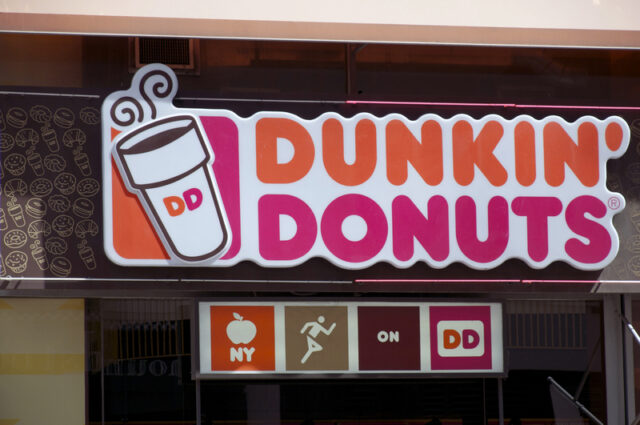
The morning ritual for millions of Americans, particularly in the Northeast, usually involves a quick stop for a caffeinated jolt and perhaps a sugary treat. But that daily routine has suddenly become the front line of a brewing cultural and regulatory war. Robert F. Kennedy Jr., the U.S. Secretary of Health and Human Services, has set his sights on the nation’s largest coffee chains, specifically Dunkin’ and Starbucks, demanding they prove their high-sugar beverages are safe for consumption.
The move, part of Kennedy’s broader “Make America Healthy Again” (MAHA) initiative, has sent shockwaves through the food and beverage industry and ignited a fierce defensive reaction from the “Dunkin’ Nation.” As The Washington Post reported, Kennedy’s latest crusade has “the potential to escalate” into a significant political standoff, declaring what many see as a “war on Dunkin’,” the Massachusetts-based chain that is less a brand and more a way of life in New England.
The Challenge to “Big Sugar”
The opening salvo of this conflict took place last week at the “Austin Eat Real Food Rally,” an event hosted by MAHA Action. Kennedy, known for his skepticism of industrial food processing and chemical additives, did not mince words when addressing the audience about the sugar content in popular iced beverages.
“We’re going to ask Dunkin’ Donuts and Starbucks, ‘Show us the safety data that show that it’s okay for a teenage girl to drink an iced coffee with 115 grams of sugar in it,’” Kennedy told the crowd. He added, with characteristic defiance, “I don’t think they’re going to be able to do it.”

Kennedy’s focus is not just on the calories, but on the regulatory status of the ingredients themselves. Under current FDA rules, many substances are categorized as “Generally Recognized as Safe” (GRAS), a loophole that allows companies to add ingredients to food without explicit, pre-market government approval. Kennedy is now signaling a desire to close that loophole. During a recent appearance on 60 Minutes, he suggested that the FDA is reviewing petitions to remove the safety status for certain carbohydrates and sweeteners if companies cannot provide empirical evidence of their long-term safety.
The “Come and Take It” Response
While Kennedy’s supporters view this as a long-overdue reckoning for the “ultra-processed” food industry, the reaction from New England has been one of visceral, regional pride. In Massachusetts, where Dunkin’ is a cultural cornerstone, the response was swift and sharp.
Governor Maura Healey (D) took to social media to signal her defiance, posting an altered version of the historic Texas “Come and Take It” flag. Instead of the traditional cannon, the flag featured a recognizable Dunkin’ iced coffee cup. The message was clear: in the Commonwealth, the right to a “medium regular” is sacred.
The Washington Post noted that Kennedy, who was raised in the heart of Massachusetts political royalty, is now drawing heavy “flak on social media for his comments about the coffee chain that is a way of life” in his home state. Critics have labeled the move “wicked idiotic,” a uniquely local barb that reflects the deep-seated connection between the brand and the identity of the region’s blue-collar and white-collar workers alike.
The Math of the Menu
The health data Kennedy cites is indeed eye-popping. Nutritionists have long warned about the “liquid candy” nature of modern coffee shop menus. A standard 48-ounce latte—a size Dunkin’ has recently begun testing in select markets—can contain more than 1,000 calories and upwards of 180 grams of sugar. To put that in perspective, the American Heart Association recommends a daily limit of about 25 to 36 grams of added sugar for most adults.
Kennedy’s argument is that the sheer volume of sugar in a single serving constitutes a health hazard that should require the same level of safety scrutiny as a new drug or a chemical additive. He has pointed to a citizen petition proposed by David Kessler, a former FDA commissioner, which argues that the burden of proof should rest on the manufacturers. “To revoke GRAS status, FDA does not have to prove that the processed refined carbohydrates… are unsafe, but that their safety has not been established,” the petition reads.
A Regulatory Tightrope
Despite the aggressive rhetoric, Kennedy has sought to frame his approach as one of transparency rather than heavy-handed prohibition. On 60 Minutes, he clarified his stance: “I’m not saying that we’re going to regulate ultra-processed food,” he said, instead emphasizing voluntary cooperation and the disclosure of safety data.
However, the political reality is more complex. The White House budget office has been reviewing proposed rules that could reshape the food industry since December. With studies estimating that nearly 75 percent of the American food supply is “ultra-processed,” any move to reclassify common ingredients would be met with immense legal and lobbying resistance from “Big Food.”
The coffee industry, for its part, has remained largely silent in the immediate wake of Kennedy’s comments. Neither Dunkin’ nor Starbucks provided official responses to the Secretary’s specific challenge regarding safety data. Historically, these companies have defended their products by pointing to the availability of sugar-free alternatives and the fact that nutrition information is clearly posted for consumers to make their own choices.
The Cultural Divide
The “Dunkin’ War” highlights a growing divide in American politics that transcends traditional party lines. On one side is a movement focused on systemic health reform, targeting the metabolic health crisis and the industrial food complex. On the other is a defense of personal liberty and cultural tradition, where a “coffee run” is seen as a harmless, affordable luxury.
For Kennedy, the battle is worth the political cost. By taking on a brand as beloved as Dunkin’, he is signaling that no company is too iconic to escape scrutiny in his quest to “Make America Healthy Again.” But as Governor Healey’s “Come and Take It” post suggests, he may find that the residents of his own home state are more attached to their iced coffees than they are to his regulatory vision.
As this standoff continues, the outcome will likely depend on whether the public views Kennedy as a protector of children’s health or as a bureaucrat meddling in the simple pleasures of the American morning. For now, the “Dunkin’ Nation” is standing its ground, one orange-and-pink cup at a time.
Source: The Washington Post
Disclaimer
Artificial Intelligence Disclosure & Legal Disclaimer
AI Content Policy.
To provide our readers with timely and comprehensive coverage, South Florida Reporter uses artificial intelligence (AI) to assist in producing certain articles and visual content.
Articles: AI may be used to assist in research, structural drafting, or data analysis. All AI-assisted text is reviewed and edited by our team to ensure accuracy and adherence to our editorial standards.
Images: Any imagery generated or significantly altered by AI is clearly marked with a disclaimer or watermark to distinguish it from traditional photography or editorial illustrations.
General Disclaimer
The information contained in South Florida Reporter is for general information purposes only.
South Florida Reporter assumes no responsibility for errors or omissions in the contents of the Service. In no event shall South Florida Reporter be liable for any special, direct, indirect, consequential, or incidental damages or any damages whatsoever, whether in an action of contract, negligence or other tort, arising out of or in connection with the use of the Service or the contents of the Service.
The Company reserves the right to make additions, deletions, or modifications to the contents of the Service at any time without prior notice. The Company does not warrant that the Service is free of viruses or other harmful components.