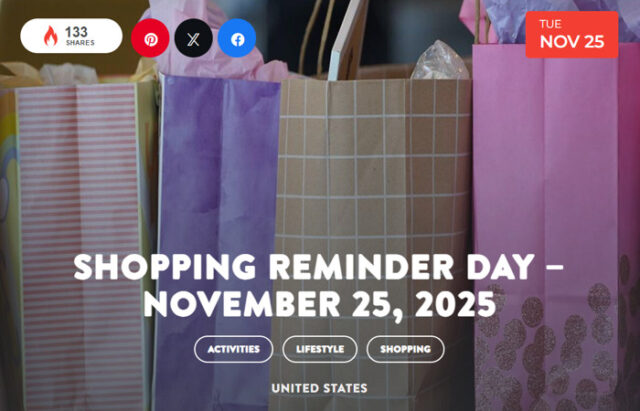
Shopping Reminder Day is held annually on November 25, and we won’t let you forget it. On your marks, get set, shop! After you’ve enjoyed the turkey and cranberry sauce on Thanksgiving, it’s time to make sure you are fully prepared for Christmas, Hanukkah, or Kwanzaa and finish any last-minute shopping.
- There are 30 days until Christmas.
- There are 31 days until the start of Kwanzaa.
- There are 15 days until Hanukkah begins.
History Facts
- 1869 – The first recorded use of the term ‘Black Friday’ is applied to the crash of the U.S. gold market.
- 1950 – The Philadelphia police use the term ‘Black Friday’ to describe the chaos that ensues on the day after Thanksgiving.
- 1985 – Retailers reinvent Black Friday, turning it into a positive experience.
- 2005 – Retailers created Cyber Monday to encourage online shopping.
- 91% of consumers plan to celebrate the winter holidays
- Consumers are budgeting an average $890 for gifts and other seasonal items
- Families with children plan to spend $33 more on average on gifts this year
- 186.9 million people are planning to shop from Thanksgiving Day through Cyber Monday this year
- Top toys include Legos, Barbie, Hot Wheels, and a doll
- Consumers are budgeting an average $890 for gifts and other seasonal items like decorations, cards, food, and candy. Source
- Consumers continue to prioritize their loved ones, and this is especially true of those with children. Families with children plan to spend $33 more on average on gifts in 2025. Source
- 42% of holiday shoppers plan to browse and buy items before November, but even with the early start, most shoppers (60%) expect to wrap up their holiday buying in December. Source
- The busiest shopping day of the year is the Saturday before Christmas.
- Like casinos, shopping malls are designed to make people lose track of time. This is achieved by removing clocks and windows to prevent views of the outside world.
- A shopper who first purchases an item on their shopping list is more likely to buy unrelated items later to reward themselves.
- Women are directly or indirectly responsible for up to $17.4 trillion or 85% of consumer spending. Source
- Single shoppers make 45% more impulse purchases than married shoppers.
- Worldwide, women spend almost $40 trillion on consumer goods, the equivalent of 50% of global consumer spending. Source
- 43% of women and 32% of men shop on online marketplaces. Source
- Consumer direct shopping is the least popular option among men (11% usage) and women (13% usage). Source
- Even if consumers are unaware of an item’s original purchase price, research shows that a “50% off” sign increases sales.
- Red is an excellent colour for marketing because it encourages spending. As a result, advertisers will purposefully incorporate red into their advertisements and displays.
- Escalators are strategically placed to force shoppers to pass as many storefronts as possible.
- The average mall shopper spends 80 minutes and $75 per visit.
- Seven Yankee Stadiums would fit inside the Mall of America.
- There are 46,990 shopping malls in the United States.
- The biggest mall in the world is the Ran Mall in Tehran.
- The average holiday shopper will spend $107.50 on themselves.
- Retailers rely on several psychological triggers to attract consumers into their store, such as placing limits on items, offering “gifts” with purchase, employing visual tricks, and declaring that sales are ending soon (when in fact discounts are common throughout the season)
- Six percent of the U.S. population can be considered “compulsive buyers,” which is an addiction to shopping that affects both men and women equally.
- December 15-24th is the crux of the holiday shopping season, accounting for 40% of holiday business.
- Approximately 42% of U.S. consumers use Amazon as their primary gift-buying destination.
- Consumers are naturally more drawn to the center of displays, which is precisely where retailers place pricier items. The second most popular placement is just to the right of the center, where most right-handed people are most likely to see and touch first.
- One in 3 holiday shoppers believes that it is more important to spend money on loved ones than to stay within a budget.
- Nearly 40% of Americans begin their holiday shopping before Halloween.
- Sixty percent of consumers have completed a “buy online” to “pickup in-store” purchase via mobile.
- Over 90% of people buying on Amazon wouldn’t purchase an item with fewer than three stars.
- Free shipping is the incentive online shoppers want most (88%).
- Ever wondered why stores have hard flooring? Designers believe women will spend more if they hear the sound of their heels on polished floors. Carpet, on the other hand, makes consumers feel at home.
Sources:

Disclaimer
Artificial Intelligence Disclosure & Legal Disclaimer
AI Content Policy.
To provide our readers with timely and comprehensive coverage, South Florida Reporter uses artificial intelligence (AI) to assist in producing certain articles and visual content.
Articles: AI may be used to assist in research, structural drafting, or data analysis. All AI-assisted text is reviewed and edited by our team to ensure accuracy and adherence to our editorial standards.
Images: Any imagery generated or significantly altered by AI is clearly marked with a disclaimer or watermark to distinguish it from traditional photography or editorial illustrations.
General Disclaimer
The information contained in South Florida Reporter is for general information purposes only.
South Florida Reporter assumes no responsibility for errors or omissions in the contents of the Service. In no event shall South Florida Reporter be liable for any special, direct, indirect, consequential, or incidental damages or any damages whatsoever, whether in an action of contract, negligence or other tort, arising out of or in connection with the use of the Service or the contents of the Service.
The Company reserves the right to make additions, deletions, or modifications to the contents of the Service at any time without prior notice. The Company does not warrant that the Service is free of viruses or other harmful components.