Choosing the right roofing contractor can mean the difference between a roof that protects your home for decades and one that causes endless problems. With significant money at stake and your home’s protection on the line, asking the right questions upfront is essential. Here’s your comprehensive guide to vetting roofing contractors before making a decision.
Licensing and Insurance
Are you licensed to work in this state/county?
This is non-negotiable. Every legitimate roofing contractor, such as The Roofing Guys in Columbus, OH, should hold the proper licenses required by your state and local jurisdiction. Ask for their license number and verify it with your state’s licensing board. Unlicensed contractors offer no recourse if something goes wrong and may not follow building codes.
Do you carry liability insurance and workers’ compensation?
Don’t just take their word for it—ask for certificates of insurance and verify them directly with the insurance company. Liability insurance protects your property if the contractor damages something during the job. Workers’ compensation protects you from liability if a worker is injured on your property. Without these, you could be held financially responsible for accidents or damage.
Can I see proof of your insurance coverage?
Request current certificates of insurance and check the expiration dates. Call the insurance company to confirm the policy is active. A legitimate contractor will have no problem providing this documentation.

Experience and Reputation
How long have you been in business?
While newer companies aren’t necessarily bad, established contractors with 5-10+ years in business have a proven track record. They’re also more likely to be around if warranty issues arise years down the road.
Do you specialize in residential roofing?
Some contractors handle both commercial and residential work, but you want someone experienced with homes like yours. Ask how many residential roofs they complete annually.
Can you provide local references from recent projects?
Ask for at least three references from projects completed in the last year, preferably in your area. Actually call these references and ask about their experience, the quality of work, how the crew treated their property, and whether they’d hire the contractor again.
Do you have online reviews I can check?
Look beyond their website to independent review sites like Google, Yelp, and the Better Business Bureau. Pay attention to how the company responds to negative reviews—it shows their customer service approach.
Have you worked on roofs similar to mine?
If you have a steep roof, historic home, or unusual roofing material, ensure the contractor has specific experience with your type of project. Ask to see photos of similar work they’ve completed.
Project Specifics
Will you provide a free, detailed written estimate?
Be wary of contractors who charge for estimates or provide only verbal quotes. A detailed written estimate should include materials (brand and grade), labor, timeline, payment schedule, and warranty information. Get at least three estimates for comparison.
What roofing materials do you recommend for my home, and why?
A good contractor will explain the pros and cons of different materials based on your climate, home style, and budget. They shouldn’t just push the most expensive option or only work with one manufacturer.
Will you remove the old roof or install over it?
Most experts recommend the complete removal (tear-off) of old roofing to allow inspection of the deck and ensure proper installation. Installing over existing shingles is sometimes allowed but can mask problems and reduce the new roof’s lifespan.
How will you protect my property during the project?
Ask about their process for protecting landscaping, siding, windows, and outdoor furniture. Will they use tarps? How will they handle debris? What about protecting your vehicles and driveway?
What does your cleanup process include?
Roofing projects create lots of debris. The contractor should thoroughly clean your property, including using a magnetic roller to pick up nails. Ask if this is included in your estimate or costs extra.
Timeline and Logistics
How long will the project take?
Most residential roofs can be completed in 1-3 days, depending on size and complexity. Be skeptical of timelines that seem too short or unnecessarily long. Ask what factors might extend the timeline.
When can you start, and do you have the project in writing?
Get the start date in writing. Busy seasons might mean waiting weeks, which is fine—good contractors are often booked out. But you should have a firm date before signing a contract.
Who will be doing the actual work?
Will it be the company’s own employees or subcontractors? Subcontracting isn’t necessarily bad, but you want to know who’s responsible for the work quality. Ask if the same protections (insurance, workers’ comp) extend to any subcontractors.
Will there be a project supervisor on-site?
For larger projects, having a supervisor or foreman ensures quality control and gives you a point of contact for questions or concerns during the work.
Contract and Payment
Can I see a copy of your standard contract before committing?
Review the contract carefully before signing. It should include all project details, materials, the timeline, the payment schedule, warranty information, and what happens in the event of delays or disputes.
What’s your payment schedule?
Be cautious about contractors who demand full payment upfront. Standard practice is usually a small deposit (10-25%), a payment at the midpoint, and final payment upon completion and your satisfaction. Never pay in full before the work is done.
Do you offer financing options?
Many roofing companies offer financing through third-party lenders. If you need financing, ask about terms, interest rates, and any fees.
What happens if we need to cancel or if there are unexpected issues?
Understand the cancellation policy and how changes to the scope of work are handled. What if they discover rotted decking that needs replacement? How will that affect the cost and timeline?
Warranties and Guarantees
What warranties come with the job?
There are typically two warranties: a manufacturer’s warranty on materials (often 20-50 years) and a contractor’s workmanship warranty (typically 1-10 years). Make sure both are clearly outlined in writing.
Is the manufacturer’s warranty registered?
Some manufacturer warranties require registration to be valid. Confirm that the contractor will register your warranty upon completion.
What does your workmanship warranty cover?
Understand exactly what’s covered under the contractor’s warranty. Does it cover leaks? Failed flashing? How long is it valid? Get this in writing.
What’s your process if there’s a problem after completion?
Ask how they handle warranty claims and how quickly they respond to issues. Do they have an emergency contact for urgent leaks?
Building Codes and Permits
Will you obtain all necessary permits?
Reputable contractors handle permit applications and ensure all work meets local building codes. If they suggest skipping permits to save money, that’s a major red flag.
Will the work be inspected?
Most jurisdictions require inspections at various stages. Ask when inspections will occur and who schedules them.
Do you guarantee your work will pass inspection?
The contractor should stand behind their work and make any corrections needed to pass inspection at no additional cost to you.
Safety and Professionalism
What safety measures do you take?
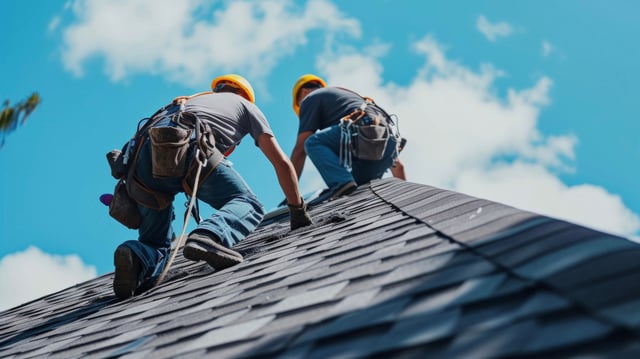
Ask about their safety protocols, especially for steep or high roofs. Do they use safety harnesses? How do they protect workers and your property?
Will you provide a certificate of completion?
A certificate of completion or final inspection report documents that the work was completed to standards. This is valuable for your records and future home sales.
How do you handle communication during the project?
Establish how you’ll communicate—will there be daily updates? Who’s your main point of contact? Can you text or call with questions?
Red Flags to Watch For
As you ask these questions, watch for warning signs:
- Reluctance to provide documentation or references
- Pressure to sign immediately or “today only” deals
- Requests for full payment upfront
- No physical business address
- Significantly lower bids than other contractors (often means cutting corners)
- Unwillingness to put agreements in writing
- Suggestions to skip permits or inspections
- Poor communication or unprofessional behavior
Trust Your Instincts
Beyond getting the right answers, pay attention to how the contractor interacts with you. Are they patient with your questions? Do they explain things clearly? Do you feel pressured or respected? Your gut feeling matters.
A professional roofing contractor will welcome your questions and appreciate that you’re doing your due diligence. They understand that your home is likely your biggest investment and that you want to make an informed decision.
The Bottom Line
Don’t rush this decision. Take time to interview at least three contractors, ask all these questions, check references, verify credentials, and compare detailed written estimates. The cheapest bid isn’t always the best value, and the most expensive isn’t automatically the highest quality.
The right contractor will earn your trust through transparency, professionalism, and clear communication. They’ll educate you about your options, respect your property, stand behind their work, and deliver a roof that protects your home for years to come.
Remember: legitimate contractors expect these questions and appreciate working with informed homeowners. If a contractor becomes defensive or evasive when you ask these questions, that tells you everything you need to know. Move on to someone who values transparency and professionalism.
Your roof is too important to trust to just anyone. Ask the tough questions, verify the answers, and choose a contractor who demonstrates competence, integrity, and respect for you and your home.
Disclaimer
Artificial Intelligence Disclosure & Legal Disclaimer
AI Content Policy.
To provide our readers with timely and comprehensive coverage, South Florida Reporter uses artificial intelligence (AI) to assist in producing certain articles and visual content.
Articles: AI may be used to assist in research, structural drafting, or data analysis. All AI-assisted text is reviewed and edited by our team to ensure accuracy and adherence to our editorial standards.
Images: Any imagery generated or significantly altered by AI is clearly marked with a disclaimer or watermark to distinguish it from traditional photography or editorial illustrations.
General Disclaimer
The information contained in South Florida Reporter is for general information purposes only.
South Florida Reporter assumes no responsibility for errors or omissions in the contents of the Service. In no event shall South Florida Reporter be liable for any special, direct, indirect, consequential, or incidental damages or any damages whatsoever, whether in an action of contract, negligence or other tort, arising out of or in connection with the use of the Service or the contents of the Service.
The Company reserves the right to make additions, deletions, or modifications to the contents of the Service at any time without prior notice. The Company does not warrant that the Service is free of viruses or other harmful components.