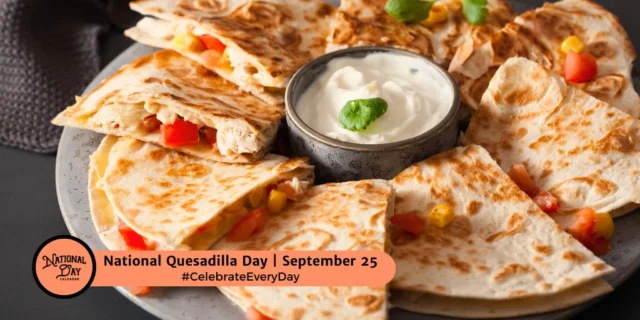
National Quesadilla Day, on September 25th, encourages us to pull a chair up to the table and eat some authentic Mexican food. While it’s not a sandwich or a taco, the quesadilla satisfies snack cravings while also completing a meal.
- 500 BC – Corn tortillas are made in Mesoamerica
- 16th Century – The earliest forms of quesadillas originate in northern and central Mexico.
- 19th Century – Other countries around the world began making and eating quesadillas.
- 21st Century – Quesadillas cross over from just authentic Mexican restaurant menus to more typical chain restaurants.
- The word ‘quesadilla’ literally translates to “little cheesy thing”.
- The predecessor of the quesadilla was an Aztec dessert made from a corn tortilla folded over squash and pumpkin.
- Traditionally, a corn tortilla is used in preparing quesadilla, but it can also be made with a flour tortilla.
- Quesadilla is a dish that came from Colonial Mexico.
- Quesadillas provide energizing carbs, filling fiber, nutrient-packed vegetables, and muscle-building proteins.
- Generally, a sandwich is considered to be two bread-like slices with some fillings in between them, and the quesadilla fits into that description.
- Though they are traditionally Mexican, quesadillas are widely eaten by Americans, with one in three Americans making it every week.
- V&V Supremo recently found one in three people are making quesadillas at least once a week*.
- National Quesadilla Day (Dia de la Quesadilla) was founded in 2020 by V&V Supremo, which is an American company that makes cheese and other Mexican products.
- in certain South Korean Mexican restaurants, you might a kimchi quesadilla on their menu.
- Oaxaca cheese, which has a similar texture to mozzarella, was traditionally used to make quesadilla.
Sources:

Disclaimer
Artificial Intelligence Disclosure & Legal Disclaimer
AI Content Policy.
To provide our readers with timely and comprehensive coverage, South Florida Reporter uses artificial intelligence (AI) to assist in producing certain articles and visual content.
Articles: AI may be used to assist in research, structural drafting, or data analysis. All AI-assisted text is reviewed and edited by our team to ensure accuracy and adherence to our editorial standards.
Images: Any imagery generated or significantly altered by AI is clearly marked with a disclaimer or watermark to distinguish it from traditional photography or editorial illustrations.
General Disclaimer
The information contained in South Florida Reporter is for general information purposes only.
South Florida Reporter assumes no responsibility for errors or omissions in the contents of the Service. In no event shall South Florida Reporter be liable for any special, direct, indirect, consequential, or incidental damages or any damages whatsoever, whether in an action of contract, negligence or other tort, arising out of or in connection with the use of the Service or the contents of the Service.
The Company reserves the right to make additions, deletions, or modifications to the contents of the Service at any time without prior notice. The Company does not warrant that the Service is free of viruses or other harmful components.